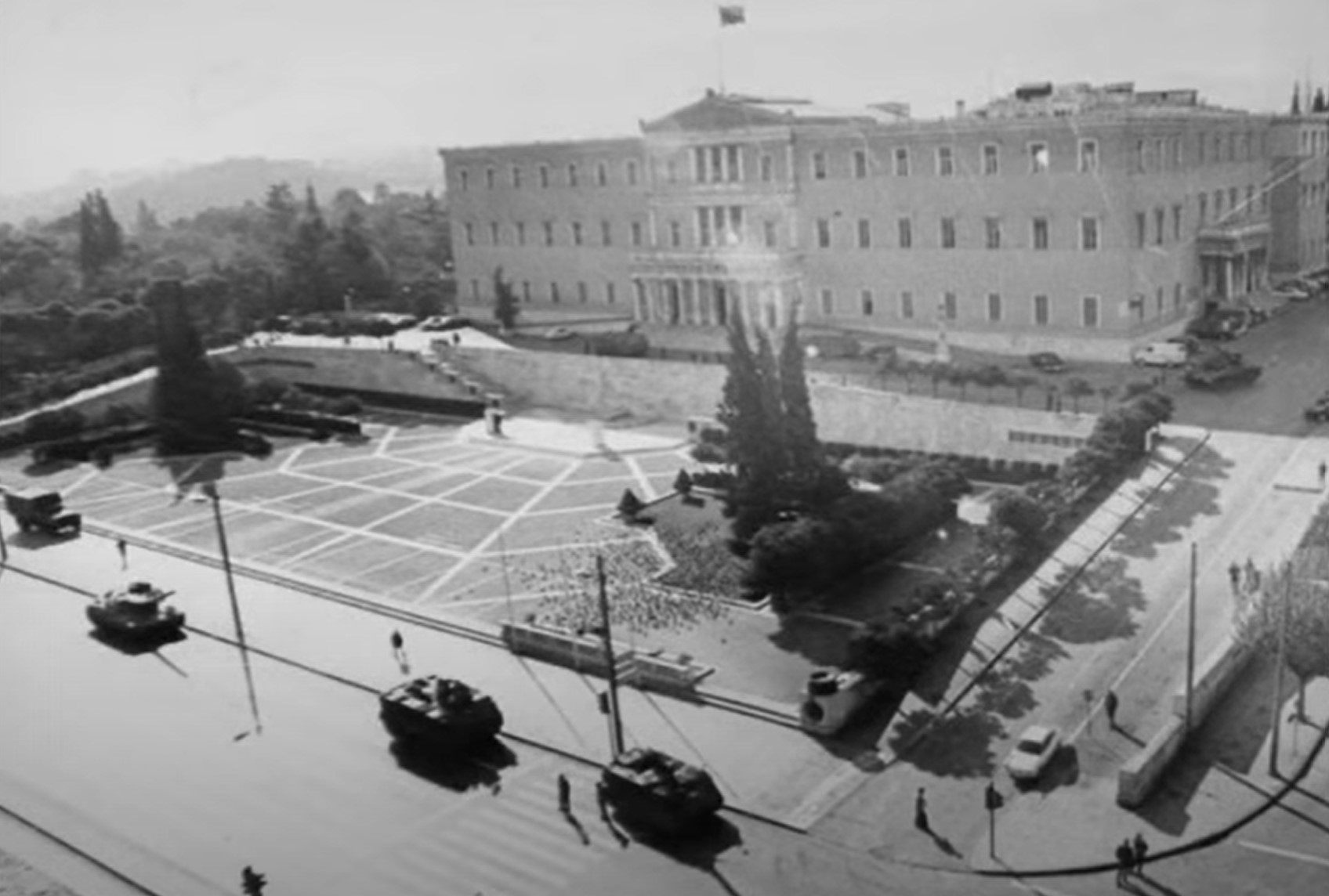
Friday morning, April 21, 1967. Saturday eve of Lazarus. Strange activity in the streets of Athens. Groups of soldiers pour into the «heart» of the city in jeeps and military trucks. Soon you hear the sound of crawlers. Tanks approach the centre from the north and north-east. Careful observers spot similarities in some of the tanks to those that a few weeks earlier had driven down from northern Greece for the March 25 parade. They are the same. After the parade, they were declared «damaged» and for their ... repair they were taken to the tank center at Goudi's, where Brig. Gen. Stylianos Pattakos.
The orders that the tank operators carry from their commander are clear: «occupied the government buildings, Pentagon, radio, telephone, telephone, OTE, Parliament». A considerable force of light tanks surrounds the palace in Tatoi and the airport. But, as of 01.30, even before the tanks have poured into the streets, arrests have begun. At 02.00 the crawlers are coming out of the camps. Within an hour, the men of the Military Police arrest Prime Minister Kanellopoulos, Papaliguras, the leader of the Centre Union, G. Papandreou, his son Andreas, Aleyras, Eliou and many other political and intellectual figures, the head of the Metropolitan Police and several senior officers of the Armed Forces, including the heads of the General Staff, the General Staff and the General Staff, Vice Admiral Egolfopoulos, Vice General Antonakos and Lieutenant General Spandidakis respectively.
The telephone network is going dead. The city is isolated. The radio broadcasts military marches, interrupted by not so enlightening messages. «Attention! Attention! Due to the resulting disorder, from midnight the army has taken over the government of the country.». An entire country is caught sleeping. Armed soldiers roam the streets, but for the moment it is unknown who they are taking orders from. The next radio message announces that eleven articles of the Constitution are suspended. These are the ones concerning individual and civil liberties. The order is given «... because of a manifest threat to public order and security of the country from internal threats».
A plan of military mobilization, which they themselves call «revolution», is underway and involves Armoured Corps, Military Police and Evelopis under the command of their commanders, Brigadier General Stylianos Pattakos, Colonel Ioannis Ladas and Lieutenant Colonel Dimitrios Ioannidis respectively.
Soon Greek history will open a seven-year dark chapter.
«A MILITARY MOVEMENT HAS BROKEN OUT - POLITICAL MEN HAVE BEEN ARRESTED». With this headline and «hat» «On the 2nd morning», the newspaper KATHIMERINI manages to wedge a single column into its front page of April 21. In the face of the development of the coup, the side news becomes completely irrelevant and uninteresting, but of course there is no time to tear out the whole page. This single column is the only one with the news in proper journalistic time. The rest of the press within the Greek borders, which in any case cannot catch up with the dictatorship, will be silenced for years.
DESIGN «SUPPLIED» AGAINST THE COMMUNIST DANGER - OTHERS ARE PLANNING IT AND OTHERS ARE CARRYING IT OUT...
In the early hours of the morning, the leadership of the coup leaders rushed to Tatoi with a «yes or no to the revolution» ultimatum and asked the young king to swear in the «revolutionary government». On the afternoon of 21 April, Constantine... blesses the coup plotters by oath, making it a condition that no military man should take over the premiership, a position to which the palace loyalist, former prosecutor of the Supreme Court, Konstantinos Kollias, is eventually appointed, with Gregory Spadidakis as vice-president of the government and Minister of Defence, who, although not from the beginning with the movement, nevertheless joins easily.
In his documentary book entitled «The Trial», the judge of April, Yannis Deyannis, expresses the opinion that «it was not only Constantine's anxiety for the throne, but as he was armed with so many armour that he did not know how far they would go, he was confused, cowed, frightened. Those who advised him to resist were few and did not rule out civil war. He preferred the subjugation that was closer to his character».
Pre-election period. The polls are set for 28 May. It is a time of deep political crisis. The country has not yet recovered from the civil war. It has been preceded by the fall of the Paraskevopoulos government, which has received a vote of confidence from the two major parties, ERE and the Centre Union, but has not managed to fend off the section of MPs close to Andreas Papandreou, who are insistently calling for a special regulation extending parliamentary immunity to the election period, in order to avoid criminal prosecution against him for the ASPIDA affair (Andreas Papandreou is alleged to have a leading position in the organization, which, according to allegations by conservative figures, was created by left-wing military officers to ideologically corrupt the army and displace «nationalist» officers). The arrangement is not accepted by the ERE and the government collapses. Attempts to form an ecumenical government fall through and Panagiotis Kanellopoulos, who receives from the king the mandate to form a government, is called upon, unsuccessfully as it soon turns out, to manage the crisis.
Political factions are unable to come to an understanding, the army has been eroded by the parties and the American factor, bloody clashes between students and police in the streets of large urban centres are almost a daily occurrence. On the other hand, the «internal information» of the KYP that in view of the May 28 elections the climate is in favour of the progressive forces and especially in favour of the left wing of Andreas Papandreou, fuels the ferment of generals for a timely implementation of the «Prometheus» plan (NATO's plan to counter the communist danger), a coup of the army with the blessing of the palace, in order to stop the momentum of the progressive area.
In the general upheaval, some other officers, junior officers, who have long been preparing for a coup at all costs, lose no time. They find a hole and enter... They want to «save Greece from the threat of communism, which still hangs over the country's suffering body from the civil war». Besides, the Americans« preference for colonels rather than generals is related to developments in Cyprus, where the constantly worsening dysfunctional situation threatens a rupture in Greek-Turkish relations and this will result in the collapse of NATO's southeastern wing and a blow to the US side. For the Americans, the Colonels» group appears more «manageable» on this issue. The circumstances, therefore, seem to favour the junior officers and as the historical author Spyros Linardatos writes in his five-volume work "FROM THE EMPIRE TO HUDA", «once the tanks start, it's very hard to stop them. It's all about catching up.».
And indeed, the tanks are coming out and no one can stop them anymore.
In the post-independence period, in five consecutive front pages under the general title «HOW THE DOORS OPENED IN THE DICTATORSHIP», Eleni Vlachou will give the chronicle of the dissolution of the Republic, as she experienced it, starting with the image of the city in those first hours... «I had just returned to KATHIMERINI, which I had left a few hours before, to go to sleep. Already most of the streets were blocked and we were doing laps to get to Omonia. The drive was like a bad dream. The city had already taken on a different look, a different character, different sounds. Few pedestrians, few cars, the army everywhere, harsh military shouts, orders mixed with protests and angry voices of civilians who didn't understand why they weren't being allowed to go home, angry drivers who didn't obey the short, dry, sharp orders. All this against a background of bizarre noises out of place in a calm peaceful city. Harsh metallic sounds, heavy passages of tanks, military cars, grinding brakes, beastly shadows that traveled, tearing up the night with piercing screams. As if some huge mistake had been made, as if the sound of a war film had been mixed into a documentary of the life of a city»
Η «THROUGH PERSUASION»... PURGATION IN THE EATS - «ABSOLUTE LONGHAIRS» AND FREEDOM OF THE PRESS IN THE MINDSET OF THE COLONELS
The arrests on this night of the upheaval exceed 1,000 and it is only the beginning. Of these first arrests, dissident military personnel are taken to the Pentagon, politicians to the Armored Center, and communist intellectuals and citizens to the AEK stadium in Philadelphia and the Hippodrome. From the following day onwards the number of arrests multiplied progressively. The security list is long... According to the junta's data, the number of arrested persons amounts to 6,509, of which 1,328 are dismissed in the following days. Party sources and foreign correspondents say the number is twice that. However, the majority of those who fall into the clutches of the FSA end up on tankers in Gyaros and Leros.
«The government hopes that the present situation will not last long, but only for the time necessary to clear the country by persuasion and not by force, from the anarchists and communists.» declared in a few days to the French News Agency the vice-president of the «government» Spadidakis. At the same time, in the nightmarish detention facilities of the Military Police's Investigative Department, on the roof of Mumboulinas Street, where the Security Department is housed, in the exile drying grounds and elsewhere, the commander of the Corps, the «invisible dictator» Dimitris Ioannidis, is working miracles! He cleanses the country «through... persuasion» from anarchists and communists...
«The country ran the ultimate risk of being overrun by communism. The Greeks, both by historical tradition and by basic social perception and education, have never been susceptible to communism.» (!) has been announced from the first hours in his «speech» by the head of the coup leaders Papadopoulos after the victory of the tanks.
Now, in the «sick country that has been put in a cast», as the self-appointed doctor and its «saviour» Papadopoulos puts it, without the consent of the coup plotters, not a mosquito moves... Everything goes through strict censorship. «The Christian Orthodox Greek nation must be cleansed of the disease of communism and be delivered clean and untainted to its citizens.»...
https://www.youtube.com/watch?v=Nobn1SCD2LM
The doctrine of Greece, which belongs to its Greek Christians (Hellas of Greek Christians, is the motto of the junta) is transformed into a nightmare for the citizens whose daily life has been put under the microscope, scrutinized and when it is not «appropriate», the rod is pressed... And in Greece the dictators, as in the whole world, impose martial law even on thought. Every new dawn holds surprises... A list of orders with penalties for non-compliance...
Indicative of this is the front page of the Saturday, May 6, 1967, edition of the newspaper MAKEDONIA, a record with a striking title which draws the attention of young people: «Respect for elders - Students and pupils are required to give up their seats on buses - Strict action will be taken against those who do not comply». It foreshadows a resurgence of the famous 4,000 Act of 1958 on teneboys. The «in chrome» (with the fine) haircut, long long put on ice, will come back with a vengeance. The «tentiboys» would be renamed «unwashed long-haired», «diakoniaires» and «scapegoats» and, as the later NSA commander Ioannis Ladas would declare, the aim of the «of good government is not to cut their hair, but to cut off their mentality, which is destructive to them and to Greece.» (!). For the next seven years, however, the newspapers will continue to print government announcements of all kinds of bans and impositions, such as that... masterpiece announcement about the forced consumption of potatoes by Greek households of at least two billion a week, because of an unforeseen overproduction of the product!
In general, newspapers were the great fear of the colonels. ELEFTHEROS KOSMOS and ESTIA are on the side of the «revolution», but all the others... Of course, they, the... defenders of both democracy and freedom of the press, cannot possibly impose censorship, but even if they do, how can they selectively close the newspapers? In the first few years they do, and sometime, somewhere around 1969, they are forced to fold, to limit censorship, at least for the types. For a period they try to prop up their own two papers, but those have always had a meagre circulation anyway. However, on the night of the tanks, the movers and shakers don't waste any time. They send soldiers to the offices of KATHIMERINI, ELEFTHERIA and ATHENAIKIS and stop any publications in the air. «We caught the news because KATHIMERINI was coming out at three or four in the morning. We didn't have those lazy days when the newspapers close at midnight and everyone goes to bed... Some of the papers got there before the soldiers showed up.» Vlachou will explain years later.
«The military had taken care of «AFGI» and «ALLAGI» earlier... They had closed the offices and had summarily arrested editors, who were even searched in their homes! As for «ELEFTHERIA», it had lost its two main members. Fortunately, there are foreign newspapers and they are not censored. Between 1967 and 1974, Greece appeared in a few headlines, not at all flattering for its government...
On April 22, the Saturday of Lazarus, Papadopoulos summons the newspaper directors to his office and... draws them a decree on the sacred aims of the «revolution», which has the King's blessing, and because - as he repeats insistently - «the aim is sacred», he will impose censorship from the 24th of this month. Which is being done.
Faced with the prospect of... journalism on demand, most publishers are suspending the circulation of their newspapers. Eleni Vlachou is among them. In a meeting with the editor of KATHIMERINI and MESIMVRINI, Papadopoulos tries to convince her to publish the papers again, promising that the censorship will stop. He tries to convince her, first with politeness, then with threats... «I swear on my mother's grave» he finally tells her and she holds back at the last moment from bursting out laughing. Or crying...
The rhyme ends as follows:
BL: We will wait (for the abolition of censorship)
PAP: No! You must be extradited immediately! Show that you believe in the promise I'm making to you!».
The editor does not budge. Of course, the censorship continues unabated.
«America does not interfere in the internal affairs of Greece - Nor does it have the legal right to do so» will be published in a few days on the front page of MAKEDONIA, entertaining impressions... The many, however, papers that refuse to comply «with the suggestions», remain closed. Editors and directors are being dragged to court. In fact, censorship is strict and basically incoherent. You see, the staffs fail to understand what is bad and what is good for the «holy cause.» In the end, to keep their heads in peace and after passing even the wedding announcements through a censor, they decide to cut the 90% of news!
THE FIRST EUPHORIC REFERENDUM - HOW A FUNERAL BECOMES AN ACT OF RESISTANCE
Five months have passed since the imposition of the dictatorship and Constantine, who has legitimized the diversion, finds that he has lost his powers, which causes him discomfort. Having weighed up pro-royalist military men and... American patronage, he decides to respond to the coup with a coup d'état. The plan involves the King's sudden move to Thessaloniki, mobilization of the «talked» 3rd Army Corps, disruption of communications and, in consultation with the Larissa army, a descent of tanks into the capital. Constantine goes to Northern Greece on the scheduled day, but everything goes wrong. The Turkish threat has displaced the bulk of the army in Thrace and Thessaloniki is empty. Moreover, the secret plan is not so secret anymore... It has been «flashed» by a few of the army's lily-livered little birds and has certainly reached the ears of the dictators. The junior officers neutralize the pro-royalist gallants, and faced with the possibility of bloodshed, Constantine takes his wife and flies to Rome. The dictatorship grows stronger. The then Deputy Minister of Defence, G. Zoitakis, is installed as Regent and Papadopoulos ousts Kollias and makes himself Prime Minister. In a pretextual attempt to constitutionally legitimise the regime - masquerade the people are called to a referendum. The Greeks must decide with a YES or an NO vote whether they accept the draft constitution presented by the «revolutionaries». Political prisoners are excluded from the «free choice». The other voters have to choose in a militarised environment with the YES and NO - which they themselves have to take from the counter - placed at a distance from each other, which creates risks... The citizens, fearing that they will be «nailed» by crossing the distance from the YES to the NO, choose the nearest YES and throw it in the ballot box! The YES vote comes out of the ballot box at a rate of 92.2% ! Another junta's travesty tramples on the most powerful weapon of the citizen: free will, free choice.
The foreign states are oriented towards a new reality and as the king does not form a government in exile, they proceed to establish «functional relations» with the «legalized» junta. Of course, the US...
But in Greece, the imposing presence of the Armed Forces, the constant national-Christian messages through the dry, creepy voice of the Chief Commander-in-Chief on radio and modern television (as «the second character, out of a bad Greek film, with an obnoxious voice, sealed with dirty deceitfulness» characterizes Vlachou) where the programme opens and closes with the emblem of the junta - the soldier in front of the palm tree reborn from the ashes - the «discreet» presence of the ESAjajis with or without armbands on the corners of the urban streets, add fear to insecurity. A people, which imbued humanity with the winds of democracy and freedom, is for the umpteenth time in its history entering a state of gloom. Civilians combine military uniforms with terror. A uniformed officer travelling to a mountain village in Epirus gets into a conversation on the bus with villagers. «How do you get along in your village?» he asks them and gets the enthusiastic response: «Fine. We are happy and more than happy. We have everything good.» Continuing with the questions and as the man refers to individual government benefits, which he understands from the answers that are absent from the village, he turns indignantly to the villagers: «Then what the hell are you having a good time for?». «Well, you know, we saw you in uniform and....».
On 21 April 1968, the first anniversary of the coup d'état, on Easter Day, the voice of Georgios Papandreou is heard on the BBC. The last elected Prime Minister of the country, G. Papandreou, the last elected Prime Minister of Greece, has recorded a message in Greece and has smuggled it to London, where it is being broadcast: «The day of the Resurrection of the Lord coincides this year with the anniversary of the Crucifixion of our People. The dictatorship drafts the Constitution of the Republic! To tyranny it adds mockery [...] I address the free world. We had hoped, after the Second World War, that fascism had been definitively crushed and that it could no longer appear, at least in Europe. And yet it happened. And it is a disgrace to us that it began in our country, Greece, the cradle of democracy. For this I address the free world, its peoples and its governments. We ask for their own solidarity and support. And an international isolation, both political and economic, of the junta will lead to its immediate collapse. And this we invoke on behalf of the enslaved Greek people whom we represent...».
From the very first moment of the regime, resistance is being built. Organizations upon organizations, they methodize the fall of the junta, boosting the morale of the Greek people in every way possible. The majority of the political world and the intellectuals of the country judge, condemn and make their positions known. The most determined organisation is striking directly at the bull's eye. Its leader, Alekos Panagoulis, with a daring plan attempts to kill the dictator Papadopoulos. He fails and is dragged to an extraordinary court martial, along with twenty of his comrades.
Resistance cells multiply, not with impunity. Courts martial are suffocating. (As Judge Deyannis will later testify, the extraordinary military tribunals tried 2,254 not individuals, but cases, for «offences against the regime»!).
As long as the dictators try, convict, imprison, torture and exile «reactionary elements», as long as they dismiss thousands of civil servants and teachers as «illegitimate», as long as they try to subdue the beast, it resists and grows stronger. The people are encouraged to stand up. The first mass manifestation of resistance to the regime is the funeral of Georgios Papandreou on 3 November 1968. Despite the bans of the junta, an endless ant of people accompany the old man to his final resting place.
In a few months, the Nobel Prize-winning poet George Seferis will record a statement on the occasion of the national anniversary of March 25. He acts in the same way as Papandreou. The tape of the statement travels secretly to London and there the message is broadcast by the Greek service of the BBC, with a rebroadcast by the Paris radio station and the «Deutsche Welle». Says the poet:
«... It is now two years since we have had a regime imposed on us that is totally contrary to the ideals for which our world and our people fought so brilliantly in the last world war. It is a state of enforced hibernation, in which the spiritual values that we have managed to keep alive with pain and effort are also being submerged in the marshy waters. It would not be difficult for me to understand how such damage does not matter much to some people. Unfortunately, it's not just about that danger. Everyone by now has been taught and knows that in dictatorial situations, the beginning may seem easy, but tragedy awaits, inevitable in the end. The drama of this end torments us consciously or unconsciously as in Aeschylus' old dances. The more the anomaly remains, the more the evil progresses.
I am a man with no political affiliation whatsoever and, I can say, I speak without fear and without passion. I see before me the precipice where the oppression that has covered the country is leading us. This anomaly must be stopped. It is a national imperative. Now I return to my silence. I ask God not to put me in a similar need to speak again».
«The government became more tyrannical, arbitrariness became a regime and the indignation of the people grew.» states from abroad, where former Prime Minister Karamanlis is, shortly before the country's expulsion from the Council of Europe, where - as he notes - Greece is considered a «leper»...
By 1970 the militants realize that no matter how many holes they struggle to plug, there will be many more that will be found to exude the stench of their regime. They understand that muzzling the press makes no sense. The accused's benches, filled with editors and directors, fail to add points to their... social shares and the newspapers that glorify the government's work day and night do anything but service to the cause of the «revolution».
Since the early 70s, censorship has been partially lifted. The colonels do something smarter... They leave the judgement to the directors and woe betide anyone who defies the order! However, there is always a way to get the message across... A typical case is that of a newspaper which published a photo of Zoitakis walking across the threshold of the Pallas cinema, where the play «Crime and Punishment», which is the title of the news item, is being shown! In another place, where another «holy suggestion» of the government is hosted with the title «parents, be careful of the books your children read!», «completely by chance» the adjacent news is entitled «released the »I believe« of George Papadopoulou“!
«FIRING THE KING» - PAPADOPOULOS ON THE FRONT PAGE OF TIME
https://www.youtube.com/watch?v=BFzBWcCUSm0
Papadopoulos, who has concentrated most of the political power in his person, causing discontent within the regime, is now determined to proceed to a partial, certainly controlled, politicisation of the landscape and a pretended creation of political freedoms. In the meantime, he is increasingly backing his associates into a corner, providing them with political positions with the aim of cutting them off from the military. At first he gives them positions as general secretaries and then ministerial posts so that they give up their uniformed claims. But the road to «liberalisation» is not at all to the liking of some regime agents who are nostalgic for the early years of the dictatorship. On the other hand, how is it possible that a dictatorship imposed by tanks, which has smeared the liberal and democratic past of a country, which has dragged thousands of citizens into torture, can now claim to get popular approval? The first measures of liberalisation and the inability of the people to legitimise the regime are leading to an explosion of reactions with widespread popular participation. 1973 is a particularly turbulent year. In February, some 1,000 students occupy the Athens Law School and in May the Navy Movement takes even more points away from the dictators. In early June, Papadopoulos tries to regain lost ground by abolishing the monarchy with a cabinet act. On June 11, 1973, the magazine «TIME» comes out with «Greece΄s President Papadopoulos» on the front page and oblique hit «FIRING THE KING».
In the summer Papadopoulos, recognising the weakness of the regime, entrusted the prime ministry to the veteran politician Spyros Markezinis, in order to lead the country to political normality. He also announces a second referendum to formalise the abolition of the monarchy and the establishment of an unconstitutional presidential democracy, at which point he will naturally place himself in the position of President of the Republic. With an equally... suspicious majority, the participants again... ratify with their YES vote the plan of the «government»... The participation in the referendum reaches 85.5%. Of the voters, 78 out of 100 are in favour of YES and 21 in favour of NO! The next day, with an inspiring mantinade, which he puts in the mouth of his Cretan hero, the cartoonist of BRADYNIS Vassilis Christodoulou satirizes... «It was not until yesterday that such a damn box of NO to throw in the morning to come out YES in the evening...».
Papadopoulos translates the message of the second referendum, which was conducted in the now familiar climate of violence and fraud, as he sees fit, since even this deliberate positive vote does not necessarily constitute an approval of the dictatorship, but most probably a rejection of the monarchy. He then decides to show his... democratic face by lifting martial law and granting general amnesty to political prisoners. But after so many years of repression, the eruption of anti-dictatorial demonstrations is rather expected, and the Polytechnic uprising is the most prominent of them. A combination of fear, amateurism, spasmodic movements and incoherence leads to the violent suppression of the student reaction with the military tank under the direct orders of the «president of the Republic» tearing down the gate of the institution and setting off a new cycle of terror and bloodshed, this time orchestrated by the «invisible dictator» Dimitris Ioannidis. Lower ranking officers, disillusioned with the junta of «67, rally around the conspiring commander of the NSA, the only military officer not »dismantled" by Papadopoulos.
In the general panic, Ioannidis finds the opportunity to knock his mentor off his throne, encouraged by the... Encouraged by the Americans and assisted by the commander of the 1st Army, Lieutenant General Phaedon Gizikis, and armed with misanthropy, foolishness, ineptitude and inability to lead things to Attila's invasion and occupation of the northern part of Cyprus. After the disintegrating term of Papadopoulos' junta, having now completely weakened the functioning of the country and carrying the blood of Cyprus in their hands, Ioannidis and his cohorts call the political leaders and hand over the tattered body of Greece to them.
The difficult task of restoring political normality is undertaken by the former Prime Minister Konstantinos Karamanlis as head of a council of «National Salvation», who is summoned and arrives urgently from Paris.
Santarosa Street Courts. Large ground floor hall. The junta is on trial. On August 23, 1975, after a month-long hearing, 24 retired officers, cornered in the dock for the crimes of treason and sedition, will hear their heavy sentences and 20 of them will be taken to prison, where most of them will breathe their last.
It will be a long time before Greece manages to stand on its feet again.
By Tonia A. Maniatea