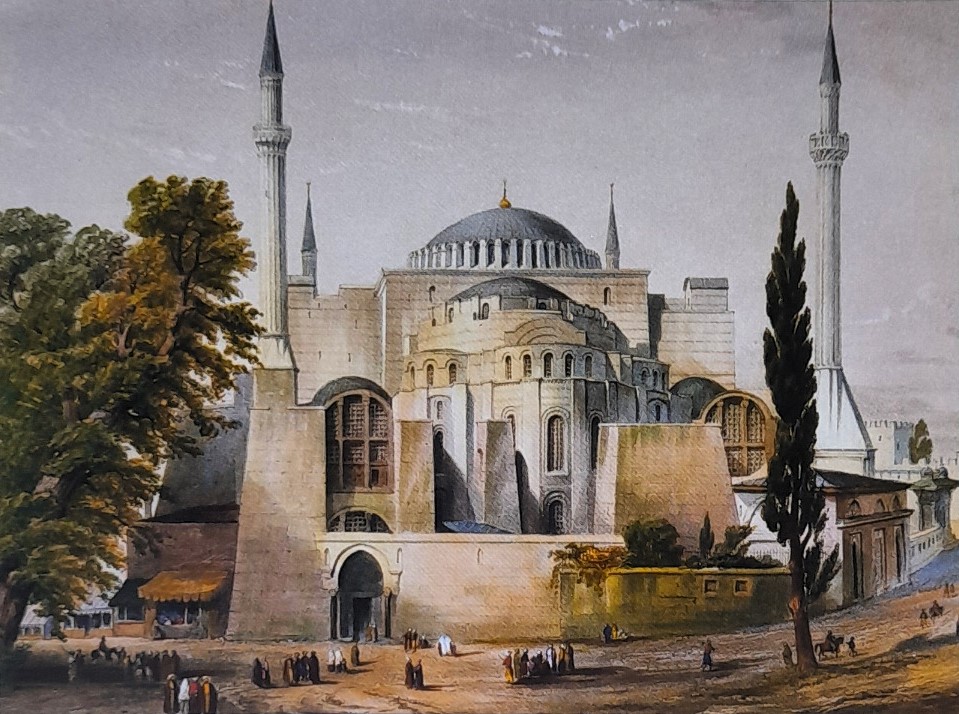
«... When one comes to pray, he immediately realizes that this work was not so perfected either by the power or the art of men, but by divine action; his mind is transubstantiated and directed towards God, and he thinks that God is not far away, but that he has slipped in, without being perceived, among those whom he himself has chosen. And this happens not only to the one who visits the temple for the first time, but unceasingly to everyone the same impression is made, as if it were the first time he had seen this sight...».
Procopius of Caesarea, the most important historian of the 6th century, tries to describe the - in reality - indescribable achievement of the emperor Justinian: The Temple of St Sophia. In his book «On Buildings», he describes in detail the wise architectural structure, the unique aesthetics and the splendour of the Great Church of God in Constantinople, the seat of Byzantium. Even if his description is accompanied by lofty flatteries about the «boss» emperor (pp. the text was commissioned by Justinian himself, inspired by authoritarian ideas that prompted him to project his glory through great works and impress the peoples within and outside his borders), it is impossible for him to hide his admiration for the architectural masterpiece, which - as the author notes - is more reminiscent of a divine construction than a human one.
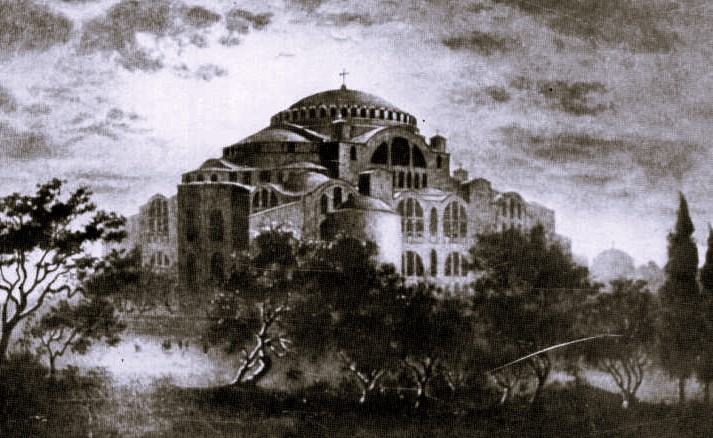
But however much admiration Procopius may express for the divine creation of his time, it will be impossible for him to imagine that this masterpiece of architecture will exist a millennium and a half later! That it will stand unbroken through time, that it will survive earthquakes, wars, disasters and that on another 27th of December, that of 2025, this unique temple will celebrate 15 centuries of life!
If the Hagia Sophia were human, it would blow out 1,488 candles today! In fact, that day of the opening of the temple (December 27, 537) in the Julian calendar corresponds to the exact same day in the Gregorian calendar, as the 13-day difference between the two calendars arose from 1582 onwards, when Pope Gregory XIII pointed out the difference in the number of days that had accumulated from leap years. Before the 16th century it was negligible.
Today, then, is the «birthday» of the church, which still retains the title of the reference point of Byzantine temple architecture and the glorious symbol of Christianity, and it is an opportunity to look back to the time of its «birth», as described by those who lived it or heard it first hand...
... THE BIRTH...
After Nika's bloody stand in January 532, during which Justinian I's image had suffered a severe blow, the emperor threw himself zealously into restoring his lost glory. As the wider area of the Sacred Palace and next to the church of Agia Irini was occupied by the wooden-roofed royal church of Agia Sophia, which had been burnt down in the Stasi incidents, he decided to build a new church on the same site, which would be the most enviable architectural monument in and outside Byzantine territory. Such an achievement would bring a double benefit to Justinian. It will gain the impressions lost by the Stasis and provide a disarming answer to the Roman aristocrat Anicia Juliana, who not only ’dared« to finance the construction of the impressive in beauty and volume St. Polyeuktus in the Middle Way of Constantinople, but she also inscribed an inscription inside the temple with her contempt for the humble emperors Justinian I and Justinian I.
With his passion to re-emerge and his rage for the impressive St. Polyeuctus on the one hand, and the booming economic situation, since the tax-collecting policy of John Kappadakis has paid off, on the other hand, he proceeds without delay to the reconstruction project of the church he dreams of («having taken care of the money of all» - without sparing money), entrusting it to Anthemio of Trallies, who is «the wisdom of wisdom called engineering» and makes models of works, and to Isidoros the engineer from Miletus. He promises them «land and water» if they manage to create in the shortest possible time a house of worship that will surpass in volume and grandeur even that of Solomon.
The foundation stone is laid in just 40 days from the end of the Stopover. Justinian, under the direct supervision of the two chief engineers, places 100 of their colleagues, each of whom directs 100 workmen. Hence, 10,000 builders are employed on the vast construction site and they are divided into two groups of 5,000 working simultaneously from opposite sides towards the central axis. The emperor personally supervises the work. According to an anonymous historical record, «Justinian does not sleep even at night watching the workers, whom he rewards for the extra hours of work sometimes with one and sometimes with two gold coins».
The construction of the temple was completed in just five years and a few weeks from the start of work and has officially cost 320,000 gold pounds (unofficially, much more).
The engineers and craftsmen have put their best foot forward. Anthemios and Isidore have invented and applied new techniques to support an imposing dome, 60 metres from the ground, surrounded by 40 openings to the sun, giving the impression of floating lightly on a belt of light. «A huge spherical dome, which rests lightly on the building, gives the structure extraordinary grace. It even gives the impression that it does not rest on a solid building, but that it covers the space with a golden sphere hanging from the sky.» describes Procopius, who is equally impressed by the way in which the four central pessaries at the base of the dome have been created: «They are not constructed in the same way as in other buildings [...] The placement of one stone on top of another results in a square shape. The stones, which are hard in their composition, have been polished by suitable treatment and are cut square as those used on the outer parts of the sides of the pile and square as those intended for the inside. The stones have not been joined together with “ titanon,” which they call lime, nor with asphalt, which is the fuel of Semiramis in Babylon, nor with anything similar, but with molten lead, which was poured into the interstices and proceeded to all points and joined the joints and supported one stone to another.».
The temple was consecrated in 537 AD by Patriarch Minas. According to the testimonies, at the inauguration, on 27 December, the prefect of the Church in the middle of the central royal gate and the members of the priesthood lined up on either side waiting for the emperor.
Justinian enters the courtyard of the temple and stops in front of the flask (fountain) of agnisms. It is made of jasper and on it is engraved in crustacean writing «NIPSON ANOHMATA NOT MONAN OPSIN» (wash away your sins, not just your face). He bends down, humbles himself, then heads for the main gate, turns his gaze upward, opens his arms and kneels with an exclamation: I have conquered you, Solomon! He stands up again and enters, accompanied by his cortege. The people follow.
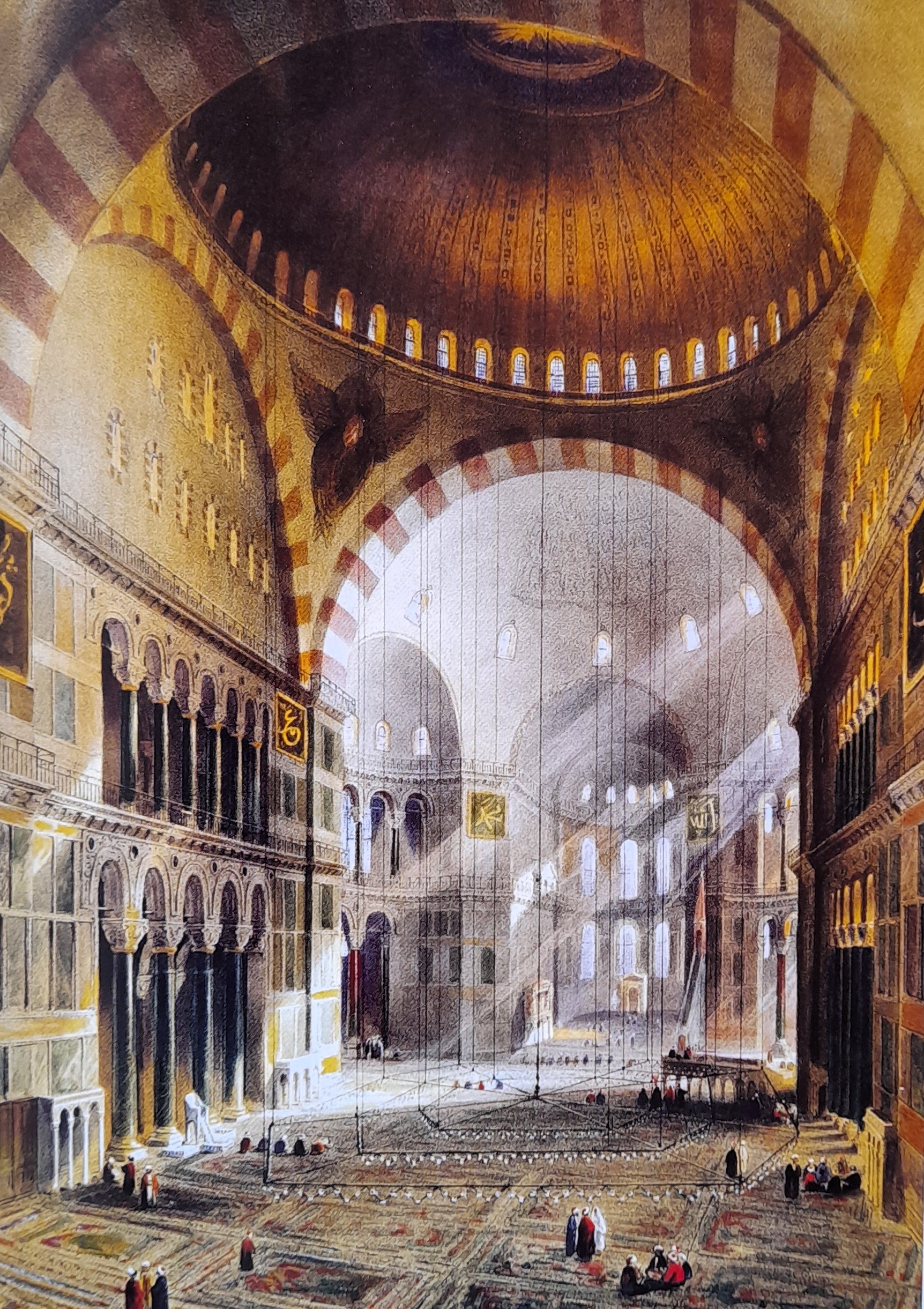
The interior of the church dazzles the flock with its luxury.
The imposing doors have exquisite lintels and double door leaves made of fine solid wood and are decorated with brass, gold and silver ornaments.
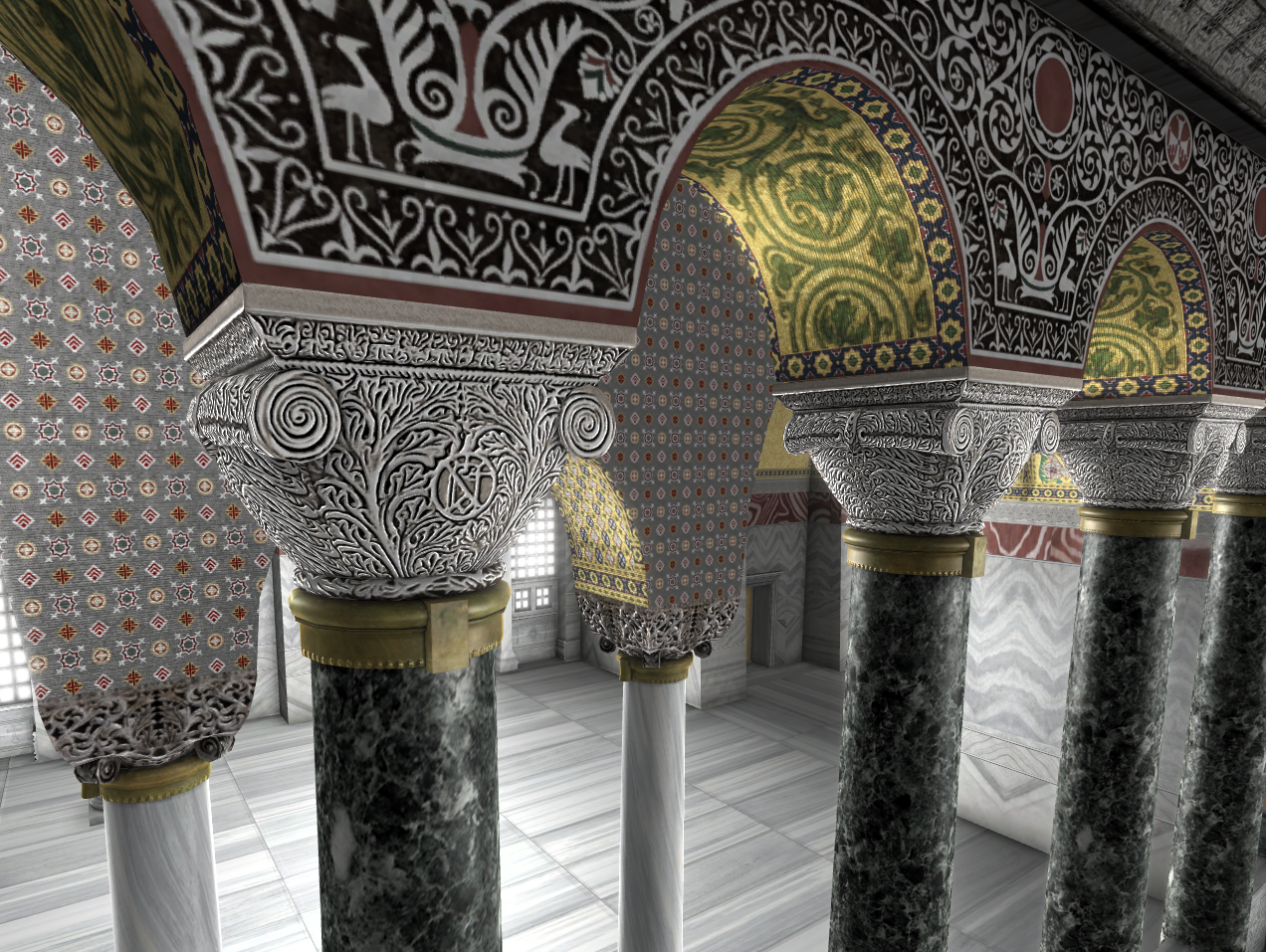
The floor is paved with the best marble in the world. They are uniquely combined with jasper, alabaster and porphyry to create a colorful carpet of exceptional art and high aesthetics. The arches, covered with impressive mosaics, resemble the colourful bow of Iris, described in his metrical work «Expression of the Temple of Hagia Sophia» by Paul Silentiarius, a member of the supreme imperial council (the «Silentius», the silence). The large columns of the central nave are made of green marble from the Hasabali quarries of Larissa, red volcanic rock from Egypt and off-white marble from the quarries of Proconissos, near Constantinople. The Ionic capitals, made of silver, bear the monogram of Justinian, while the pessaries and the low part of the walls, which is in contact with the congregation, are covered with colourful marble slabs. In the centre of the dome, a huge cross of precious stones gleams in the sunlight streaming through the 40 windows around the perimeter. «The entire ceiling is covered with pure gold, combining grandeur with beauty, but the glitter of the marbles, reflected in the gold, prevails» will be described nine centuries later by the Byzantine historian Georgios Sfrantzis.
In the centre of the church, under the dome, is the marble pulpit, a platform with perimeter parapets, dressed with red marble slabs, precious stones, ivory and silver. It is supported on eight columns. The dome is covered with gold plates and precious stones. The pulpit is connected by a raised platform to the Beautiful Gate.
To the right and left of the nave, two galleries, with a slightly higher ceiling than the nave, are reserved for male pilgrims and for women. Their domes are decorated with gold leaf.
The iconostasis that separates the Holy Step from the rest of the church is marble, covered with silver. It bears twelve columns and three gates, the Beautiful and the side ones. Silver polychandeliers glitter on the architrave.
«The sanctuary... This place is completely inaccessible to all but the priests. They call it the altar. It is covered with forty thousand liters of silver!» writes Procopius, trying to convey an image that does not fit his eyes... «You would think you were in a beautiful flowering garden [...] you could admire the colour of the purple... the grass... the deep red that spreads across the surfaces or the white that sparkles the most... When one comes to the sanctuary to pray, he realizes at once that this work was not made so perfect either by the power or the art of men, but by divine agency; his mind is transfigured and directed towards God, and he thinks that God is not far away, but that he has crept in without being perceived among those whom he has chosen.».
In the niche of the sanctuary a marble synod with six steps is reserved for the priesthood, while the patriarchal throne of gilded silver dominates the highest step. Under a ciborium rises the altar. It is of solid gold, adorned with precious stones and enamel. Its four legs are of gold and the supports of its majestic dome of gilded silver. On its top is a gold cross.
THE FIRST ALIENATION - THE GREATEST PILLAGE
Hagia Sophia is the metropolis of the empire. Here the patriarch will function, here the coronation of the emperors will take place, here the «mercy of God» will be celebrated on the great feasts. The centre of the temple could not therefore be without a splendid imperial throne, dressed with precious stones, nor, of course, could it be without a metatower, a place where the emperor could change his clothes.
On the nights of the great feasts, the Hagia Sophia shines like an earthly star. Paul Silentiarios describes how 3,000 gilded polychandeliers, boat-shaped lamps, tree-shaped candlesticks and the small candelabras, which seem to float around the dome, release such light with their flames that they make the night seem like day.
At this time, the temple is decorated with aniconic mosaics (crosses, floral or geometric shapes). The first figurative mosaics of Christ and the saints were commissioned by Justinian I's successor, Justinian II, but two centuries later they were destroyed by the iconoclastic patriarch Nikitas. The second cycle of iconographic votive painting will be inaugurated after the final condemnation of Iconoclasm in the middle of the 9th century.
In 1200 the Russian archbishop of Novgorod, Antony, visited the church. His description captures his impressions: «In the temple of Hagia Sophia, I worshipped the table where Christ rested on Maundy Thursday with his disciples, the tablets of Moses with the Ten Commandments and the golden vases with the gifts of the Magi [...] As the exodus of the Holy Gifts was taking place, the deacons held the tablets of Moses and the cantors sang the Alleluia. At that moment the whole congregation wept. What holy fear, what humility and humility and devotion dominated the bishops, priests and deacons of this Divine Liturgy! What splendour was in the gold and silver chalices adorned with gems and pearls!».
Over the centuries, the temple will experience both glorious and dramatic moments of humiliation. It will «crown» emperors, «swear in» patriarchs, bless, confess, purify hundreds of thousands of worshippers, and one day fall into profane hands, become a trophy and spoils of victory, be stripped of its costly ornaments and see its most priceless treasures stashed away in corners of the West. For the greatest plunder will be suffered by the Crusaders in the first conquest, in July 1204. In their eyes, the Hagia Sophia is not a house of God, it is a precious treasury. Gold, precious stones, expensive utensils, and sculptures of immense artistic value from the imperial complex to which the temple belongs will be channeled to Western cities, where they will adorn museum showcases. Frankish ships loaded with sacred vessels, holy relics, manuscripts, icons, sail from the Basileus on a route to Western ports. The patriarchal seat is transferred to Nice, where it remains until 1261. The Great Church, the patriarchal temple of Agia Sophia, is still the seat of the Patriarchate. «the central artery of the organism (i.e. the Byzantine state) and the lifeblood of its life» (Tamara Talbot Rice, Russian professor of Byzantine Studies, early 20th century)
THE SECOND SALTING
What little the Franks had left after sixty short years of occupation, the Ottomans finished off with the second fall of Constantinople in May 1453. Mohammed II the Porter kept the building and the name of the temple (Aya Sofya), but he converted it into a mosque, which meant that the magnificent mosaics depicting holy figures and emperors, which from the 9th century onwards adorned its walls, had to disappear. Islam is a strictly non-figurative religion. Allah and the Prophet Muhammad are invisible forces and their anthropomorphic representation is forbidden. The houses of worship of Mohammedans are decorated with geometric designs, flowers and abstract jewellery that symbolise the infinite nature of God. Some of the mosaics in the temple are torn up and others are covered with mortar.
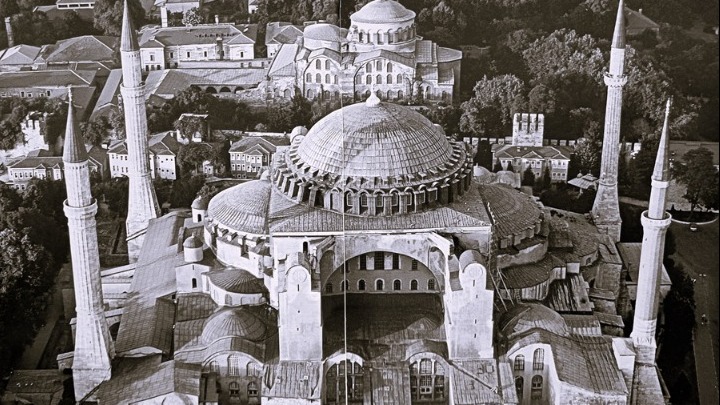
The Great Church, Hagia Sophia, is being turned into a mosque. Fiery panels with prayers from the Koran are hung internally in the four corners, under the spherical triangles that absorb the weight of the dome. Access to the temple is free only for the Ottomans, who enter unsupervised to praise Allah. The call to prayer from the minaret, added to the southwestern outer edge of the temple, echoes throughout the city. In the 16th century, the Ottoman architect Sinan replaced this original minaret with a new one and added three more at the remaining ends of the building.
In the mid-19th century, the Swiss architects Gaspar and Giuseppe Fosati were called upon to clean the mosaics and restore other damage that the church had suffered over the centuries. The overwhelming majority of the paintings revealed are from the Middle Byzantine period (843-1204), with the earliest compositions being those of the enthroned infant Virgin Mary and the archangels in the central apse of the church in the typical iconographic programme established after the Iconoclastic period.
For five centuries the symbol of Christianity functioned as an Islamic mosque, until in 1935, Kemal Atatürk, the founder of a new, modern Turkey, in an attempt to convince his country that his country was a secular state looking towards the West, turned the temple into a museum.
Its gates are reopened to all, but the pride of Justinian and Orthodoxy is now a stripped, wounded, humiliated, sad remnant of a glorious era. A battered basilica with a dome, surrounded by four minarets, ragged, yet still bearing the weight of its long history.
Nearly a century after its conversion into a museum, by decision of Turkish President Erdogan, the temple is once again being «re-christened» as a mosque. On May 6, 2024, the recorded voice of the muezzin announces the beginning of Muslim prayers in the symbol of Christianity.
The marble floors and mosaics of the nave, which depict holy figures of Orthodoxy, have been covered with cloth and access to the nave of Hagia Sophia is allowed only to worshippers of Allah. «All-religious» visitors enter only through side entrances leading to the balconies of the monument, where fortunately the precious mosaics remain uncovered. Women are required to wear a «long garment with a headdress», a garment which is strictly enforced by the monument's roving guards.
Hagia Sophia will embody in the most striking way the synthesis of the ancient Greek and Orthodox spirit. For later historians it will be one of the two models of the Great Idea (the other being the Parthenon). On its solid foundations will be based the ideology of the historical identity of Hellenism, as formulated more than a century later by the most important representative of «unity», Konstantinos Paparrigopoulos, who tried to link Antiquity with medieval Hellenism, using analogies of affinity: ...the «first Hellenism» gave birth to the «Macedonian», which created the «Christian Hellenism of Asia», so that medieval Hellenism was the great-grandson of the first, and the physical and moral relationship between them cannot be explained unless we follow the adventures of the second and the third...
Thus Hagia Sophia ceases to have a historical status and becomes a national symbol outside of time, containing within it all Byzantine culture and therefore its continuity in the present.
Our wish is that it will stand for many many more years...
SOURCES OF INFORMATION AND PHOTOS
- «On buildings», Procopius Caesareus, text 6no αι.
- «Expression of the Church of Hagia Sophia», Paul Silentarios, text 6no αι.
- «Synopsis of stories», Georgios Kedrinos, book 12no αι.
- «Chronicle of the Fall», Georgios Sfrantzis, text 15no αι.
- «The Panthean patriarchal temples», Al. Kariotoglou (Militos Publishers, Athens 1996)
- «Hagia Sophia», by G. Fosati (Gnosi, Athens 2012)
- «Byzantine Constantinople and the patriarchal house», Th. M. Provatakis (Arsenides Publishers, Athens 1992)
- «History of the Greeks - Early Byzantine times» (DOMI, Athens 2006)
- «Lost Homeland, Istanbul» - photo album (Militos, Athens 2014)
- «History of Greek Architecture and Urbanism», D. Filippidis (Ed. EAP, Patras 2011)
- Foundation of the Hellenic World
- Cultural Centre «Hellenic Cosmos», Agia Sophia - 1500 years of history
- Photo archive T. A. Manatee