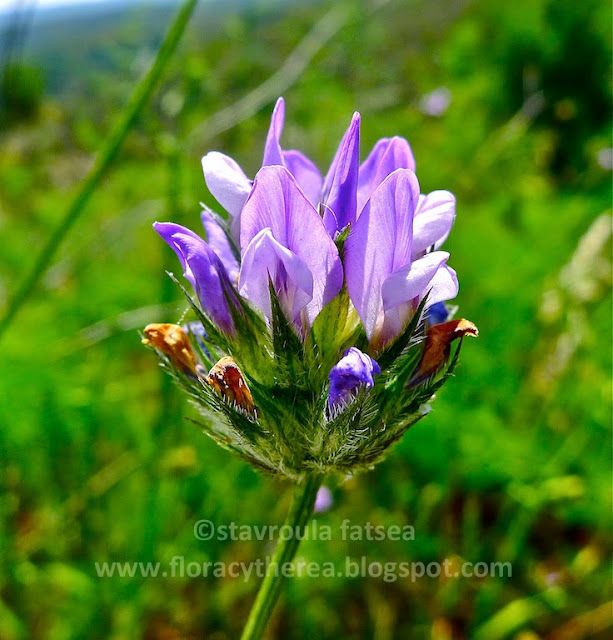
Bituminaria bituminosa (L.) C.H. Stirt.
Fabaceae/Leguminosae
Syn. Psoralea bituminosa L.
Asphalt the bitumen
Perennial plant spread throughout the Mediterranean. Flowers from late February to May. It seems an insignificant to annoying weed as the many branches of its shoots give it great bulk. It fills roadsides and cultivated or uncultivated fields in early spring. The leaves and shoots give off a strong tarry smell, hence the Latin name and adjective, bituminosus -a um = one that smells of tar. Some subspecies are considered great fodder.
According to Dioscorides (M.M. III,109) the seeds, leaves and root of the plant Triphyllous, which refers to scabies, can be used for the treatment of urinary diseases, epilepsy, dropsy in the early stages, as a poultice it relieves pain from snake bites and is generally a good antidote to most poisons:
“Trifyllon: and the sturgeon call them [and the minyanthes, and the asphaltion, and the kneckion, the Romans call them trifyllon, and the trifyllon call them odoratum]. A bush is a thicket or a shrub, having thin, black, ropey sticks, having branches, with leaves of the same kind, three for each growth; and the smell of them is the smell of a well, And the blossom of the aniseed is purple, and the seed is under the leaf, and under the branch, and on the other side it is like an antenna; the root is thin, long, and solid. {2} And he helpeth the seed and the leaves in the water with pleurisy, dysurisy, epilepsy, water-droplets, hysterics; and he eateth also the catamenia: and he seeth the seed three drachmas, and the leaves four drachmas; and he maketh the leaves of the seed and the leaves of the seed to be of a beastly nature. And some have shown that the decoction of the whole bush and the root, and of the leaves, when poured over the reptiles, relieves the pains. And if a man be cured by water, he shall be cured by the water; and if any other ulcer be consumed, he shall suffer the same: and some watered three leaves or three seeds in the wine on the third, and four on the fourth, as a remedy for the sores; and the root thereof shall be mixed, and the remedy shall be for the disease.”
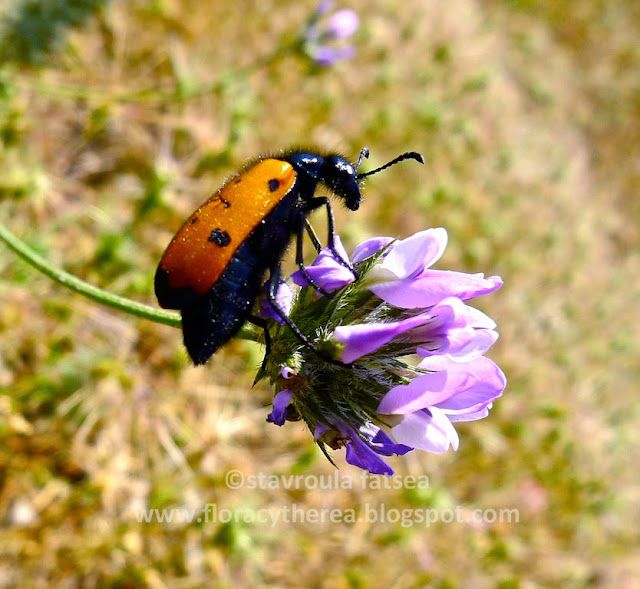
Traditional folk medicine in the Balkans uses Psaralea to treat skin diseases and strengthen the scalp, while in Malta there is a record of its use for the treatment of rheumatic pains. There is a homeopathic medicine made from the plant, abbreviated as psoral.

Modern research confirms to a certain extent the tradition. Extract of all parts of the plant is presented rich in active ingredients that have significant antibacterial and antioxidant properties. (Azzouzi S, et al. 2014). Experiments on rabbits show encouraging results in the treatment of skin diseases, in particular vitiligo (Kurian-Sankar 2007).
Learn more about the flora of Kythera on Stavroula Facea's blog Flora Cytherea.