Researchers at Kyoto University in Japan have developed a robot with an artificial intelligence system that gives it a sense of humour and the ability to laugh according to the situation. The robot reacts appropriately to human laughter with its own laughter, thereby creating a sense of empathy and better communication.
For thousands of years, at least since the time of Plato and much later Freud, philosophers, psychologists and scientists have grappled with the questions «what's so funny?» and «why do we laugh at jokes?». Questions that hardly have an answer accepted by all.
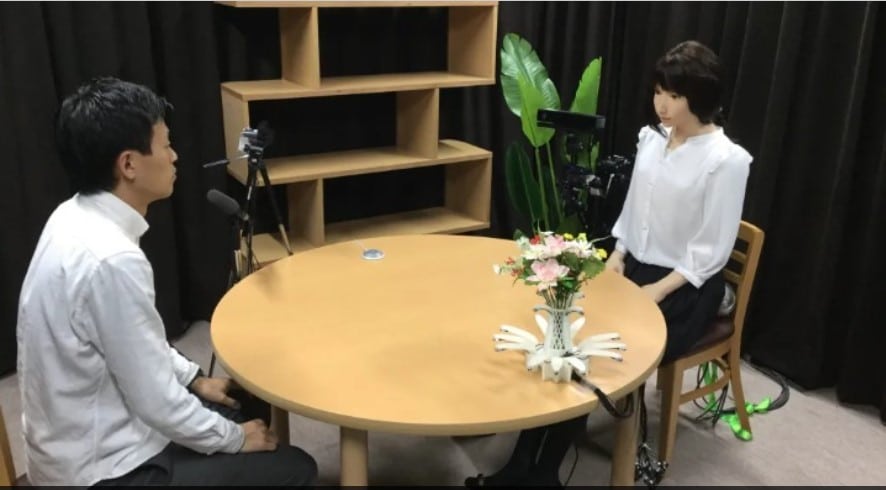
The Japanese researchers, led by Associate Professor Koji Inue of the Department of Intelligence Science and Technology, who published the paper in the robotics journal «Frontiers in Robotics and AI», have equipped the humanoid robot «Erica» with an «intelligent» interactive laughter system to improve the naturalness of communication between humans and machines.
The new artificial intelligence system has three subsystems: One that detects human laughter, one that decides whether to laugh in response to something funny, and one that selects the appropriate type of laughter for the situation (polite and subtle, loud and hilarious, etc.).
The sense of humour acquired by Erica thanks to the integration of the new system was then tested in short dialogues of two to three minutes between a human and the robot, in order to confirm that the latter does not always laugh even when it does not have to, that it does not remain silent when it has to laugh and that it laughs in a way that shows understanding and empathy. The new system seemed to work better than expected.
Of course, laughter is only one aspect of a natural conversation between a human and a machine. As Inoue said, «robots should have a distinct character and they can show this through their behaviours during dialogue, such as laughter, gaze, gestures and speaking style. However, we don't think this is an easy problem at all and it will probably take more than 10 to 20 years before we finally achieve a conversation with a robot as we would with a friend.».