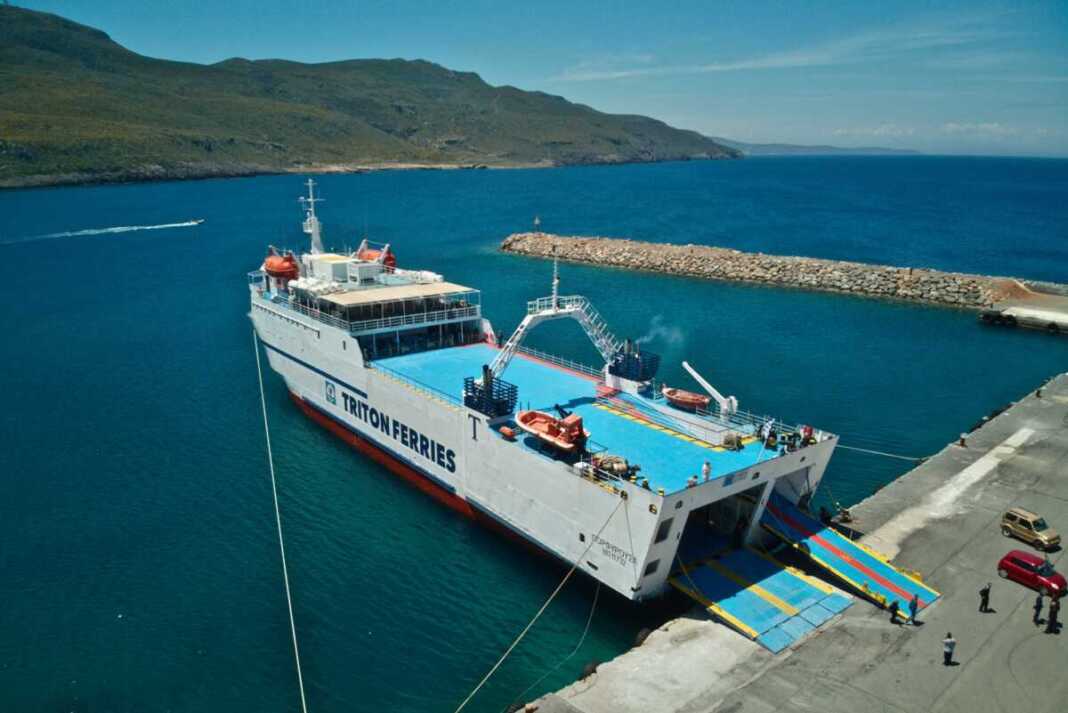
When we hear the word «Kythera», our minds travel to the turquoise waters of the Ionian Sea, the Castle of Chora and Kapsali. But it seems that in the next decade the name of our island will make a much more distant journey: it will travel millions of kilometres away, into space, with the final destination being the planet Aphrodite.
The reason for proposal of the new space mission “KYTHERA”, which was recently presented at the 57th Lunar and Planetary Science Conference (LPSC) by a team of leading researchers from the Delft University of Technology (TU Delft) in the Netherlands.
The wonderful symbolism behind the name
But why did Dutch scientists choose to name a state-of-the-art spacecraft “Kythera”? The answer lies in Greek mythology and is a brilliant connection.
The planet Venus is named after the goddess of beauty and love. According to Hesiod, when the goddess emerged from the foam of the sea, the first place to which the waves brought her was the island of Kythera - hence the nickname «Kytheria Venus». By naming the landing craft «Kythera», the researchers create a touching poetic metaphor: the vessel that will explore the planet Aphrodite is named after the goddess' birthplace.
An expedition to the «Hell» of the Solar System
While our Kythera is an earthly paradise, the planet Aphrodite is the exact opposite. It is often called the «evil twin sister» of Earth, as its surface is literally a hell.
- Extreme Temperatures: The average temperature reaches 464 degrees Celsius (capable of melting lead).
- Crushing Pressure: The atmospheric pressure is 92 times that of the Earth, which is equivalent to standing 1 km under the ocean.
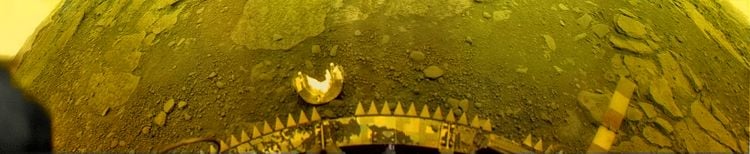
These extreme conditions make exploration almost impossible. The record for survival of a spacecraft on its surface has been held since 1982 by the Soviet Venera 13, which «lived» just for 127 minutes before it melts and is crushed.
The ambitious 200-day target
This is where Mission KYTHERA comes to change history. The Delft team's ambitious project aims to create a lander that will land and survive for up to 200 Earth days, constantly performing scientific experiments!
To achieve this technological feat, “KYTHERA” is planned to be equipped with:
- Innovative cooling systems to tackle the killer heatwave.
- Radioisotope generators (nuclear batteries), similar to those used by rovers on Mars, so that it has uninterrupted power.
- Seismometers and spectroscopes resistant to high pressures, to analyse the geology and possible volcanic activity of the planet (in the Lakshmi Planum or Lada Terra regions).
Rendezvous in 2035
The team proposes to launch the mission between 2035 and 2037. We are still at the mission concept stage, but the proposal has already caught the eye of the global aerospace community, paving the way for long-term exploration of our most hostile neighbouring planet.
When that time comes, the name of Kythera will be written in gold in the history of space exploration. Until then, we proudly witness the birth of this unique scientific endeavor!