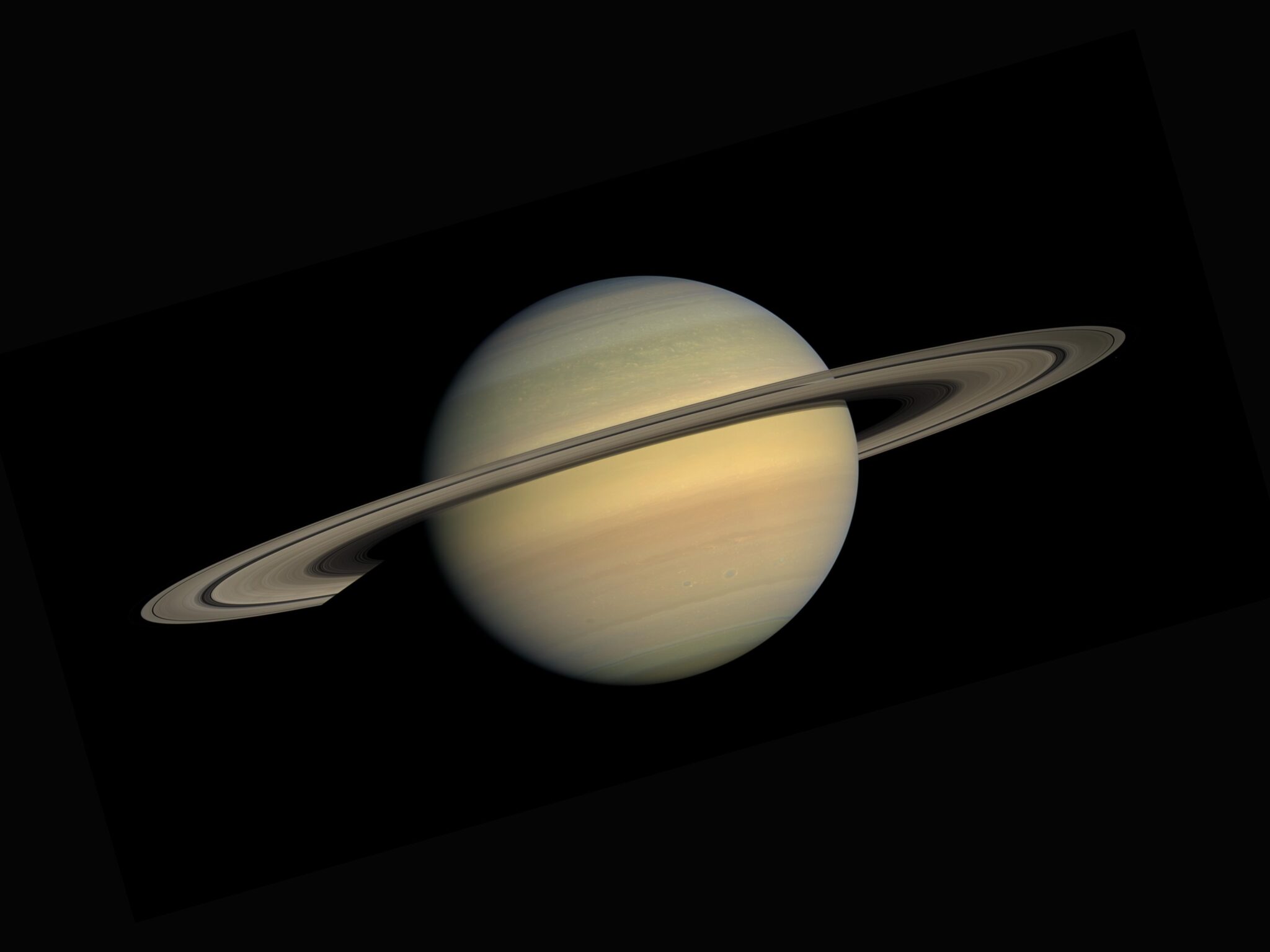
Of all the planets in our solar system, Saturn is undoubtedly the one that captures the imagination the most because of its impressive rings. Even today, experts do not agree on the origin of their formation, or even their age.
To this burning issue, a new study - published yesterday Thursday in the prestigious journal Science - comes up with a convincing explanation. According to it, about 160 million years ago, an icy satellite broke up and its remains gradually formed the rings of Saturn.
«Saturn's rings were discovered by Galileo about 400 years ago and are one of the most interesting phenomena in our solar system to observe even through a small telescope,» says Jack Wisdom, head of the team that published the study. Speaking to Agence France-Presse (AFP), the professor of planetary sciences at the Massachusetts Institute of Technology (MIT) welcomes the «convincing explanation» that his team has come up with regarding the formation of Saturn's rings.
The scientists, who analysed data from NASA's Cassini spacecraft and used computer simulations, concluded that the destruction of one of Saturn's satellites is responsible for both the creation of the planet's magnificent rings and its unusual orbital tilt of about 27 degrees.
They named the hypothetical satellite «Chrysalis», drawing inspiration from the second stage of the caterpillar's metamorphosis into a butterfly. «Just as a butterfly emerges from a chrysalis, so Saturn's rings emerged from that satellite,» Jack Whisdom says in the study.
About 99% of the debris was lost in Saturn's atmosphere, while the remaining 1% remained in orbit around the planet and eventually formed the ring system, one of the wonders of the solar system, according to the researchers.
According to scientists« estimates, the »Chrysalis" was about the size of Jupiter (diameter 1,470 km), the third largest moon of Saturn.
Saturn's rings, made up of dust and ice particles, are located up to 282 000 km from the planet.
Saturn is the second largest planet in our solar system and is 750 times larger than Earth. It is composed mainly of hydrogen and helium and has 83 natural satellites. Among these is Titan - the second largest moon in our solar system - which is larger than Mercury.
Titan is allegedly responsible for the destruction of Chrysalis, which scientists believe destabilized its orbit and pushed it closer and closer to Saturn, eventually breaking up. «Saturn's gravitational pull broke it up the way Jupiter broke up Comet Shoemaker-Levy 9,» explains Burkhard Militzer of UC Berkeley in California, referring to a comet that collided with Jupiter in 1994.