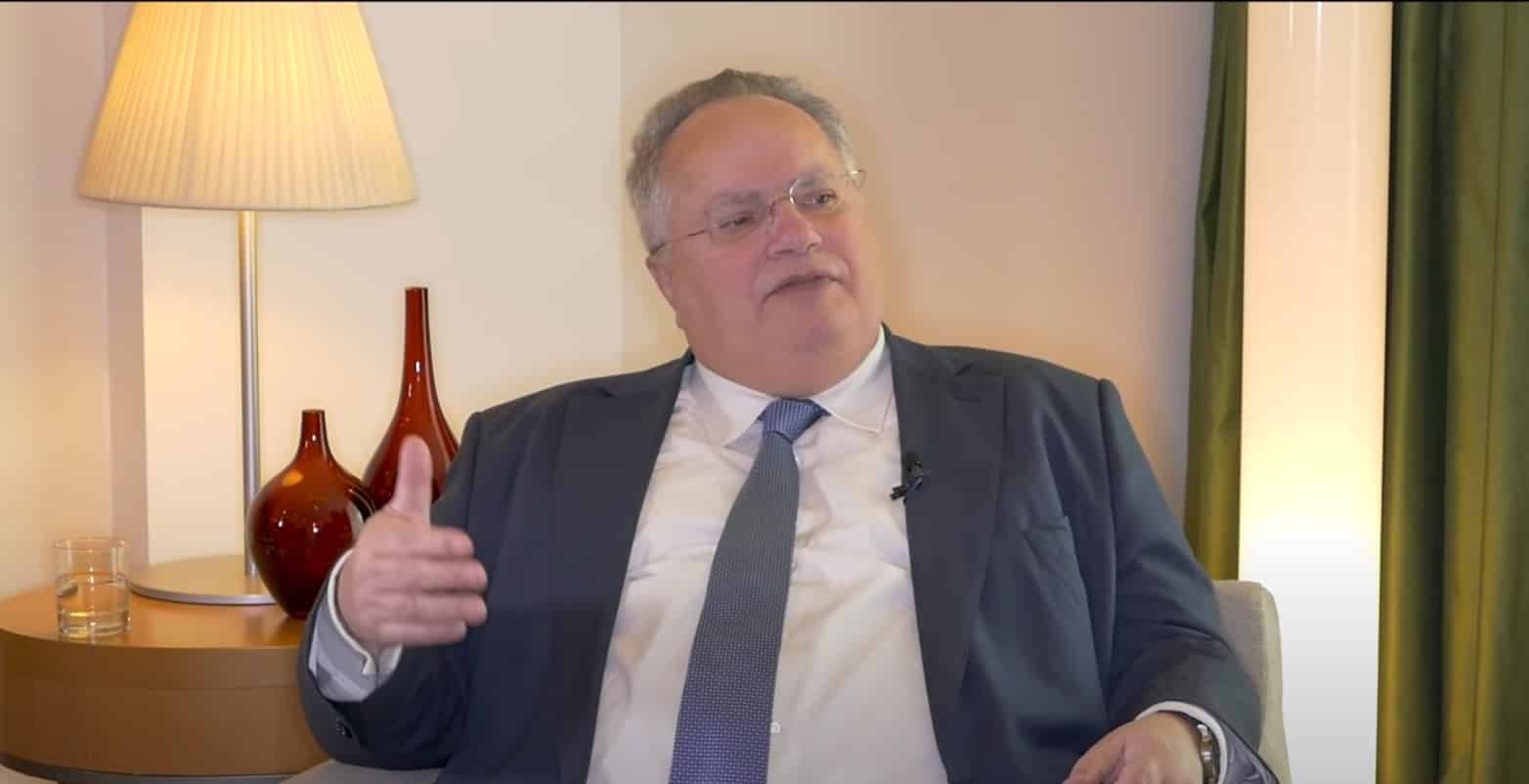
Ο former Foreign Minister, Nikos Kotzias in an interview with Nea Egnatia, analyses in depth Greece's military agreements with France and the US and points out the dangers of our unconditional surrender to their interests. Kotzias cites a non paper of the Foreign Ministry dated 14 October, from which he says that «the US allows us to enter the kitchen to wash potatoes»!
The revealing interview with Kotzias in NEA EGNATIA:
«Greece must have a multidimensional foreign policy and a mediating role between the West and the East and not to enter unconditionally and in exchange under the skirts of the USA or France for their own adventurism or expansionist wars., pointed out, among others, the former Foreign Minister and head of the «PRATO» Movement, Nikos Kotzias, in a major interview with «NE».
Asked to comment on the Greek-French agreement, Kotzias stressed that would be positive, if it were limited to the interests of France and Greece, namely the maritime zones and the Greek Cypriot EEZ, elements that are absent from the agreement., while declared himself totally opposed to the assistance of Greek forces in operations in the Pacific or in the Sahel, explaining that Greece had never waged wars of aggression or participated in colonial operations. However, he also commented on the agreement with the US, which, as he explained, provides Greek territory to the Americans and indefinitely, in exchange for allowing us to enter their facilities! He underlined, the risk in both cases of opening fronts with the Arab world in the first case and with Russia and China, which the US wants to «strike», in the second.
From everything is ridiculous in Greek-Turkish relations, we go to a vast scaremongering
«We have to distinguish three things, first is armaments, second, the defence agreement and third, the political will. The government in the first two years, always ironically and smiling, said that there was no problem with the Turks, that what was happening was a fake and I also recall that the Foreign Minister still said that even the casus belli was a fake and that we are done with the era when warships and gunboats determine international developments. Has the government not explained to us what has happened from the time when it said that there was no need for gunboats and that we are done with them, to today, when it is buying them? We have a big shift from everything is ridiculous, to the theory that it cannot do research inside the Greek EEZ because it cannot listen because of other ships and the theory that General Wind is dragging a Turkish research ship into our territorial waters and it was pharaonic to deal with the theory that says the country is in danger and its territorial integrity is at risk. Then the Turks occupied a sandbar in Evros, which has belonged to Greece since 1926 for a short period of time and the then Foreign Minister of the Government had said that for a few hours they occupied some Greek territory. So, we have a shift of the government from everything being ridiculous in Greek-Turkish relations to a vast scaremongering, because it is now doing business with defence systems.».
The government took an agreement, as they were given it, to sign it
«Yes, they need defensive systems. I'm a fan of both defence alliances and broader alliances and meeting the needs of the country, a defence agreement with France, where we have common interests in the Eastern Mediterranean, is a good thing to do, it's good to have a good defence agreement. But the government took an agreement as it was given to sign, it has done so with the EEZ in the Ionian Sea, with the EEZ with Egypt, and signed whatever they were given.
During my ministry we had a discussion about a defence agreement with France and Cyprus, because the main point that we have to protect today is the Eastern Mediterranean and the part from Kastelorizo to Cyprus. This part is essentially left out of the agreement they have now made with France. Secondly, at the moment and for several years to come there are common interests between France and Greece. Greece does not want to be subjected to any more pressure and provocations from Turkey and wants to repel them, and France does not want to leave Turkey's sovereignty in the Mediterranean, which it considers its own sea, and you can see the big problems that France has with what is happening in Libya, but also what has happened in Syria and Lebanon, where France has traditionally had a special relationship, that is, it has developed interests in this region.
Because we have common interests in the Eastern Mediterranean with France, a defence agreement would suffice and should be limited to these common interests. If this agreement coincides with the purchase of war material from France, i.e. with the receipt of at least five billion from France, there is no reason to escape from common interests and from this purchase. What was this agreement? After they left out Cyprus, after they left out the Greek continental shelf and the EEZ, after they left out the Greek continental shelf and the EEZ, after they left these as objects that are not of interest to Greek defence and are limited to the territorial integrity of Greece, after they took armaments, they made an agreement that Greece will contribute to two things. The first is that it will assist wherever there is French territory, and some people were mocked by the interconnected press, as I say, that here we have from the Caribbean to the Indian Ocean! Because France has a cluster, an area of about 1.5 million square kilometres in the Pacific with a population of about 1.6 million. It's two areas where it did its atomic bomb tests, it includes two clusters of islands where there is guerrilla warfare, hard guerrilla warfare! And I asked myself, why did we not limit the agreement to the An. Mediterranean, where we have common interests, and to give the possibility that any time France makes an adventurism or a conflict in the territories it holds in the Pacific, we can go and interfere?».
When the EEZ, the continental shelf, Cyprus is not included, why include the Sahel?;
«To all this we added the Sahel region which starts from the Atlantic and goes out into the Arabian seas, the Indian Ocean, where we committed ourselves to assist France in these expeditions that it is making to the old colonies. We have no reason to be confused, nor is it right to say that if France is going to defend us, we should defend it where it has geostrategic interests. When France does not include an EEZ and a Greek continental shelf, when this agreement does not include Cyprus, what business do we have to include the Sahel? We, for 400 years we were a colony of the Ottoman Empire, we were not just an oppressed nation, we were a colony and it is important to understand that. What are we doing in the old colonies in Africa, what are we getting ourselves into? We didn't get into trouble when there was a strong Hellenism in North Africa that lost its properties and was persecuted by various kinds of regimes.».
Technology transfer and manufacturing in our country that is not foreseen
«I stress that when the discussions with the French started, including Cyprus and the Greek maritime zones and not including the Pacific and the Sahel, the current government signed what was put in front of it, without any negotiation. The French found a government willing to agree to anything. I am also concerned about Cyprus being left out of such a major defence agreement, not to sign whatever they put in front of us, but where we have common interests.
In the Pacific and in the Sahel we don't have common interests, but in Cyprus we do, don't forget that they claim the air base in Paphos and they wanted this kind of cooperation with Cyprus. Nowhere in the world, Turkey shows us this and the biggest example is the development of China in the last 40 years, nowhere in the world do you make agreements to buy large technological systems without getting something, that is, without taking technology or a large part of production in your country. France can build a frigate, give us its technology and then a large Greek shipyard can produce the rest of the ships, we have a lot of experience with ships, the Greeks, but it doesn't look like that in the deal, it doesn't look like there will be a transfer of technology.
All modern countries, in order to either accept investments or to buy large technological weapon systems, make the transfer of technology a condition and a requirement that most of it be produced in their own country. And there should also be the so-called countervailing benefits, i.e. how we can use the French market to promote Greek products, starting with our agricultural products and industry. They didn't do that, and it's no coincidence that while Turkey had a smaller defence industry than us 35 years ago, today it has a very, very large defence industry with a large volume of exports, and Greece, on the other hand, has shrunk completely. Instead of having all this in the agreement, we have signed an agreement that takes us out of the region and takes us somewhere where we have no interests.».
We never went to war to support colonialists
«What Turkey is doing, claiming from us territories and seas from the time of its decolonization, is a historically unprecedented phenomenon, neither the British, nor the Italians, nor the Dutch, no one does it anymore, claiming retrospectively areas that were in their empire and when Turkey is cornered to say that it is not the Ottoman Empire, but a new state. I recall that the day before yesterday the Turkish Deputy Prime Minister said that Cyprus has always been Turkish since 1,560, that it was Turkish, with a colonial regime! This is madness! Greece is not like most EU countries, a colonial country, but it suffered colonialism on its body and culture. We never went to war to support colonialists!».
The country surrenders its territories for continuous control and exploitation by third powers
«The Americans have consistently asked me for a five-year agreement and I have consistently told them no, because a one-year agreement has a number of advantages, because if national needs are different and if the Americans are not coordinated with us but align themselves with Turkey, you can take away the privileges and facilities they have in Greek territory. We did not agree with the five-year agreement, but the one they have now made is almost indefinite, because you cannot denounce it as an agreement a few months before its termination, but it requires you to denounce it two years before! So it's open-ended!
We are entering a very bad process, the essence of which is that for the first time the country is handing over its territory for constant control and exploitation by third powers. There are more serious questions, based on this agreement, who is the enemy? The Greek government tells us that somehow the Americans are somehow standing by us in the Greek-Turkish conflict. Who told them that the definition of common enemy includes Turkey? Yesterday the US State Department spokesman made a statement that neither the EEZ nor issues that fall under international law with another NATO member state are included. We are being fooled! The question is who is the enemy? Are the Americans going to set up bases to strike with us Turks? Or to prevent the Turks from making sneaky strikes against the Greek defense and integrity of the country's territorial sovereignty? No, it is Russia they have in mind!
And the question that arises is: do we have a reason to make an indefinite agreement and give Greek territory without actually controlling it to the Americans to provoke Russia? Or, as in our economic policy, do we have reasons for cutting off our good relations with the Chinese because the Americans demand it? I will answer you strategically, Greece is a country that is an ally of the United States, Greece is a country that belongs to NATO and the European Union, these are the facts. But in this context, it should have its relative autonomy and should advocate and promote its multidimensional foreign policy.
Greece should not be put together with 100 other countries under the skirts of Germany or America, it should have its autonomy. Because Greece, with the policy that Andreas Papandreou in particular, but also the government under Prime Minister Tsipras, has a multidimensional foreign policy, Greece must not intervene in third countries. Its foreign policy has been and must remain the doctrine that we defend our territorial integrity and our sovereignty.
We never fought wars of aggression, except that after World War I we went with the French again, I remember in 1919, to take over Odessa and Crimea and not only were we destroyed then, the 6 corps was destroyed.000 Greek soldiers and officers, but he turned the Bolsheviks, after we tried to intervene and overthrow Lenin, he turned him towards Kemal Atatürk, which had grave consequences on the results of Greek policy in Turkey in the early 20s, remembering the lessons of history. We should have a policy where we are leaders, where we have the ability to mediate, to arbitrate on behalf of the West where Greece is today with the rest of the world that is emerging.».
Iran, China and their relations with Greece
«When I came back from Iran in 2015, after one day the then US Secretary of State came to Athens and after telling me about Iran in front of everyone to teach me a lesson, he took me in his arms and said: can you mediate with Iran to release four Americans? I said, why are you asking me to do this? He says, because you have good relations and you can play the role of a bridge, of mediating between us who do not speak and them. Are we going to give up this great avant-garde? We have abandoned the space of ancient civilisations, where we played on a global level alone with the Chinese. But the Chinese consider us a sister culture to us, they respect us and listen to us carefully, why should we give up this trump card we have against the West?».
The US allows us to go into the kitchen to wash potatoes!
«I have in front of me an internal non paper from the Ministry of Foreign Affairs from October 14, 2021 and it says the good things about the agreement, in the fourth one it says the US is investing in Greek military facilities in key areas of strategic importance, such as Evros and Crete, investing not in Greek facilities, in key facilities and then it says in parallel it does not allow the use of the modernized facilities by the Greek Armed Forces! In other words, it is our house, it occupied it with our agreement and allows us to enter the kitchen to wash potatoes! What a great success this is! The Americans allowing us to enter the premises of their bases in Greece! Here we are told that we will set up a harsh hostile scene towards Russia, without any quid pro quo, and the only quid pro quo I hear we will get is that we will be entitled to enter these premises. What is our gain?;
As I told you, the common enemy with the Americans is not Turkey, it is other powers, Russia, China. But the role we have to play is to have an independent multidimensional foreign policy and to mediate where the West and the East are in conflict, to arbitrate, because in the end, when you arbitrate and negotiate on behalf of others, when you put forward your own demands, everyone will listen to you.
Greek diplomacy in my time, and I was awarded world prizes, mediated between large parts of the Arab world and international Jewish or Israeli organisations, ensured that discussions took place between the two sides, etc. This resulted in us being respected on both sides, being respected by the Arabs and also making these strong partnerships, both with Arab countries like Egypt, Jordan, and Israel. We did not leave the West, there was no revolution, but even with these changes we were supported and listened to in our demands. Whereas now, when you go under the dress, they take you for granted and say we have the given, Greece, so let's see how we can convince Turkey. So, we should not give away territory for an indefinite period of time, we should not easily and without any trade-offs align ourselves with conflict strategies that eat away at Greece's role, tactics that make it convenient for Turkey to send troops, etc. Our role is our culture, our mediation and to protect the country, not to protect the interests of third parties elsewhere.».