If we want to see history not as a dry list of dates, but as a living anatomy of human exploitation, then these lyrics are the best scalpel. If you open your school history books, you will read about heroic deaths and great ideas. But you will never read about the slow death of the «orphan» on the loom. Because the Greek bourgeoisie, that hybrid born from the womb of petty ownership and nursing the milk of post-mercenarism, prefers to remember the national benefactors and forget the children who paid for their pants.
Under the smoke of the chimneys, the folk song whispered a harsh truth
«Bolonakis's fabrica whistles, it's dawning
Help, O Christ, the orphan on the melting loom.».
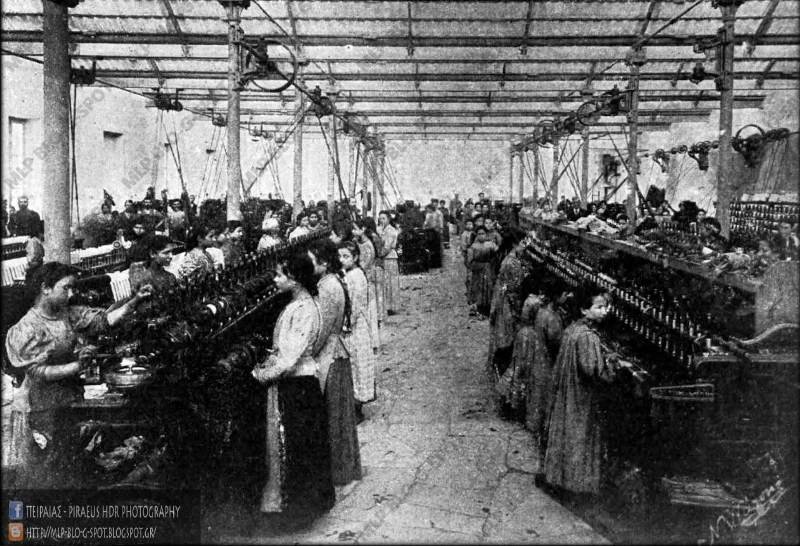
In Piraeus at the end of the 19th century, the whistle of the fabrica was not an invitation to work; it was the death rattle of childhood. It was in the working-class neighbourhoods and the humid crafts, where the smoke of «progress» was choking the horizon, that the country's first female proletariat was being born. An army of «invisible» beings who did not choose their fate, but were thrown into the millstones of the nascent Greek bourgeoisie.
The Greek bourgeois, that hybrid of the cutthroat and the metapractor, understood early on that in order to set up «industry» without paying a penny, he needed a workforce that could not articulate a word. And who is more convenient than an orphan girl?;
These women, usually orphaned girls and refugees who had been deprived of everything before life had given them the basics, were the first yeast of our working class. While the «national benefactors» in their high hats were counting profits in the saloons, these «orphans» were counting hours on the loom, melting together with the threads, under the gaze of a God who seemed as slow as time off work.
They were not just workers; they were the first to feel what it means to be the «cheap material» of a development built on misery. The folk song was not an art; it was the cry of a class that was beginning to realize that, if it did not help itself, neither Christ nor the boss would.
Let's face it. In 19th century Greece, capitalism came not by investment, but by «forced integration». The free artisans of the time, those proud small producers, resisted proletarianization. They preferred to starve rather than become employees. Thus, capital found a solution to refugeeism and orphanhood. In Greece, as we know, history is written in two ways: in the blood of the suckers and in the ink of the swindlers. And the history of the female proletariat in the land of the fustian and the ill-fated capitalism is the classic example of «our national constitution» on the bones of the weakest
In 1847, Loukas Rallis set up his factory in Metaxourgeio. The workers, minor orphans. The wage? One drachma. Exactly what a pair of English socks cost the «philanthropic» industrialist. You worked one day to buy two pairs of socks. Behold the «social sensitivity» of our ancestors.
After the Crimean War and the cholera of 1854, Piraeus was full of corpses and orphans. These orphans became the mass base of Greek industry. It was a time when the word «work» literally meant slavery. The word «slave» was no accident. Dependent labour was then considered a form of personal enslavement that offended conservative mores, but the need for survival was stronger than social outrage.
The Greek state, patriarchal to the core, came up with a wonderful excuse not to pay: Women's work, it says, is «supplementary». The man brings the bread, the woman the salt.
Result? While the man got 4 drachmas, the worker got 50 cents to 1.5 drachmas. We are talking about a difference of the order of 80%. Exploitation was not only class-based, it was also gender-based. The woman in the factory was the «tool in a skirt», destined to work 12 hours a day, even on Sundays, with no insurance, no pension, no tomorrow.
The Shaitan Revolution was not long in coming.
The strike of the rapier workers in Athens, which culminated mainly in the 1883, is one of the first and most shocking milestones in the history of the Greek labour movement. It was the time when the «needle» began to pierce the flesh of employer arbitrariness.
The tailor of Athens in 1880 was not a craftsman, he was a convict of the thread. He worked in holes where the mould competed with the stench, so that the “gentleman” could wear his tails and stroll down Panepistimiou. So when these people decided to cross their arms, Athens was shocked. It was not just a work stoppage; it was the first time that the “scissors” of the working class tried to cut the suit of power to the measures of the dike
This strike, although it did not directly bring about a «revolution», achieved something much more important, broke the fear. It showed that the needle can become a weapon in the hands of those who produce the country's wealth.
So we arrive at April 13, 1892. In the factory of the Retsina brothers in Piraeus, the setting was ideal for the employer. He had hired entire families. If one rebelled, they all went hungry. The ultimate hostage situation.
Women worked «by the piece». They took 80 minutes for each tope of cloth. And suddenly, the employers decide to cut 15 cents off. Take them down to 65. We're talking about their children's bread at a time when food was more expensive due to the recession.
There, the 60 women workers of one of the five factories threw the shuttles. They didn't ask for the sky with stars. They asked for the ’righting of wrongs«. Η Callirroe Parén, the first Greek feminist who understood that women's liberation goes through the wallet and not only through the hat, wrote in the «Journal of Ladies»: «Enriching all by the sweat of their brow the factory owners» pockets".
The «Ladies» Gazette« of Callirroe Parene then became the voice of their anger, deploring the injustice of those who were getting rich »through the sweat of poor working women" at a time when bread was becoming more expensive. Although the outcome of that first women's strike was lost in the oblivion of time, their act remained a bright landmark. On that day, the women's proletariat ceased to be a mere statistic and took its rightful place at the helm of the struggle, proving that dignity has no gender, but has a voice.
Although the final result of that strike was lost in the dust of time, their act remained as a beacon. On that April day in 1892, the «invisible» women of Piraeus proved that they were not just a supplement to production, but the conscious vanguard of a movement that was just being born.
We don't know if they won. Official history does not record the small victories of the sidewalk.
We don't know yet if they won the 15-minute gap. They probably beat them up, fired them, or replaced them with other hungrier ones. But on that day, the «orphan» of the folk song died and the worker was born. And this, for the Greek bourgeoisie who wanted women locked up in the basement, was the greatest defeat.
Because, as the late Marx would say (who Retsinas probably thought was a beer brand), conscience begins in the pocket. And Greek women workers in 1892 understood that Christ helps, but the strike saves.
The female proletariat in Greece was not born in the salons of Athens, but in the mud of Piraeus. And the first strike of 1892 is proof that class consciousness has no gender, but it has a memory. Let the chair historians try as much as they like to drown it in the lace of our «glorious» history.
On that April day in 1892, the «invisible» women of Piraeus proved that today, 134 years later, their memory reminds us that justice is not given away - it is won on the loom of history.