The first autonomous Greek State, after the collapse of the Byzantine Empire, was created when Bonaparte's French Republicans abolished the Venetian Republic of Venice, a development that brought the end of the long Venetian rule in the Eastern possessions. This small state was the Ionian State from 1800 to 1807 and the successor Ionian State from 1815 to 1864, a milestone in the Union with Greece.
The Seven Islands State was the result of the Russo-Turkish alliance against Napoleon Bonaparte. As Nikos Kourkoumelis, a doctor of history, points out in the APPE-MPE, «the French stayed in the Ionian Islands for two years and the unholy alliance between the Ottomans and the Russians followed. In 1799, they occupied the Ionian Islands and arrived in Corfu with Admiral Usakoff and Kandir-Bay. They expelled the French and settled on the islands. The occupying force treated the population with courtesy, because they have other plans. The creation of a protectorate in the region, along the lines of the Ragusa system, today's Dubrovnik.».
On March 3, 1800, a firman recognized the autonomy of the State, under the protection of the Sultan and the tolerance of Russia.
A Greek state before the national liberation from the Ottomans
The Ionian State, a single autonomous federal state, with its own flag, with a Constitution of 212 articles drawn up by the Zacynthian-born Russian diplomat George Montenegro, a Senate with a president who was also the ruler of all the islands. The first ruler was Prince Spyridon Georgios Theotokis, who, from 1803, hired Ioannis Kapodistrias as Secretary of State, at the suggestion of Montenigu.
The ceremony of recognition of the Ionian State, the signing of the Convention of March 23, 1800, the firman recognizing the Ottoman protection under the guarantee of Russia, took place with a glorious ceremony in Constantinople, while a similar event was held in St. Petersburg. Envoys to the High Gate were the father of Ioannis Kapodistrias, Antonios-Maria Kapodistrias, and the Zakynthian Nicholas-Siguros Desyllas.
The first Greek war corps flag in the Ionian State
In Istanbul, the presentation of the flag was also held, while a praise service was held at the Patriarchate.
The flag, on a silk canvas of cyan colour, depicts in the centre, in gold, the winged Lion of Saint Mark. On the left side is a closed Gospel, with a cross from which project 7 spears, as the number of islands, and the date of the formation of the state, 1800.
The flag has national and commercial use
Nikos Kourkoumelis points out that the flag of the Ionian State was the flag of the Ionian troops, the so-called Ionian Regiment, which defended Lefkada in 1807 together with Ioannis Kapodistrias as representative of the Senate during the siege of Ali Pasha.
Mr. Kourkoumelis emphasizes that it was the first military flag of Greeks during the battles with Ali Pasha. Under this flag, as he points out, great thieves and charioteers fought, from Katsantoni to Kolokotronis. At the same time he poses the question: «Tell me, why is it not in the War Museum? Perhaps no one thought of it...».
In 1815, the British added three crosses to the top left of the flag, a symbol of the British Union.
The end of the Ionian State, which was at the table of the disputes and claims of the great powers of the time, comes after Napoleon's victory at Austerlitz and the Treaty of Tilsit, according to which the Ionian Islands are again ceded to the French.
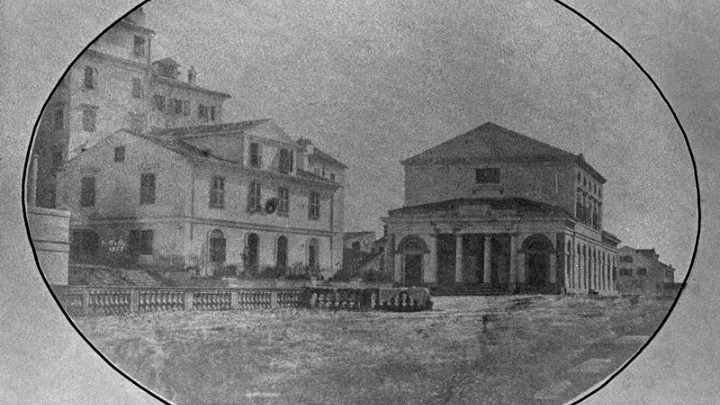
It is a period of blossoming of democratic ideas and values, of reshaping the situation, of modernization, of the creation of the Ionian Academy, an intellectual institution of general education with personalities from all over Europe. During this period, the emblematic Liston building complex was built, which is perhaps the most talked about reference point in Corfu.
Radical MPs pave the way for Union with Greece
In the mid-19th century, Europe was faced with revolutions. The British decided to appoint as High Commissioner to the Ionian State, Lord Seaton, a military scholar, an important figure with a European education, who changed articles of the Constitution, made liberal reforms and paved the way for the creation of parties.
Until then, the Senate functioned as an upper house and there was also the Parliament, without parties but with wards.
The Radical Authority Party is the parliamentary party of the Ionian State's unification with Greece. In 1850, twelve Radical deputies proposed a resolution, drafted by Ioannis Detoratos Typaldos, for union with Greece. The reaction of the British was strong, they were unable to pass it in Parliament, the proceedings of the House were suspended, and persecution, exile of MPs and the cessation of the press supporting the Union followed. However, the message had got through to society.
Six years before the Union, the British propose changes in favour of the Ionians. They appoint Lord Gladstone, a prominent figure, a philhellene, as the new High Commissioner on a temporary basis to appease opposition and keep them part of the British Empire. However, the Ionians, led by the Kefalonians, rejected all of Gladstone's good intentions.
«The Ionian people demonstrated national dignity, there was a national state», Nikos Kourkoumelis notes. After negotiations with the great powers, the Treaty of London on 29 March 1864 marked the union of the Ionian State with Greece. The Treaty came into force on 21 May 1864 when the British withdrew from the Ionian Islands.
Mary Jora
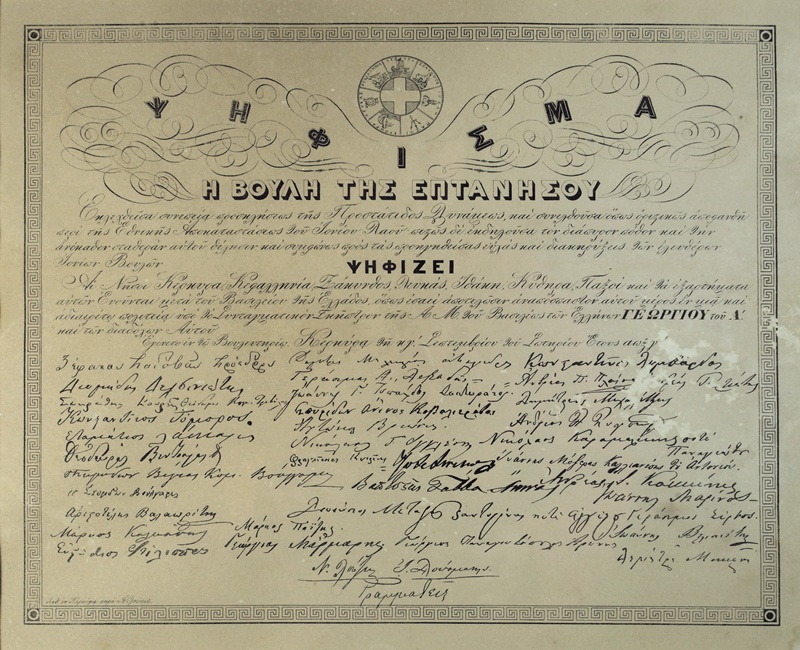
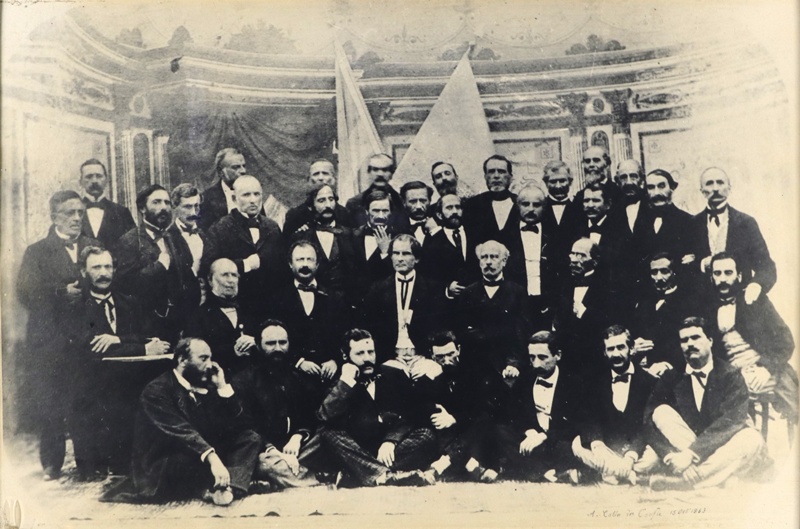
(photos provided by Dimitris K. Zymaris, scientific director of the Corfu Diagnostic Society of Corfu)