In history there are events that do not stand up, even though they have been outstanding and true, but for many different reasons have been suppressed.
The Greek Revolution of 1821 belongs to these moments.
It's not just a straightforward narrative of heroes and sacrifices, but a body that is broken, a body that moves forward while at the same time breaking apart.
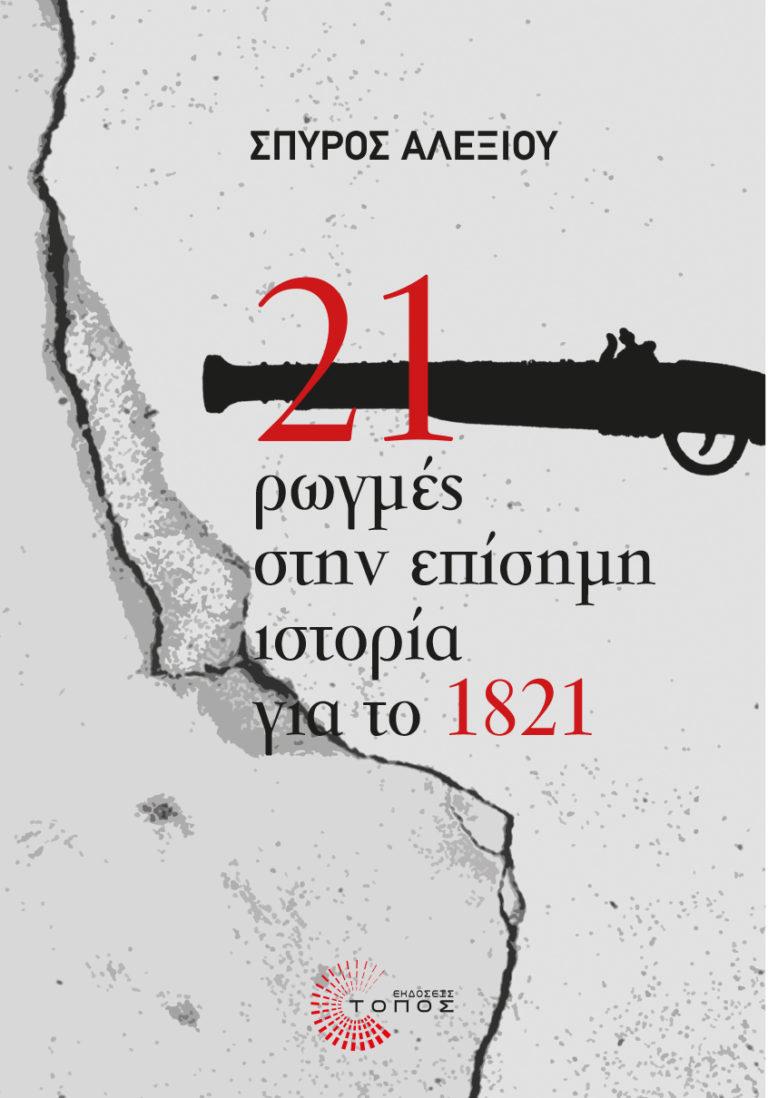
The book «21 Cracks in the Revolution of 1821» by Spyros Alexiou does not come to take away from the Revolution its greatness; it comes to return its weight.
History is not what we can bear to remember or rather what some people want us to remember, history is what insists on standing behind the curtain and forces us to look for it.
Underneath the flags, where the wind makes them look uniform, there are seams, inside the seams, there are threads pulled in different directions. The Revolution was never one hand raised, but many hands claiming the same height.
Some spoke of freedom, others of power, and others never spoke because they were fighting.
The narrative we received taught us to see a nation emerging. The book invites us to see something harder, a world colliding to decide what that nation will become. The preachers, the chieftains, the islanders, the peasants are not just faces of a shared history, but bearers of different worlds. Worlds that were not united, but coexisted through tension, suspicion, competition.
And somewhere there, in the noise of the guns, something more silent was born, the claim of the future.
The State did not appear after the Revolution, it was already there, as a promise, as a shadow, as a booty, before it had even acquired borders, it had already become an object of conflict.
Who will rule it, who will name it, who will speak on its behalf. The civil conflicts were not a sad interlude, they were the very moment when freedom was transformed into power.
And power is not easily shared.
So we see that history is moving away from the light of anniversaries and returning to the twilight of actions. Where decisions have not yet been vindicated and people have not yet become symbols. Where violence has not been purified, but remains what it is, an act that leaves a trace.
Tripolitsa is not just a victory, it is a reality that has existed and has influenced, benefited some and harmed others. .
Every reality in history leads to a choice.
The book does not denounce but reveals. It does not deconstruct to cancel, but to shift the gaze, from the top to the crack.
In the crack appears the material of history, not marble, but blood, fear, desire.
And then the others come, the Great Powers, who did not appear as invaders, but as regulators with the language of diplomacy and the weight of fleets, intervening not to fulfill a dream, but to
serve balances. The Battle of Navarre is not only a moment of salvation, it is also a moment of dependence; from there on, independence will never be fully self-sufficient.
Every freedom carries with it the way it was acquired.
And when the Revolution finally ends, when it ceases to fight, its narrative begins, there the cracks are filled, the contradictions are smoothed over, the conflicts are forgotten. A state to stand needs cohesion, and cohesion to exist needs a history that is tolerable.
Thus, memory becomes selective and history becomes a utility for power.
But the cracks do not disappear. They remain, like the lines in an old building, invisible from a distance, but crucial to its structure. Every time we talk about unity, something in us remembers the split. Every time we invoke freedom, a shadow recalls its price.
The book proposes, finally, another form of respect for the
Revolution, not to protect it from its truth, but to protect it from the
to endure, because the truth does not diminish the facts, it deepens them.
And perhaps it is there, in these cracks, that the most essential meaning of history lies, because it cannot only be a unifying narrative, but knowledge that forces us to look again, not at what happened, but how it happened and what of it still exists within us.