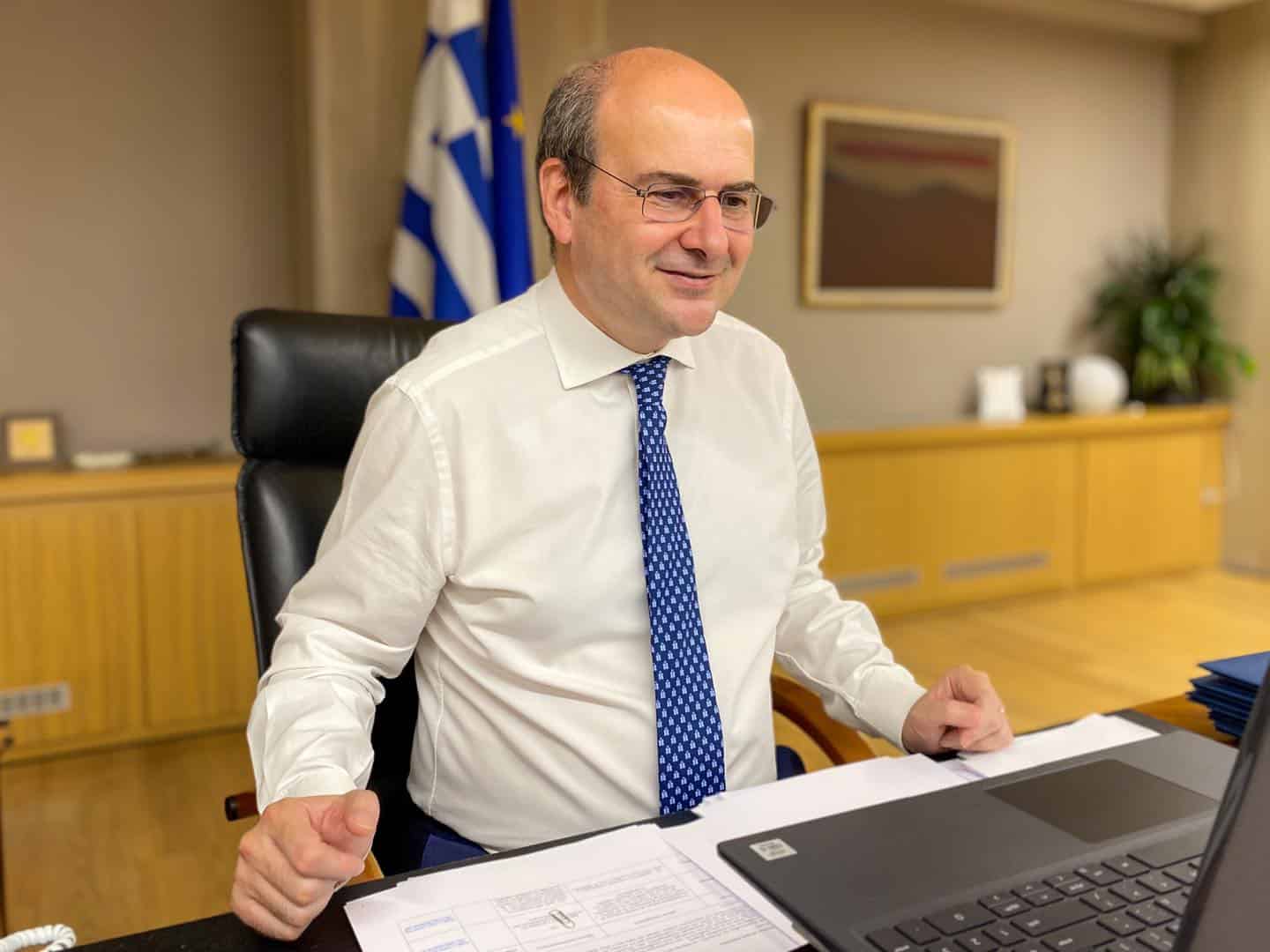
Greek Economy and Finance Minister Kostis Hatzidakis says he is confident that the Greek economy will achieve the target of a primary surplus of 1.1% of GDP by the end of the year. At the same time, in an exclusive interview with APE-MPE, the minister points out that, compared to previous estimates, the final text of the budget to be submitted on Tuesday, significantly changes for the better, on the one hand, investments (expected to increase in 2024 at a rate of 15.1% against a previous forecast for an increase of 12.1%), and on the other hand, the large increase in spending on health and education.
Asked about possible changes to the new way of taxing freelancers, he leaves open the possibility, after the public consultation, for changes, saying that «as in every public consultation we will consider all comments honestly and impartially». However, he adds, «any changes will be punctual», noting that the State cannot continue to «bless» tax evasion.
At the same time, the minister does not seem to share the concerns of the Bank of Greece about a new increase in «red» loans due to inflation and high interest rates, saying that «it does not seem that in the foreseeable future we will have a new increase in interest rates from the ECB». And he says that «the boost our policy gives to the economy is also the best defence» for red loans, while there is a second counterweight, the current institutional framework, which is being strengthened.
Here is the full text of the interview of the Minister of National Defence Costis Hatzidakis to RES-ME and Homer Emmanouilides:
Q: On Tuesday you present the budget. Can you give us a preview?;
AP: Despite the fact that 2023 was an election year and even more so a year with major natural disasters and corresponding public obligations, the budget is overperforming because the economy is overperforming! And the economy is outperforming because for four years now we have been implementing a serious economic policy: reducing taxes and contributions, simplifying licensing procedures, promoting structural reforms, attracting more investment.
According to the budget execution data, we can be fairly confident that by the end of the year we will reach our target of a primary surplus of 1.11T3T of GDP! What changes significantly for the better for 2024 compared to our previous estimates are: First, that investment is expected to grow in 2024 at a rate of 15.1% versus our previous forecast of 12.1%. And, second, the significant increase in spending on Health and Education, with resources coming from our effort to curb tax evasion. All this shows that the government is in practice combining economic and fiscal seriousness with social sensitivity!
Q: You announced the social solidarity allowance for the vulnerable. Can citizens be optimistic that this will also happen in 2024?;
AS: Well, it's too early to talk about that! 2023 is not over yet! In any case, in 2023, together with the strict respect of our budgetary targets, we have achieved a surplus compared to the targets, which we are returning to society: 352 million euros which will be given at Christmas to 2.3 million vulnerable citizens (vulnerable families, low pensioners, people with disabilities, beneficiaries of the minimum guaranteed income). As a result, together with the aids already foreseen (Youth Pass, personal differential allowance, 8% increase in the minimum guaranteed income, heating allowance), the income support for citizens in December is in the order of €717 million. I also recall the permanent support measures in force from 2024 (increases in civil servants’ salaries, increases in pensions, increase in the tax-free allowance for families with children, reduction of the ENFIA for insured homes, exemption of former beneficiaries of the EKAS from participation in the purchase of medicines), which amount to 1.6 billion euros per year!
Of which, I would like to highlight the following two elements: First, that the average civil servant from the government initiatives for 2023 and 2024 will see a net increase in their pay of €1,476 per year. And low-paid workers, including the government's recent measures, will see increases of around 5%. But I also want to make the following point: If today we can give what we are giving, we are doing so because we are implementing a serious economic policy. Therefore, let us not listen to all those who enter bidding wars, feed rabbits with straws and appear ready to give everything. Only with economic seriousness can we move forward and that is how we are determined to continue!
Q: Minister, you have put the new bill to tackle tax evasion out for public consultation. There is, however, opposition. Will you make changes?;
AS: The tax bill is a key reform policy of the government. It reflects its willingness to address the issue of tax evasion in an effective and balanced way. It is a key element of the tax reform process. The Prime Minister himself has been very clear in his recent statements. As he noted, the government will stick to the basic philosophy of the bill.
Of course, as with any public consultation we will consider all comments honestly and impartially. In any case, however, any changes will be of a point nature and we do not know them at this time. Because the consultation has only just begun! Therefore, what is written is out of place! It would, however, be unfair to all those who pay their taxes if the State continued to «bless» tax evasion for reasons that are incomprehensible. Wherever it comes from. The government will therefore move forward by showing all Greek citizens that it understands, but also treats the problem seriously. And it would be very interesting to see if there will be a «movement» in favour of tax evasion in our country!
Q: Many governments have announced a crackdown on tax evasion, without delivering results. There is therefore a great deal of mistrust in public opinion. What is your response?;
AS: It is true that tax evasion is a long-standing problem. It is not true, however, that there has been no progress. Look at electronic invoices and electronic transactions, which have advanced over the past four years. Look at the so-called «VAT gap» - the revenue we lose annually from VAT - which has fallen from 23% in 2018 to 15% today. And which we want our initiatives to reduce to the EU average of 9%.
So there is progress. However, the problem of tax evasion is serious. And that is why we are trying to intervene at many different levels in order to achieve tangible results: We are expanding electronic transactions, limiting the use of cash, adopting strict measures to fight smuggling, modernising the framework for short-term rentals, promoting a fairer system of taxation for freelancers. With this multi-faceted effort, we are optimistic that we will indeed succeed in reducing the social scourge of tax evasion!
Q: Some critics of the government, though, say you're trying to curb tax evasion by taking on the small guys, because you don't want to take on the big fish...
AP: The opposite! The initiatives I have spoken to you about apply to all businesses regardless of size. While there are also regulations - such as the smuggling regulation and indirect control techniques - which are precisely targeted at the «big fish». All citizens will benefit from the implementation of these actions. And, of course, businesses themselves - especially the smallest ones - who will see the rules of competition and fair taxation strengthened. But even our interventions on the self-employed, if you look at them, as they will reduce the workload of the VAT authorities, will enable them to concentrate on chasing large-scale tax evasion on the highest incomes!
Q: Since you mention the freelancers, their representatives claim that the bill finally introduces a capitation tax. What is your response?;
AP: I challenge anyone to come and show me where in the bill any increase in tax rates, or any imposition of a new tax, is mentioned! What we are attempting to do is to apply common sense rules to the issue of taxation of freelancers. Currently, of the 500,000 freelancers who have income just from practicing their profession, half (54%) declare zero income, while 85% declare an annual income below the income declared by minimum wage workers!
We say that it is not conceivable that a freelancer, and indeed for many years, should survive with losses or declare less than a worker who is paid the minimum wage. But also that this category cannot pay an average of EUR 867 in taxes per year, while the average worker pays EUR 1 160 in taxes per year! To put it simply: Do we want employees to pay more than their bosses pay? If we do, let us agree as a society that we will go with the current system. But in that case, please, let's also stop talking about the problem of tax evasion in our country!
Q: But even so, doesn't the tax burden on freelancers go against the relevant New Democracy election commitments?;
AP: We are the ones who in the last four years cut over 50 taxes and contributions. We are the ones who already at the beginning of this four-year period initiated the additional reduction of the ENVIA by 10% for homes insured for natural disasters. We are the ones who increased the tax-free allowance for families with children. But even now, if you look, in this bill to tackle tax evasion, what we are doing is that we are reducing another tax, the business tax, which will initially be reduced by 50% in 2024 - for freelancers who declare more than the «minimum wage» - and will eventually be abolished in the biennium. That's earlier than our election commitment! But what we also said during the election was that a further reduction in tax rates would also be linked to an increase in tax compliance. So that is exactly what we are trying to do!
Q: Another reservation that is raised is whether the new system effectively «prohibits» a professional from having losses, since he will pay tax in every case as if he had profits?;
AS: The system we are bringing in is not one of our patents. France and Italy are doing something similar. Countries that I don't think anyone disputes that they are more advanced than us. But at the same time, if you look at the revenue that other EU countries have from the taxation of the liberal professions, it is 2.1% of GDP. In Greece again it is only 0.8% of GDP. And with our intervention we are going to 1.1%- 1.2%. Well, you don't call that an extreme increase!
However, the Bill recognises the possibility that a self-employed person may not be able to cope with his/her professional obligations for a certain period of time. That is why we said from the outset that the presumption would be combated. And we included specific provisions such as, in particular, reasons of force majeure, health reasons, natural disasters, military service, pregnancy, etc. However, precisely because the presumption is combative, any self-employed person who considers that he or she is being unfairly treated and is not even covered by these exceptions can go to the competent authorities and prove it by means of a corresponding check, of course. Just as is the case with the presumption of living today for the so-called ’E1«. Except that not many people do it!
I would also remind you that at the same time there is a zero presumption for new professionals for the first 3 years of operation and only from the sixth year onwards they will pay the 100% of the presumption tax. A reduced presumption of 50% is also provided for those living in villages of less than 500 inhabitants or on islands of less than 3,100 inhabitants and a zero presumption for persons with disabilities. In conclusion, with this bill we recognize the special circumstances in which a self-employed person might find themselves and give them special accommodations and exemptions where needed!
Q: The Bank of Greece is concerned about an increase in «red» loans due to inflation and high interest rates. Do you share these concerns?;
AS: Of course high interest rates are a problem. There is certainly a problem of interest rates. However, it does not seem that we will see a new rise in the foreseeable future.
Beyond that, however, we have two important counterweights. The first is that the Greek economy is doing well. It is growing at a higher rate than other European economies, it has taken the investment grade, new jobs are opening up, unemployment is falling, disposable income is rising and the budget is over-performing so that we can return the surplus to society.
The boost that our policy gives to the economy is the best defence for what we are discussing. At the same time, we have a second counterweight, which is the institutional framework that exists - and which we are trying to strengthen - in our country. The regulations adopted over the past four years have largely succeeded in freeing the banking system from the thorn of «red» loans. In addition, the law on debt adjustment and second chance was adopted, which was a real reform for the country, establishing permanent debt adjustment tools, such as the out-of-court mechanism. Now, with our draft law, which is currently under public consultation, we are attempting to further strengthen the existing institutional framework!
Q: What changes?;
A.P.: With the interventions we are introducing, we are taking the next step in addressing the private debt that is still outstanding in the economy, putting obstacles in the way of even stronger growth that the country can achieve. Speeding up settlements through the out-of-court mechanism with improved protection for the truly - and not the supposedly - vulnerable, establishing a strict framework of transparency rules for servicers, stimulating competition in the banking system and systematically monitoring the evolution of private debt are the key tools we are using, combining the goal of economic consolidation with social protection!
Q: The sale of the 22% held by the HFSF to the National Bank was completed last week. What is your comment?;
AS: It's another proof of what I was saying: that the Greek economy is doing well. Because if the Greek economy and the banks were failing, nobody would come to invest. It is indicative that this transaction was the most successful in the last three years in the EU in terms of the demand that was manifested and the minimization of the discount on the sale price. We are therefore encouraged by this development. A development that is combined with recent similar positive developments in the banking system, with the successive credit upgrades of the Greek economy in recent months and the corresponding positive ratings for the country by international organisations!
Q: The regaining of the investment grade gives «prestige» to the Greek economy and makes it easier for the government and businesses to borrow. It gives the Greek economy a prestige and gives credit to the Greek government and the Greek government is giving the government a credit rating and the Greek government is giving credit to the Greek economy; however, what can it mean for the ordinary citizen who experiences the problems of everyday life?;
A.P.: It is a very important event that a number of agencies have received the investment grade: the Japanese R&I, the two Chinese agencies, the Canadian DBRS, the German Scope (which by decision of the ECB is now among the rating agencies that it recognizes), and of course Standard & Poors, which is also recognized by the ECB.
All these are a seal of confidence in the prospects of the Greek economy. But they also have tangible benefits. And therefore, a precondition ultimately for sustainable growth and more investment and jobs. Greece is moving up from the B National League to the A National League. And from now on, we will fight not to be the last among the first!
Q: Discussions are currently taking place at the European level on the new Stability Pact. Are you optimistic that an agreement will be reached soon? Can the exemption of defence spending, as requested by Greece, be achieved, as there are rumours that there are objections from the Northern side?;
A.P.: I was recently at the Eurogroup and ECOFIN meetings in Brussels, where my fellow finance ministers and I discussed these issues. I can tell you that progress has been made on the outstanding issues and we agreed to intensify work at all levels with a view to reaching an agreement as soon as possible.
Greece's position is that the new fiscal rules should ensure both fiscal discipline and economic growth, while care should be taken for countries with high defence spending, such as Greece. In any case, however, Greece, regardless of the final content of the agreement, will continue on the path of fiscal seriousness. I am optimistic that we will soon reach a balanced agreement!
Homer Emmanouilides