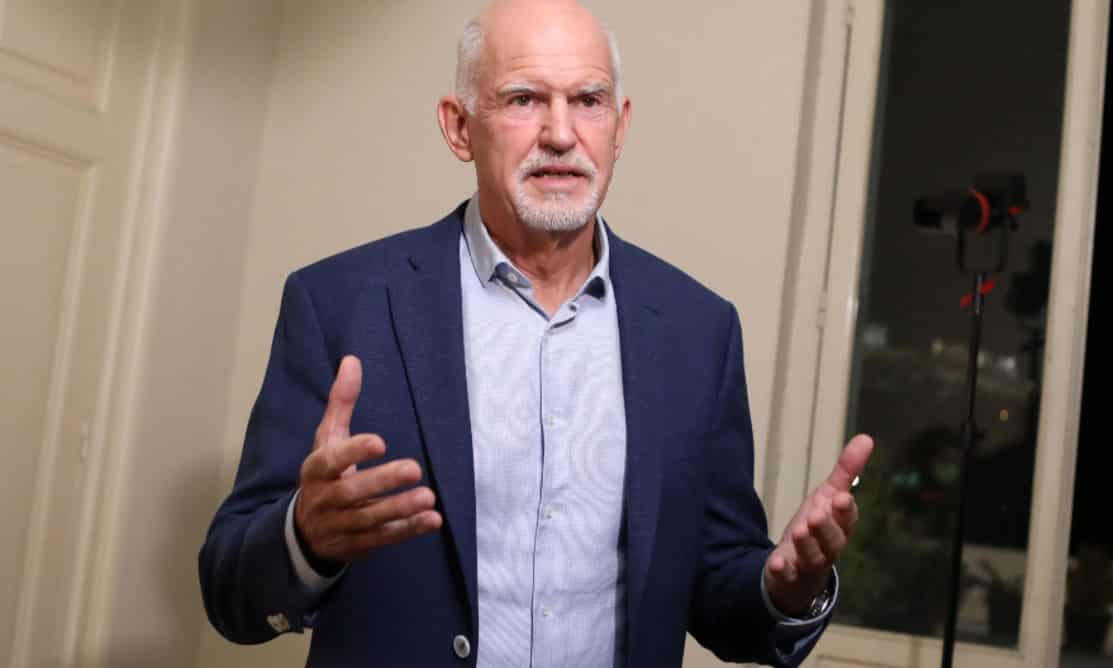
Former Prime Minister George Papandreou gave his own stern response to SYRIZA and those who try to appropriate for their own benefit the political legacy of Andreas Papandreou.
«My father in his will gave me only one thing, his name. A great honor. But his work and his history do not belong to me either, they do not belong to anyone, they belong to the Greek people and to Greek history,» Papandreou said, speaking on Saturday evening on ERT's Central News bulletin.
He noted how «we have a strange relationship with history. Sometimes we try to appropriate symbols such as the Parthenon, the flag, our fighters, when we should be discovering and learning about history,» he added: «If we want to learn and honour the history of Andreas Papandreou, we should see what his struggles were. Andreas Papandreou brought, so that Greece could experience for the first time, a deeply democratic Left, far from idealism, dogmatism, centralization, far from the logic that there is a leftist authority, populism, or authoritarianism that knows all the solutions. It came with a logic that it is the people who must have the say. And indeed, I don't like the logic that Andreas is the savior we should emulate. Andreas did not believe in saviors, nor should we.».
George Papandreou pointed out that «Andreas managed to liberate the forces of Hellenism. Millions of people who believed, not just in one person, believed in the liberation and the potential of the Greek people. In other words, he managed to give hope, optimism, self-confidence, that Greece can. That we can make changes and I think this also annoyed the traditional left. Obviously the establishment and the right. Of course, there was also the dirty ‘89, because it basically broke the perception of the establishment who want to control and see power as a spoil.
That's what Andreas Papandreou brought, a confidence that Greece can. And this is, I believe, the project and the stakes of these elections. At last, to finally get away from the perception that the state is the spoils of the winners, either of some party nomenklatura or of some oligarchy of wealth.
And of course, we were also hit in 2009, when we tried to make changes precisely against such logic and establishment.».
Ahead of the elections, the former Prime Minister was asked about the issue of governmental cooperation and the attitude of PASOK-KINAL and supported the line of Nikos Androulakis.
He specifically stated: «New Democracy, Mr Mitsotakis talks about self-reliance. I believe that he basically wants a monarchy. Therefore, he does not want partnerships. On the other hand, SYRIZA, I don't know what it wants, because it talks about a coalition government only if it is first, while it has voted for simple proportional representation. So I wonder if they really believe in partnerships. What is the spirit of cooperation? If we are going to fight over the quilt, over how to divide the spoils, of course we don't want that kind of cooperation, because that's basically how they want to have the arbitrary use of this power. We would not want such cooperation. We would not allow either the surveillance by the NSA, or the gagging of the press with advertisements, or the clientelism of management with the tragedy of Tempi. Nor, of course, would we tolerate the excess profits of the big energy companies and the impoverishment of the Greek people, nor the privatisations, even of water, nor the degradation of health and education. Nor, of course, the management of the Greek people's money through procurement through emergency legislation.
If there is a willingness to change Greece, not to look at power and how to distribute the posts and the spoils, if we want to change Greece, to go to a digital green fair era, to strengthen and change education, health, welfare, to help Greece to be a modern democratic country, deeply democratic, with rules so that young people who leave abroad can feel dignity, then there is scope for cooperation. Then there is the possibility of programmatic convergence. So, in the next few days until the elections, they will have to clarify whether they want cooperation and what their programmatic lines are.».
On Greek-Turkish relations and their prospects in view of the elections in Turkey and Greece, George Papandreou disagreed with Dendias« assessment that the exploratory contacts had no substantial result. »They are necessary. In my experience, dialogue is always useful. Dialogue allows us to understand what our real differences are and whether there is scope for solving the problems. It is the megaphone diplomacy that creates tensions, it also creates more extreme attitudes and sometimes electoral perceptions around problem solving," he observed.
Regarding the discussion on the revision of Article 16 and the Universities, Papandreou recalled that in ‘75 with the change of the Constitution, it was New Democracy that imposed Article 16 as it is today and Andreas Papandreou had said that we should broaden the scope of those who can make university schools, such as the GSEE, local government, chambers of commerce, cooperatives. «I think it needs to change for another reason. We have a mess right now of private, unregulated colleges, etc. We will get to the point where as we legalize some buildings that are unauthorized, we will legalize something that is certainly not even regulated. So we have to regulate. But I will say something else. Article 16 should be changed and to support the public university, which is highly centralised, bureaucratic, to free up university powers, to have universities that can decide what degrees they will give, what changes, what new subjects will arise, what exams will be, so that there can be a plurality of exams.
We should not flatten the children in courses, so that there can be different talents, so that the university can be connected - decentralized - with the region and democratic planning, which is not happening today, because the connection that concerns more universities than local communities is only helping shops and rents.
We are exporting students when we should be importing students and there is a huge global demand for education. Greece is an ideal place. We had brought a law in 2011. We voted to open the universities. Unfortunately, as soon as we left, that was reversed and we went back. So, therefore, our education needs big radical changes,» the former prime minister said.