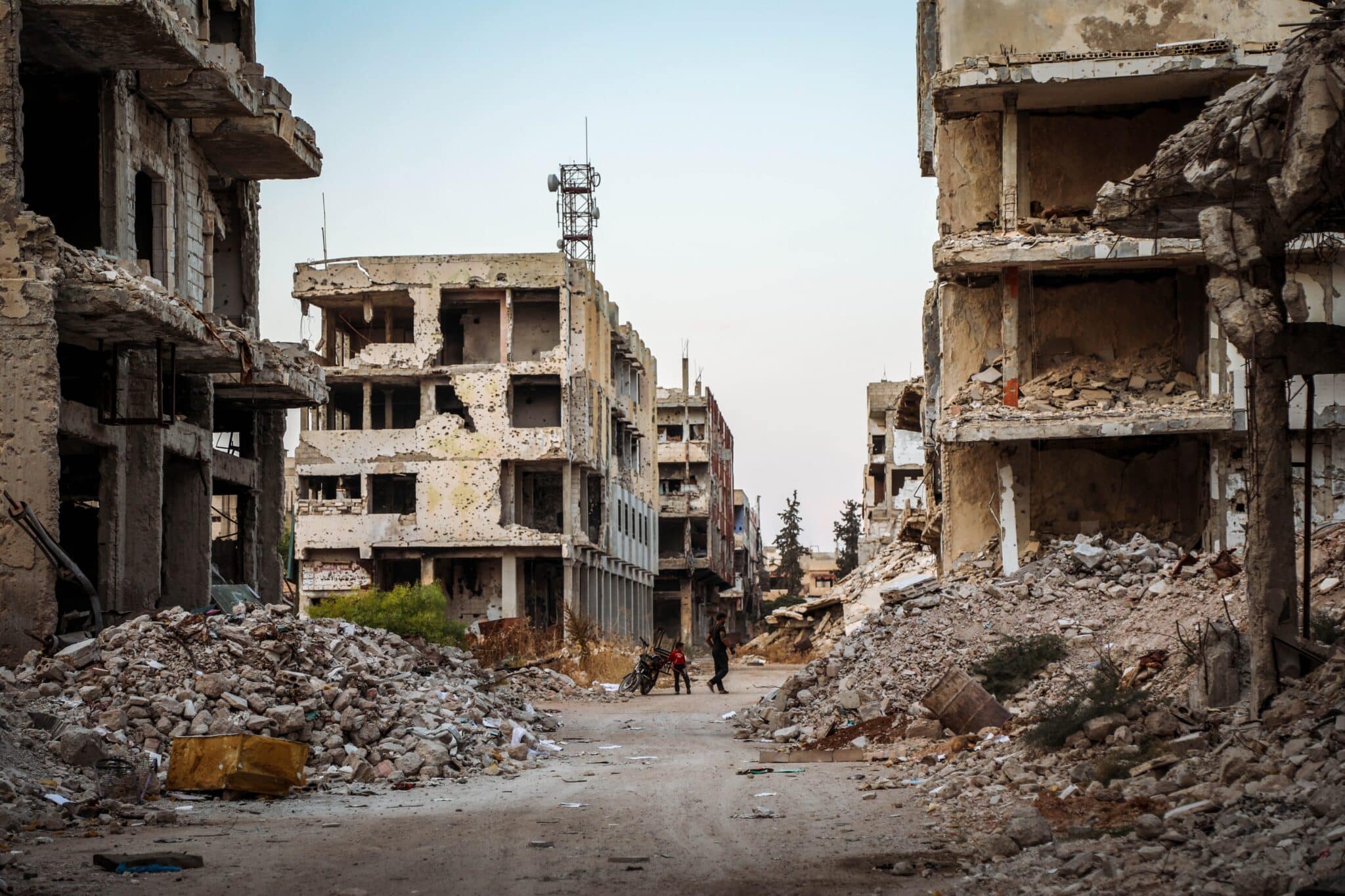
A new Turkish military invasion in Syria, the third in four years, began at four in the afternoon (local time) of 9 October 2019, under the Orwellian name of «Fountain of Peace». It was preceded by operations «Euphrates Shield» in 2016-2017 and «Elaia Branch» in 2018. Back in the present, with the de-facto blessing now of a now an inarticulate Donald Trump, the Turks are unilaterally attempting to unilaterally realize what they have long desired for years:
- the formation of a zone tens of kilometres deep within Syrian territory along the Syrian border with Turkey
- a zone that will now extend not only west but also east of the Euphrates River
- a zone under Turkish control
- a zone in which there will be no more Kurdish fighters (YPG/YPJ), no more Kurdish parties (PYD), and no more de-facto Kurdish autonomous structures.
Thus, in the name of «security» and refugee management, Turkey is now attempting to eliminate any Kurdish trace of not only resistance but also political/ethnic Kurdish expression in the wider Turkish neighbourhood.
Moreover, Ankara has not hidden for years that it considers the Kurds as a greater «terrorist» threat than even the jihadists of ISIS. And now that it has been given the opportunity (thanks to Trump), the Turkey of the Islamic nationalist Erdogan, the (new strongman) Houloussi Akar and the (now khaki-clad) Mevlut Cavusoglu is launching a new attack on foreign territories, but this time on the basis of a more long-term strategy aimed not only at the military defeat of the «enemy» (in this case the Kurds) and its removal as far as possible from the Turkish borders, but also at the formation of a future regime of consolidated Turkish suzerainty on the territories of military operations within Syria (the territories of a foreign state in this case).
Officially, the Turks claim that once they have successfully completed their military operation, they will then proceed to the repatriation of a total of millions of Syrian refugees to the territories of northern Syria... And this is how they justify their military invasion, giving it the character of a «humanitarian operation».
They reinforce the risk that the jihadist threat will resurface with a vengeance. First within Syria and then more widely. Why? Because in the currently Kurdish areas of northern Syria there are facilities, guarded by Kurds, in which more than ten thousand jihadist fighters are being held, including many... Europeans. What will happen to all of them if the Kurds are forced to retreat? Erdogan's Turkey will suddenly take it upon itself to start «guarding» all those whom it once called upon to overthrow the Assad regime. France's Defence Minister, Florence Parly, asserted yesterday via Twitter that the Turkish offensive in northeastern Syria is «dangerous» and must stop, that it is more specifically «dangerous because it benefits the Islamic State». But the otherwise uninspiring Trump also sent the message that «Turkey has a responsibility to ensure that all Islamic State militants detained remain in prison and that Islamic State does not regroup in any way.» «We will make sure that Islamic State prisoners are never again released, released and do not pose a threat,» Turkish President Erdogan's spokesman Ibrahim Kalin responded via the BBC, while calling on the Europeans (countries such as Germany, France, Italy, Britain and Belgium) to «take back» their nationals who fought in the ranks of the Islamic State (ISIS) and are currently being held by Kurdish forces in northern Syria.
Erdogan's war «games» are, however, also pregnant with the risk that tensions may also rise in parallel within Turkey, especially if Turkish soldiers start returning in coffins. The nationalists (MHP, Good Party) and part of the Kemalist CHP support Erdogan's decision to invade Syria again. But the same is not true of Turkey's millions of Kurds, many of whom may be conservative voters but would hardly remain unaffected in the face of the fury of the Turkish Islamic nationalist establishment, a fury that is in essence... deeply anti-Kurdish. «Alone in a swamp» wrote the opposition Turkish newspaper Cumhuriyet on its front page the day before yesterday, criticising the way the Erdogan regime is going about engaging on the Syrian front. «The government is not in a position to rule the country. They have driven the economy into ruins: our country is scattered. They are looking for a way out and are sending Turkey into the Middle East quagmire,» said opposition CHP spokesman Faik Oztrak for his part.
Turkey's war «games» are, however, also pregnant with the risk that refugee flows will start to rise sharply again, with the number of refugees within Turkey increasing and the «pressures» towards Europe also starting to intensify. Why? Because civilians understandably flee when the bombs start falling and in northern Syria there are already civilian deaths among the civilians from Turkish attacks. And for the displaced to return to where they left, they must first make sure that peace and security are restored, which will take a long time to happen, especially in the territories of northern Syria. The Turks claim that millions of Syrian refugees will rush back there. But they have not asked the 3 to 4 million or so Syrians themselves who are currently in Turkey whether they really want to return... which they probably do not. It was Syrian refugees, after all, who had complained in previous months that the Turkish authorities were arresting them, putting them on buses and forcing them back to Syria ... for their own good. «The Turkish offensive risks causing another humanitarian catastrophe as well as new refugee flows,» warns German Foreign Minister Heiko Maas, with outgoing Commission President Jean-Claude Juncker having for his part made it clear that Turkey will not receive financial support from the EU for the resettlement of Syrian refugees within the so-called «security zone» in northern Syria.
The future, in any case, is uncertain. What will happen, for example, if the Kurds manage to defend their gains and some of their positions in agreement/alliance with the regime of Syrian President Bashar al-Assad and/or Russia? What will this mean for Turkey, for Erdogan personally and for the future of the Russian-Turkish engagement?;
There is, of course, always the possibility that Turkey will eventually proceed with a limited military operation, mainly of a communicative nature, an operation whose main objective will be to enable the Turks to set up some of their own outposts/observatories east of the Euphrates River... This, however, cannot be justified either as a great victory for the regime of Recep Tayyip Erdogan or as a solution to the refugee problem.
The questions are many. And the risks too. As for the answers, they will be judged on developments on the ground.
George Skafidas