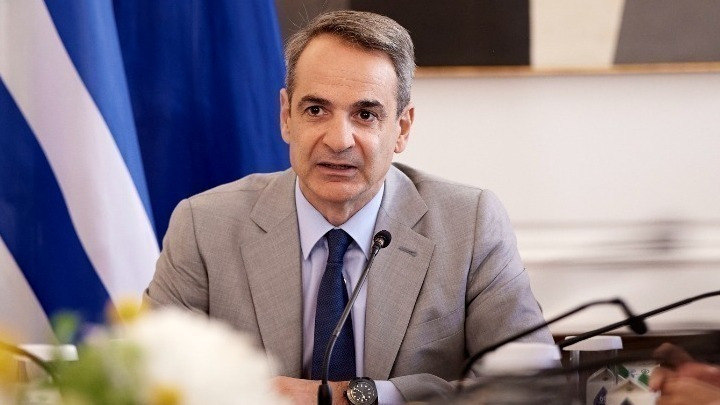
«If there is one true test of a government’s credibility, it is, without a doubt, its ability to turn commitments into tangible projects that improve the daily lives of the many. And that is exactly what the handover of the Kalambaka-Grevena section of the E65 highway, which we carried out this week, represents,» emphasizes Kyriakos Mitsotakis in his Sunday post featuring the weekly review of the government’s work.
«We’re talking about a 182-kilometer highway project that began nearly 20 years ago, weathered countless challenges, stalled during the years of the economic crisis, and was finally completed thanks to our persistent efforts to secure funding from the Recovery Fund. The E65 now effectively connects southern and northern Greece; it is part of the Trans-European Transport Networks, linking the Thessaloniki–Evzonoi highway with the Egnatia Highway and dramatically reduces travel times to Thessaly, Western Macedonia, and Epirus. »I am truly proud that this landmark project is being handed over to the public, joining the Patras-Pyrgos highway, which has been completed, and the VOAK, which is on track for completion,” the Prime Minister emphasized.
He also points out that projects such as the E65 demonstrate in practice just how much the Recovery Fund’s resources have helped us, and notes: «But the question is what happens from here on out. The answer, then, is the new National Development Program, with a total budget of 23 billion euros, financed exclusively from national resources, which constitutes the country’s central national development tool for the next five-year period, 2026–2030, in addition to the EU funds we are seeking for the period 2028–2034. Our goal is for these funds to reach every corner of Greece, financing critical needs—from roads, schools, and hospitals, to water supply projects, digital services, support for small and medium-sized enterprises, housing, and demographic issues. »This is our commitment: that the effort to improve everyday life will not end with the completion of the Recovery Fund.”.
Mr. Mitsotakis then refers to the events unfolding in the Middle East: «We know, however, that this daily life is often threatened by external upheavals. Unfortunately, developments in the Middle East are becoming increasingly alarming following the latest escalation of hostilities and the collapse of the ceasefire between the U.S. and Iran. No one can predict today where this crisis might lead, nor what its impact will be on international energy prices and, ultimately, on the cost of living. Our country cannot influence events taking place beyond its borders. However, we are striving to minimize their impact on our citizens as much as possible. A 10-lept reduction in the price of gasoline and a 5-lept reduction in the price of diesel—funded by the refineries—are already in effect. In addition, we have decided that the government will cover an additional reduction in the price of diesel for the entire month of August—another 10 leptes per liter—bringing the total discount to 15 leptes. This is a targeted intervention amounting to 30 million euros, aimed not only at supporting professionals and the transportation sector, but also to limit price increases that are passed on throughout the entire supply chain. Rest assured that, to the extent our economy allows, we are supporting and will continue to support society in the face of any external challenge—not with empty promises, but with actions.».
He then refers to a series of important measures concerning everyday life and social protection that were passed this week in Parliament.
«First and foremost, we have now officially rectified a long-standing injustice regarding widow’s pensions by repealing the cuts imposed by the Tsipras-Katrougalos law. As a result, 8,500 retirees will see their pensions double, 75,000 pensioners will continue to receive the 70% and will not owe the EFKA a single euro, the 122,000 retirees who receive two national pensions will no longer have one of them reduced, and any outstanding debts will be written off, and children who have lost both parents will now receive the full national pension. At the same time, as I mentioned earlier, we are establishing clear rules for electric scooters for the first time to protect young people on the roads, prohibiting their use by individuals under the age of 17, mandating insurance, and imposing stricter fines, while we are creating an Electronic Registry to ensure effective enforcement. Finally, four permanent policies for ’People with Disabilities« are now enshrined in law: the Personal Assistant program, Early Childhood Intervention for all children, structured education for people with visual impairments, and the new Home Accessibility Program, with 85 million euros secured annually. Together, we also voted on four major housing initiatives, creating 2,000 social housing units in decommissioned military camps, we are expanding the Demographic Development Program, and we are providing tax incentives for social housing and Supported Living Facilities.
On the housing issue, however, the National Strategy for Affordable Housing was approved this week. It is our roadmap for the next decade, with 50 measures and a budget of over 6.5 billion euros, aimed at building or renovating nearly 20,000 homes and more than 8,500 student housing units. I should also mention that 36 of the 50 measures are already included on the housing policy portal stegasi.gov.gr, while the remaining 14 are newly proposed measures. Our goal is to bring more properties onto the market, keep rents in check, and provide real relief for the incomes of our young and most vulnerable fellow citizens.
Also, as part of the same effort to provide practical support to families, applications for vouchers for daycare centers and KAPs have begun (until August 5 at the www.eetaa.gr). We are increasing funding to 393.5 million euros from 270 million in 2019, while the major change this year is that all children from large families will be enrolled in daycare centers without any income criteria.
On the transportation front, we now have some very good news for both Thessaloniki and Athens. In Thessaloniki, we’ve taken delivery of 50 brand-new electric articulated buses that will enter service in September, specifically to provide a connection to the airport, while in Athens, 125 new electric vehicles are already in service, and projects to upgrade fixed-track transit systems are underway. At the same time, a tender was announced for the complete upgrade and installation of air conditioning in first-generation metro trains, and the contract for improving accessibility at Kallithea Station has been signed. And because we want to make it easier for those considering switching to electric vehicles, we are increasing the budget for the «I Drive Electric III» program by 10 million euros and are extending the application deadline until the end of 2026.
Among the reforms that have been discussed for decades but never moved forward, I would single out the one that opens up Greek higher education to the world. This week, establishment and operating licenses were signed for seven more branches of international universities that will begin operating in the 2026–2027 academic year, following a rigorous evaluation and with the approval of the relevant independent authorities. Among them are leading universities such as Georgetown University, Iowa State University, Roger Williams University, the European University of Cyprus, as well as three institutions that were successfully re-evaluated. The next step is the accreditation of academic programs, so that every young man and woman can be confident that the program they choose meets the highest academic standards. This is a historic change that puts an end to a decades-long Greek peculiarity and creates more options for students, retains valuable human capital in the country, attracts international partnerships, and strengthens research and innovation. And I want to emphasize one more thing: the support for non-state, non-profit universities is not coming at the expense of public universities. On the contrary, it goes hand in hand with the largest investment in public universities in decades, with increased funding, new student housing, better infrastructure, and greater outreach. Because our goal is not to limit young people’s choices, but to expand them. I’d like to take this opportunity to wish every student who has been admitted to higher education following the announcement of this year’s cutoff scores the best of luck, and, at the same time, to those who did not achieve their goals, I want you to know this: nothing ends with this year’s exams; you have your whole life ahead of you to strive and achieve your dreams.».
He then goes on to discuss economic issues:
«Let me turn to the economy, where the development law that supports investment projects by Greek companies is now is moving full steam ahead, leaving the delays of the past firmly behind. We have unlocked over 134 million euros in tax breaks for 90 investment projects in tourism and manufacturing—an amount five times that of last year. This is a significant step forward for the real economy and growth, because liquidity for businesses means more investment and more well-paying jobs.«.
Mr. Mitsotakis also emphasizes that, in the area of national defense, «we are moving forward with one of the most substantial reinforcements of the Armed Forces in recent years.» He adds: «The Supreme Defense Council approved 10 new defense procurement programs totaling over 4 billion euros, spearheaded by «Achilles» Shield,» an integrated command and control system designed to counter any threat. What is important is that the Greek defense industry is actively participating with 700 million euros, while 8 of the 10 new special operations submersibles will be built here in Skaramagas. The program also includes new Embraer transport aircraft and the modernization of the four MEKO frigates. And because the strength of the Armed Forces lies in its people, we are investing in our human resources by sending officers to pursue master’s degrees in the U.S., specializing in artificial intelligence and autonomous systems.”.
In closing, the prime minister addresses cultural issues:
«Three very important monuments in Epirus—the Kaloutsiani Mosque, the Ottoman Baths at the Ioannina Castle, and the Castle of Kiafa in Souli, have been restored by the Ministry of Culture and handed over to the local community by the President of the Republic. These projects breathe new life into the region’s history and revitalize these sites, as part of our effort to protect and showcase our cultural heritage in every corner of Greece. It’s the last Sunday in July, and if you’ve made it to the end of this recap today, I truly thank you for your time. Good morning!».
N. Armenis