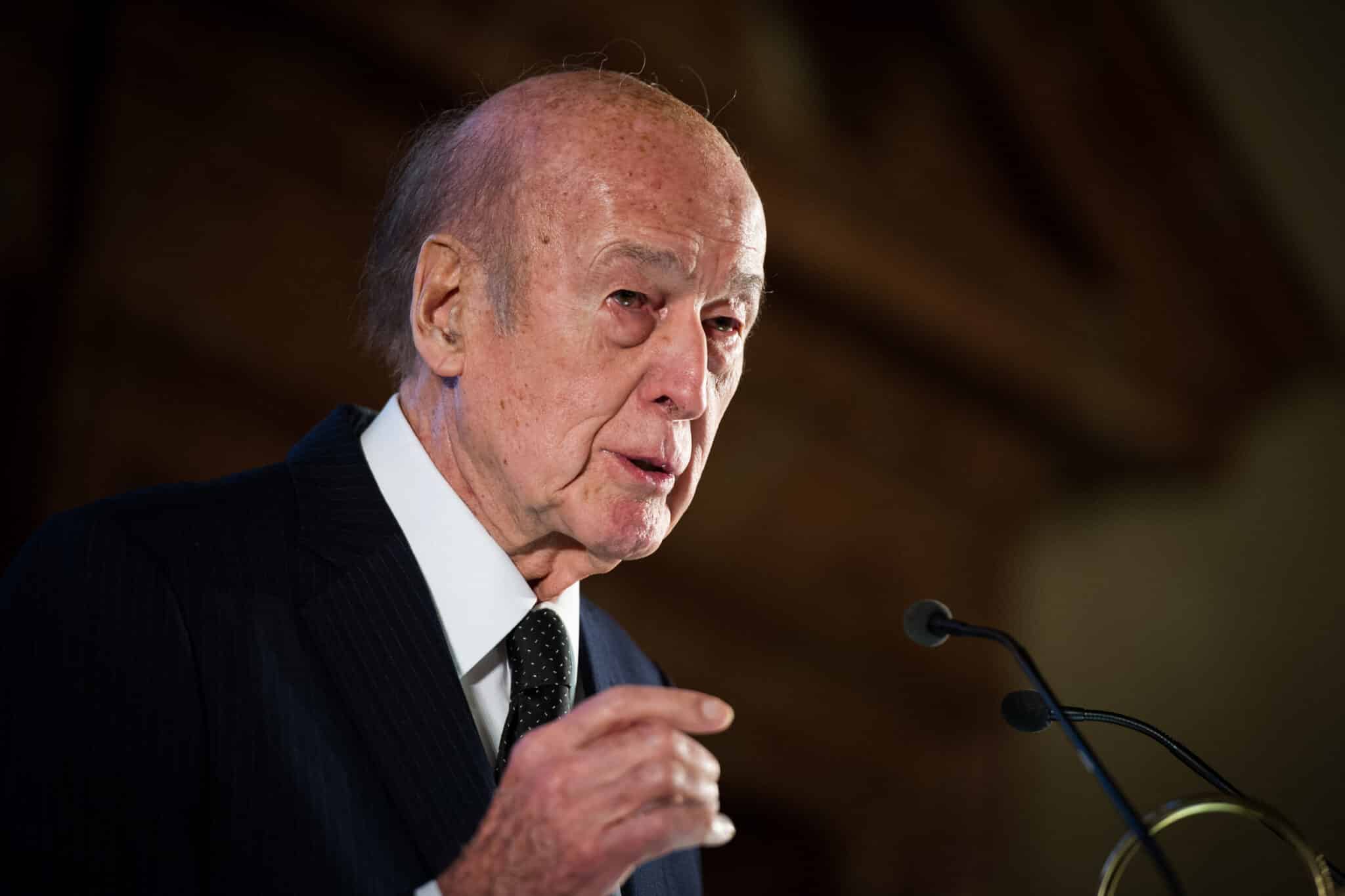
Former French President Valéry Giscard d'Estaing has died at the age of 94, according to sources close to him.
D'Estaing, who was born in 1926 in Koblenz, Germany, and was elected to the French supreme office in 1974, had recently been admitted to a hospital in the city of Tours in western France.
During his presidency (1974-81), he promoted the modernisation of French society, implementing consensual divorce and legalising abortion, and was one of the architects of European integration.
The French politician was particularly beloved in Greece not only because he was a well-known philhellene, but also for his contribution to the restoration and support of democracy in the country after the difficult years of the Junta of the Colonels, while his interventions against the regime were frequent during the seven years 1967-74.
The biography of the French politician according to Wikipedia
He was born in 1926 in Koblenz, Germany, where his father served as financial director of the French occupation authorities after the First World War. The d'Estaing family came from the south-central region of Auvergne with their own tower in Chameliers. He graduated from the Lycée Janson de Salley in Paris. During his youth he served in the armoured forces of the Army of Free France. After studying at the Grande Ecole - ENA, he finished the Polytechnic School, graduating sixth in the series, he was appointed Financial Inspector. With the Independent Republican Party, he was elected to the French National Assembly. In 1959 he was appointed Deputy Minister of Finance and three years later Minister of Finance of France at the age of 36 and went down in history as the youngest French Minister of Finance. He clashed with the Orthodox Gauls on issues of European Union private initiative, and closer ties with the U.S.A. That is why he was dismissed by De Gaulle. From 1974 to 1981 he served as President of the French Republic, pursuing a centre-right policy. During his tenure in high office, France was consolidated as the second economic power in Europe and fourth in the world. Like Charles de Gaulle, he promoted closer Franco-German relations but, unlike de Gaulle, he supported Britain's membership of the (then) EEC. In 1981 he lost the election to François Mitterrand, while Jacques Chirac, his former prime minister, broke the unity of the conservative party by turning against him. After a difficult period, he has recently begun to regain the influence he used to wield and has proposed the direct election of the President of the European Community, in the hope of being elevated to that office.
Personal Life
On 17 December 1952 he married Anne Aemon de Brandes of the large family of steel manufacturers.
In the last months of his life he was hospitalized with respiratory problems. He died at the age of 94 on 2 December 2020