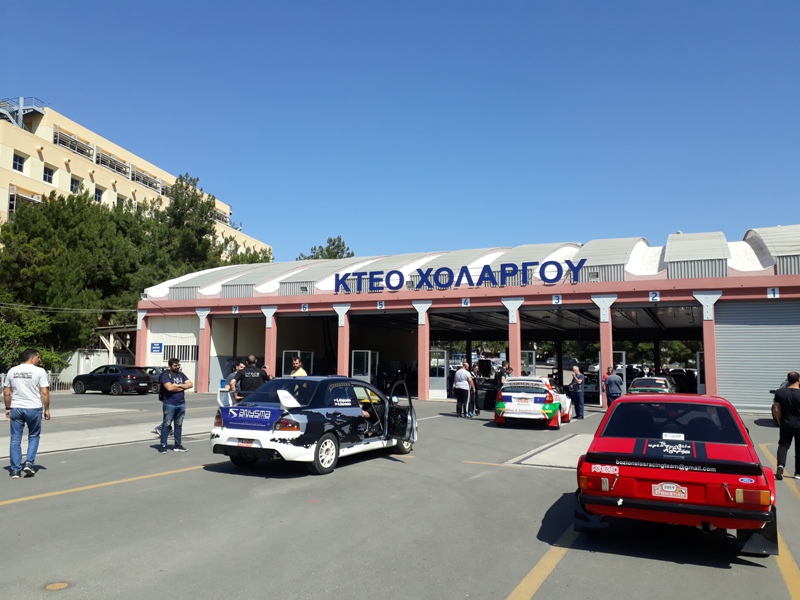
The Ministry of Transport is promoting the tightening of vehicle and two-wheeler inspections at MOTs, launching a series of changes to the Computerised System of Vehicle Inspection Centres.
Among other things, the system will send to the Ministry's register, in real time, the data of vehicles and checks, while these will now include photos of the inspection process at each stage, as well as statistics of checks, deficiencies and results per vehicle, per day, per owner and per employee of the MOT.
What is changing
In particular, with the new measures the Computerized System of MOTs will immediately transmit to the Ministry of Transport the data of the controls (directly and without the intervention of an intermediate device) from each automatic control line of vehicles.
In the case of visual checks (without machines), the input of the results will be done by the auditor. The system will record the date, start and end time of each technical inspection carried out, as well as the serial number of the vehicle presented on that day.
The start time of the technical inspection of a vehicle is defined as the time of taking the first photograph of the vehicle and the end time of the inspection is defined as the time of printing the certificate issued (Technical Inspection Bulletin, Exhaust Gas Control Card).
The system will also record the code number of each inspector employed by the MOT, corresponding to his certificate as issued by the Directorate of Supervision and Control.
Photos
For the new control mode, the photographic material will be crucial. In fact, it is foreseen that all the control lines of light, heavy and two-wheeled - three-wheeled - four-wheeled vehicles of the MOTs will be equipped with colour digital cameras, with a system of protection against external interference (change of field of view, direction) and connected to the computerised system of the MOT. In particular, the system will be operated using fixed and portable cameras, which will also take pictures in the inspection pits of the control lines or on the lifts, where the condition of the vehicle's tyres will be clearly visible.
The photos sent to the corresponding system of the Ministry should include the number of the MOT, the registration number of the vehicle, the photo number, the date and time the photo was taken. In the case of an «unregistered» vehicle, the vehicle's chassis number will be given in full instead of the registration number.
At the same time, the system puts in the frame - in addition to those responsible to the law - and those responsible for the companies that install the computerised systems in the MOTs, so that the system operates in the most complete way possible, producing valid results without altering the measurements. To this end, penalties for «broken» computerised systems will be provided for all those involved.
Vehicle inspections after 1 year;
In the meantime, the Ministry of Transport is still considering reducing the time for re-inspection of vehicles to one year, from the current two years, at least for those vehicles over 10 or 15 years old. This is not the first time that this measure has been considered, as the country has exhausted the relevant deadlines in European legislation for both the first inspection and the re-inspections, but so far no decision has been taken.
It is recalled that in Greece the first MOT inspection of a new car is carried out after 4 years of registration, while thereafter the vehicle is subject to an inspection every two years.
Today, it is common knowledge that hundreds of thousands of owners have not visited an MOT for many more years. In absolute terms, it is estimated that around 1.8 million vehicles, of which around 600,000 - 700,000 are two-wheelers, are overdue for inspections, while in total it is estimated that 4 out of 10 vehicles are never checked by MOTs.
Few rejections
However, this is not the only problem, and of the vehicles that come in for inspection, only 4.5% are cut off, according to data from the Department of Transport. At the same time in Germany, which has a much younger car fleet compared to Greece, 35.5% of cars brought in for inspection are rejected by the country's MOTs.
According to data from the Panhellenic Association of Private MOTs, about 45% to 50% of the vehicles checked, there are technical deficiencies, but of various grades. There are the dangerous deficiencies, i.e., when a vehicle is in «red» and must be taken out of circulation. There are the serious deficiencies, which the owner can repair and return for a re-inspection in a month, and a host of other notes of lesser importance that the MOT can record. For a vehicle to be taken out of circulation it must be completely damaged. However, these vehicles never make it to the MOT!
Printed version «TA NEA»