What were the customs, traditions, and beliefs of the people of the plains in western Thessaly on Holy Thursday? Vasiliki Koziou-Kolofotia, a local history researcher, author, folklorist, and educator, answers this question.
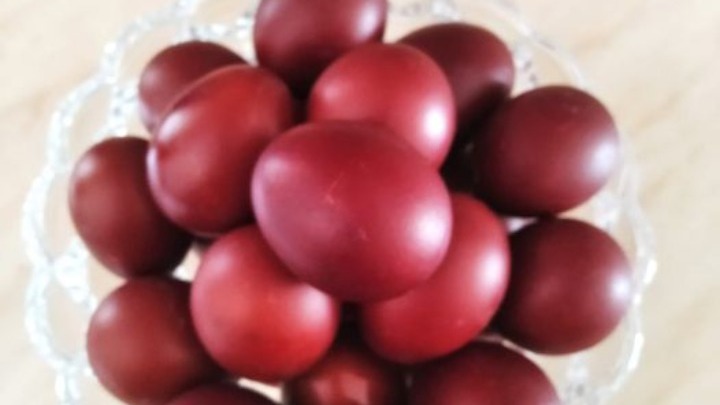
On the morning of Holy Thursday, the researcher tells the Athens-Macedonian News Agency (ANA-MPA), housewives are busy dyeing eggs. She describes two of the recipes recorded in Kerasia and Krania, Karditsa. Dyeing eggs with rice water or onion skins—which are very simple recipes—is a tradition she explains and recommends to all housewives.
Dyeing Eggs with Onion Skins
In a large pot of lukewarm water, add the onion leaves and vinegar, and boil them for about three-quarters of an hour to an hour. Then remove the pot from the heat, cover it with the lid, and let it sit for 8–10 hours to allow the color to develop fully. Next, drain the water and use a wooden spoon to transfer the eggs into the pot, after first washing them thoroughly and drying them with a towel. The eggs should be at room temperature. Boil them for a quarter of an hour, making sure they are completely covered by the water. Then, using a wooden spoon, remove them and place them on a clean towel or paper towel. Next, rub them with a soft cloth or a little cotton to make them shine.
Also, according to her: a) For 30 eggs, you’ll need about three handfuls of onion leaves and 100 grams of vinegar. b) The eggs should preferably be reddish. c) The resulting color is a dark red, almost brick-red. You can dye just as many eggs in the same water, though they’ll come out a little darker.
Dyeing Eggs with Rice Husk Tea
In a wooden container or basin, we chop up roots of rizari (an annual plant that grows in the mountains) and lapata (a type of vegetable), and let them sit for two or three days to release their color. On Holy Thursday, we boil the soaked mixture for two hours to extract the color. Then we strain it and place the eggs in the water, using a wooden spoon to ensure they are well submerged. After a quarter of an hour, remove them from the pot and place them on a cloth or paper towel. Next, using a soft cloth or cotton pad lightly coated with oil, rub them with oil to give them a shine.
In the past, the researcher points out, the root of the plant and the leaves were also grown in gardens. Using the root of the madder plant, our ancestors dyed not only eggs but also the skirts they wore, as well as their bedspreads and mattress pads. The threads of these fabrics were dyed indelibly. When the karagounes were to be dyed with indigo, they were first soaked in the water extracted from the lapata and the root of the plant, and then dyed with indigo.
Also, on the morning of Holy Thursday, during the Divine Liturgy at St. Basil’s, according to the researcher from Karditsa, women would bring two p’taria (offerings) to church—one for the priest and one for their home—which they would take back and distribute among their family members. They also brought wheat, pieces of bread, and distributed all of these to the congregation for the souls of the deceased. After church, they would go to the graves of the deceased, where they would light candles and place red eggs. On the evening of Holy Thursday, Christians would go to listen to the twelve Gospels and venerate the Crucified Christ, who was taken down from the sanctuary and placed in the center of the church, where everyone would pass by and pay their respects. Many young girls would make wreaths and place them at the feet and hands of Christ or on the cross. Many women made handmade wax wreaths as tall as their children and used them to encircle the body of Christ. Others, in turn, made several meters of wax cord and used it to encircle the church. This was done on special occasions, if they had made a vow for a sick loved one. After the service, the girls and women would decorate the epitaph, and many of them, along with their young children, would sit on their mats and keep vigil over Christ all night, singing dirges.
Speaking to the Athens-Macedonian News Agency (ANA-MPA), Vasiliki Koziou-Kolofotia emphasizes: «My first sources of information were my immediate family: my grandmother, my parents, and my relatives; then the wider community of my village; and finally, the prefecture of Karditsa. All of this material served me well in my career as a teacher and later as an active member of various cultural associations.» And she concludes by emphasizing: «Today, as globalization begins to erode all those elements that define our national identity, there is an urgent need to preserve and highlight our rich cultural heritage. In this way, we are building a bulwark to preserve our nation’s timeless values and the precious elements of our folk culture.’.
Apostolis Zois