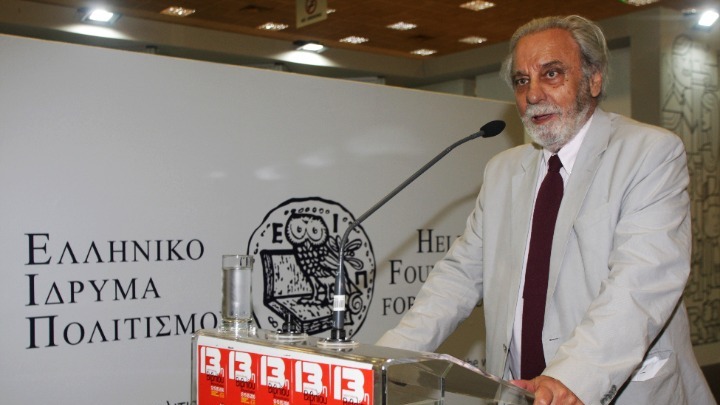
Scholar Konstantinos Tsoukalas has died at the age of 89, leaving behind an invaluable legacy. The distinguished sociologist and university professor taught at Greek, American, French, and Mexican universities, and had served, among other roles, as president of the National Center for Social Research and as a member of the Hellenic Parliament representing SYRIZA.
Konstantinos Tsoukalas was born in Athens in 1937 to a family with roots in law and politics. After graduating from the Law School of the University of Athens, he pursued graduate studies in the Philosophy of Law and Sociology at the Universities of Heidelberg and Munich in Germany, the University of Paris in France, and Yale University in the United States. He was an emeritus professor at the University of Athens.
In 1974, he was awarded a doctorate in Letters and the Humanities from the University of Paris. From 1961 to 1968, he practiced law in Athens. He worked as a researcher at the Athens Center for Social Research (1963–1967) and at the French National Center for Scientific Research (CNRS, 1968). From 1968–1985, he was a full professor of sociology at the University of Paris, and from 1985 onward, he served as a full professor of sociology in the Department of Political Science at theUniversity of Athens. At the same time, from 1981 to 1989, he served as scientific director at the National Center for Social Research (EKKE).
In 1993, he was appointed chairman of the Board of Directors of the Hellenic Center for Economic Research (EKKE), a position he held until 1996. He had also served as president of the Hellenic Sociological Association, as a member of the Supreme Council for Research and Technology, and as a visiting professor at the Universities of Paris, Princeton, New York, and Mexico City, as well as in the Department of Economics at the University of Athens, head of the Greek delegation to the United Nations Summit on Social Development (1994–1996) and a member of the Board of Directors of the Hellenic Culture Foundation. He also served as chairman of the Board of Directors of the National Museum of Contemporary Art, a member of the Board of Directors of the Cultural Olympiad, a member of the National Bioethics Committee, and a member of the research council of the Olympic Museum in Lausanne, Switzerland. From 2000 to 2014, he was a regular member of the National Bioethics Committee.
In 2025, he was elected a full member of the Academy of Athens.
Konstantinos Tsoukalas had participated as a speaker and panelist at conferences held at various universities in Europe, the United States, and Australia. He had served as president of foundations, committees, companies, and museums, and had been honored with awards for his contributions to the sciences and the arts. His major works included: *The Greek Tragedy*, Harmondsworth Penguin (1969); *Icons of Civilization: Liberty, Equality, and Fraternity in the Modern State*. Athens, Themelio (1982); War and Peace After the End of History, Athens, Kastaniotis Publications (2006), and *Age of Anxiety*, London, Eris (2018). His most recent work was *The Greek Revolution: A Critical Dictionary*. Edited by Paschalis M. Kitromilidis and Constantinos Tsoukalas, Cambridge, MA: Harvard University Press (2021).
Statement by the Academy of Athens on the Passing of Konstantinos Tsoukalas
With «deepest sorrow and profound emotion,» the Academy of Athens, as stated in its announcement, «has learned of the passing of Konstantinos Tsoukalas, a member of the Academy and a distinguished scholar in the fields of sociology and social theory.».
«Konstantinos Tsoukalas was elected a full member of the Academy of Athens in 2025, in the ‘Sociology–Social Theory’ chair, in the Third Class of Moral and Social Sciences. The full members, as well as the research and administrative staff of the Academy, express their sincere condolences to his family and colleagues. Konstantinos Tsoukalas was a great thinker and an iconic figure in the field of Social Sciences. He passes into eternity as a prominent social philosopher who left a valuable legacy to the Greek and international communities through his multifaceted academic work, his incisive critical perspective, and his decisive contribution as an active citizen, substantially strengthening civil society. The void he leaves behind at the Academy of Athens and in the scientific community at large is irreplaceable.
»The Academy of Athens will fly its flag at half-mast at its headquarters for three days starting today," the country's leading intellectual institution states, among other things, in its announcement.