Glory to your first soul and mind, Ares
Your first captain and worthy leader
Which, being all gone, the first sword was raised
against the enemy and against the traitor.
Kostas Varnalis, “Leventomana Rumeli”, 1944
In mid-October ’44 Lamia was still under German occupation. But the hour of liberation was not far away.At night, explosions of ammunition could be heard as the Germans, preparing to retreat, blew them up to prevent them from falling into the hands of the people's army. ELAS Rumeli continued to fight against Hitler's troops and liberate towns and villages. On the morning of October 17, just one day before the liberation of Lamia, a group of the ELAS XII Division clashed with the Germans at Megali Vrisi (Damaria position) where nine ELAS fighters were killed: Athanasios Psomas (Lamia), Dimitrios Varsos (Lamia), Elias Devesiadis (Lamia), Thomas Papadimitriou (Stylida), Ioannis Giannoutsos (Stylida), Giorgos Manolopoulos (Lamia), Ioannis Panoutsos (Lamia), Ginavas (Lamia) and Thanasis Psomas who was seriously injured and later succumbed to his wounds (Lamiakos Typos, Tuesday 18 October, p.4). In the afternoon a group of NS-EES entered Lamia and saw on the railway line two young fellow citizens, Argyris Daitsiotis and Kostas Gaitanis. They chased them, caught Kostas Gaitanis and executed him on the spot just before the bells of liberation rang.
On the evening of 18 October, the last German soldiers leave Lamia under the hammering of the units of the XII Division, which at dawn enter Lamia, liberators. The city was first entered by the regiment of Thymios Zoulas with the captain of ELAN Sotiris Begnis, but almost simultaneously from the other entrance of the city the division of Nikiforos (Dimitris Demetriou) with the captain-Atromitos (Dimitris Kaperonis) was entering from the other entrance of the city. On 19 October the III battalion of the 42nd regiment of Photi Vermaios (Phoebus Grigoriadis) with his captain Pericles (George Houliaras) and the 36th regiment of the XII Division from Amfissa arrived in Lamia (Papakogkas K., &Kataridis N., 2006:21).
Leaving in a panic, the Germans left the huge food warehouses intact. But they had attempted to subvert attempts to blow up ammunition depots in the Old Barracks complex. The Austrian locksmith Joseph Blehiger (Elias Kokkinos) working on the railway together with an Italian (Kostas Desimone) revealed to the ELAS reserve the location of the detonation devices and a successful operation was successfully organised to neutralise them, saving the city from being blown up. Only a few explosives escaped in the northern part of Chaltaki so some small explosions were heard in the city (LT.14441/18.10.90). The two antifascists who helped in the operation then left with the ELAS guerrillas. After liberation they remained in Lamia and lived in our city.
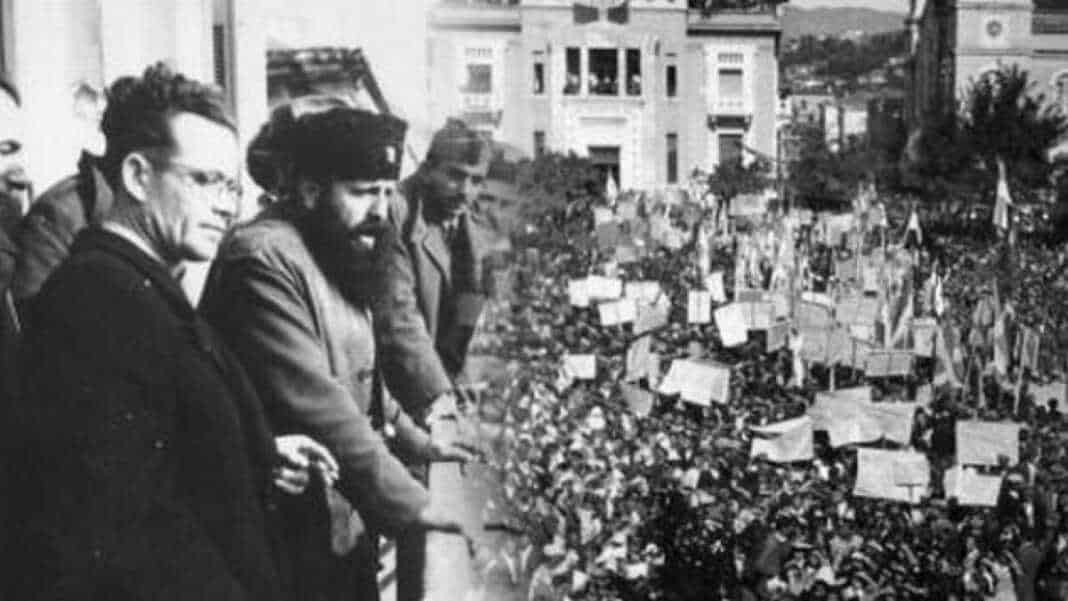
The city of Lamia became the centre of the whole of Greece in the following days. On October 19, the first representatives of the PEEA and EAM, a delegation of the KKE KKE and the General Committee of the KKE arrived in free Lamia. The KKE and the ELAS General Headquarters came to the KKE, along with the KKE and the ELAS General Headquarters. On Sunday 29 October, a solemn meeting of the EAM took place in Lamia on the occasion of the anniversary of «OXI». At this meeting Aris delivered the famous Speech of Lamia.
The triumphant reception of Aris in Lamia
Ares Velouchiotis, who was in the Peloponnese by order of the General Headquarters of ELAS, having now driven the conquerors from the Moria and having crushed the traitorous security battalions, passes to the opposite Rumeli in the direction of Lamia. On the way back he continues to pursue the retreating Germans, with obvious regret for the turn the leadership had taken in the development of the national liberation movement with the agreements of Lebanon and Caserta signed by the leadership and culminating in the ban on ELAS entering Athens, but equally firm in his decision to continue his struggle against the threat of a new national social slavery. For Aris, in contrast to the leadership of the movement, which, trapped in the government of national unity, was blind to the fact that the continuous concessions to the British and the local reaction, put in serious danger the popular sovereignty that the Greek people had conquered with effort and sacrifice (Chatzipanagiotou Yannis, Kapetan-Thomas, 1975:479).
On 14 October via Itea Aris arrives in Amfissa where he receives a triumphant welcome. There is a part of the 42 ELAS of Fotis Vermaios with his fellow citizen George Houliaras-Pericles as captain. With emotion the two fighters remember that together they started the first guerrilla groups in the mountains of Roumeli and now they are returning to their hometown liberators. Aris proceeds with his escort, which is completed by the presence of Pericles. The 42nd ELAS division and other divisions are making way by striking the Germans at Bralo and Dadi who are retreating leaving behind much booty. They make a stop in Topolia the village of Tzavela, to greet his fellow villagers and in the evening they slept in Gravia. The next day they proceeded along the old national road and arrived at Spercheio. As George Houliaras-Pericles recounts, «The bridge was blown up and sunk in the river. We wanted to cross into the river which was down but the horses were stuck. We brought passers-by from Moscochori with their own horses, but they too resisted going on. So we bypassed and crossed the river above, at the iron bridge near the Fraszomilo, and then we took the public road again.».
Aris Velouchiotis with the Mavroskoufides and among them Father Anipomonos, the later abbot of the Agathon Monastery, arrived at dusk on October 20 in his hometown Lamia, where the people welcomed them as liberators. The triumphant scene of the reception of Mars in Lamia is mentioned in many bibliographies (George Houliaras-Pericles (2006), Germanos K. Dimakos (2004), Lagdas Panos, Papakogkas K. & Kataridis N., (2006), Hadjipanagiotou, Yannis, (1975).
He is also quoted in an article in the local newspaper Roumeli with the following words. Ares, riding on his horse, with the black-skinned escort, entered the city of his birth. The welcome he received is beyond the possibilities of a description. From one end of the city to the other the regiments of the XIIth lined up to greet their leader. The rebels, carried away by the excitement, greeted him with cheers and gunfire. The thousands of the people cheered him. Flowers rained down on him. They crown him with wreaths of laurel and myrtle.
Ο George-Houliaras-Pericles in his memoirs, describes the reception of Aris and his escort in Lamia with the following words:
Outside Lamia, from Abliani and up to the entrance of the city, the people who were gathered on the right and left of the road started cheering and applauding at our appearance. Suddenly some 20 or so young people, and others behind them, jumped into the middle of the road and threw themselves on top of us, some grabbing the horses’ reins in front and others jumping to grab our hands to greet us. The horses went wild, they started to jump. We dismounted and walked on foot, Ares in front, Ares in front, to the right and left me and Papa Sleepyhead, and the Blackshirts following behind. At the entrance to the town, where the tax post used to be near the railway tracks, thousands of people were waiting for us, who greeted us with wild enthusiasm, and while the guerrilla section was presenting weapons and Papa-Thymios Zoulas was giving a report, all those people in one voice began to sing ’Forward ELAS for Greece’. What happened from here to Eleftherias Square cannot be described. The assembled crowd to the right and left of the road, on our passage cheered and showered us with [ ] and flowers while many partisans excited by what they saw began to shoot. And by the time we reached Liberty Square, many times on their way they broke the line of the guerrillas; elsewhere women to lay carpets in the street and elsewhere children and girls to pass wreaths around our necks so that Nikephoros could hand over the key to the city to Ares.
(The road is unsaved... Chouliaras George - Pericles, 2006:477-478).
Then Aris and his escort went to Makropoulos« house in Diakou Square, where the offices of EAM were located.There he was greeted with emotion by his parents Dimitrios and Aglaia Clara and his brother Pericles, a lawyer who helped with his scientific knowledge in the drafting of the Code of Popular Self-Government and Justice that the Government of Vounos applied in free Greece. There, waiting for him with obvious emotion, was the veteran communist and fellow fighter Takis Fitsos. Outside in the square and the surrounding streets a crowd had gathered, cheering, singing and shouting rhythmically, »We need a reason, we need a reason«. George Houliaras, at Aris's suggestion, came out to reassure them and tell them that Aris promised to speak once and for all on Sunday 29 October at the Panfthiotiki festive gathering that EAM was preparing in Lamia on the occasion of the anniversary of »OXI". So it happened, Pericles recounts, and the people quietly dispersed.
Edited by Hara Parmenopoulou
Bibliography
Germanos, K. Dimakos, Archimandrite, 2004, On the mountain with the Cross, near Mars, Trikala - Athens, Standard Thessalian Publications.
Glazos, Manolis, 2006, National Resistance 1940-45,
Zoidis, G., Kaila, M et al, 1979, History of the National Resistance 1940-45, Synchroni Epochi, Athens.
Lagdas, Panos, Aris Velouchiotis, the First of the Struggle, published by Sfaelos N., Athens
Papakogkas K., Kataridis N., 2006, Aris in Lamia, published by FILISTOR, Athens
Farakos, Grigoris, 1997, ARIS BELOUCHIOTIS-The Lost Archive- Unknown Texts. Athens, 2nd edition «Hellenic Letters».
Hadjipanagiotou, Yannis (Captain Thomas), 1975, The political will of Aris Velouhiotis, Dorikos, Athens
Hatzis, Thanasis, 1982, The Victorious Revolution that was lost (national liberation struggle 41-45), 2nd edition, Exantas, Athens
Chouliaras George-Pericles, 2006, «The road is unsaved...», Lamia, Oionos
Lamiakos Typos, No 14441, 18. October 1990
Lamiakos Typos, Tuesday 18 October p.4 (PEAEA archives).