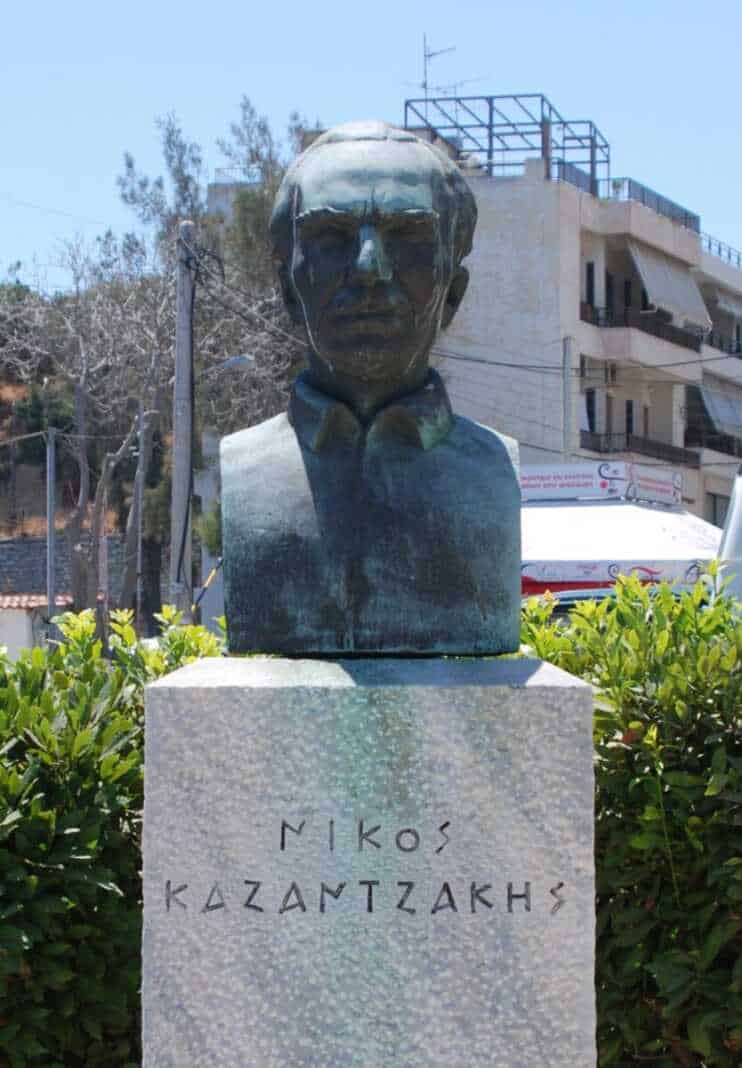
Nikos Kazantzakis was born in Heraklion, Crete, the eldest son of merchant and landowner Michalis Kazantzakis. He had two brothers and a sister who died in infancy. He spent his childhood and school years in Heraklion until 1902, when he graduated from high school, with brief periods spent in Piraeus (in 1889—the start of the Cretan Revolution—for six months) and Naxos (1897–1899—Kazantzakis attended the French Commercial School there).
In 1902, he left for Athens and enrolled in law school, from which he graduated in 1906 with honors. In 1906, his first writings were published in the magazine Pinakothiki under the pseudonym Karma Nirvani, under which he also published his first book, *Ophis and Krino*, dedicated to Galatea Alexiou. The following year, he left to study law in Paris, where he also took philosophy courses with Henri Bergson. From 1907 to 1909, he wrote his first plays (including *Dawn* [honored at the Pantelidis Drama Competition], *Fasga*, *The Master Builder* [award at the Lassaneio Drama Competition]), the novel *Broken Souls*, as well as studies and essays, all published in periodicals of the time (*Numás*, *Panathinaia*).
In 1909, he published his doctoral dissertation, titled *Friedrich Nietzsche on the Philosophy of Law and the State*, in Heraklion. In 1910, he settled in Athens with Galatea, whom he married the following year in Heraklion, and took part in the founding of the Educational Society. Until 1915, he worked on translating the works of Bergson, Plato, Nietzsche, Büchner, Darwin, and others; he volunteered for military service in the Balkan Wars and served in Venizelos’s office; he wrote five readers for elementary school with Galatea Alexiou (who also signed them), and met Angelos Sikelianos, with whom he traveled to Mount Athos.
In the summer of 1907, he tried unsuccessfully to develop a lignite mine in Mani together with the miner Giorgis Zorbas, and in the fall he traveled to Switzerland, where he had a romantic relationship with Eleni Lambridou. In 1919, in his capacity as general director of the Ministry of Welfare, he took action to support the repatriation of Greeks from the Caucasus and met with Eleftherios Venizelos in Paris. Over the next three years, he traveled throughout Europe and Greece. He participated in the Congress of Educational Reformers in Berlin and the Congress on Sexual Pedagogy in Dresden, studied the works of Freud, met Leo Sestov, and wrote *Asceticism*. In 1924, on his way back to Greece, he traveled through Italy and met Eleni Samiou in Athens.
From October 1925 to February 1926, he stayed in Russia as a correspondent for the newspaper *Eleftheros Logos*. This was followed by two more trips to Russia: one in late 1927 at the invitation of the Soviet government, and another from April 1928 through April 1929, and in his capacity as a journalist, he also visited Italy and Spain (1926, 1932–1933, 1936–1937, 1950), Egypt, and the Sinai (1927). In 1926, he divorced Galatea and traveled with Eleni to Palestine and Cyprus. That same year, he published the first excerpt from *The Odyssey* in the magazine *Anagennisi*; he completed the first draft in 1927 on Aegina and published it only in December 1938, after a total of seven drafts. In 1928, he was prosecuted for organizing a rally in support of the Soviet Union together with the Greek-Romanian writer Panait Istrati at the Ala, and during his summer trip to Russia he continued to write. That same year, he became known in France through an article by Istrati in the magazine *Monde*. Kazantzakis’s relationship with Istrati ended in December of that same year in the Soviet Union.
He continued to travel with Eleni to Germany, Czechoslovakia, France, Spain, Japan, China, and England, with stops along the way in Aegina (1943–1944) and Athens (1945—he founded the Socialist Workers’ Union, ran for election to the Academy of Athens, served as a minister without portfolio in the Sofoulis government, and married Eleni), and in 1946 he settled in France, initially in Paris (as a literary advisor at UNESCO headquarters) and then in Antibes, from where he traveled throughout Europe. That same year, he was nominated for the Nobel Prize in Literature alongside Angelos Sikelianos.
Between 1928 and 1944, he published, among other works, *Tonda Ramba*, *A History of Russian Literature*, *Tertines*, a translation of Dante’s *Divine Comedy* and one of Goethe’s *Faust, Part I*, *The Rock Garden*, the tragedy *Melissa*, as well as memoirs of his travels. In France, he wrote *The Fratericides* and *Captain Michalis*, and in 1953 he completed the novel *Christ Is Crucified Again*, which provoked reactions from the Greek Orthodox Church and the Vatican. That same year, he was hospitalized in Paris due to a lymphatic disorder. In 1954, the novel *The Life and Times of Alexis Zorbas* was awarded the prize for best foreign-language book in France. In 1955, he traveled to Alsace and met with Albert Schweitzer in Lugano. There, he began writing *Report to Greco*, which was published posthumously.
In the summer of 1956, Manos Katrakis’s Greek People’s Theater successfully staged the theatrical adaptation of *Christ Is Crucified Again*, and in 1957, the film— film by Jules Dassin, *The Man Who Must Die*, which was also based on the same play. Kazantzakis was present at the premiere. That summer he traveled to China, and on his return via Japan, he received a vaccination that resulted in him contracting gangrene. He was initially hospitalized in Copenhagen and then in Freiburg, where he contracted the Asian flu and died on October 26, 1957, at the age of seventy-four. His remains were transported to Heraklion and buried in Tapia Martinego, near the city’s Venetian castle.
A rare audiovisual clip from an interview Nikos Kazantzakis gave for French television.
The interview took place on May 22, 1957—a few months before the death of the great Greek writer—with two men of letters and journalists, Pierre Dumayet and Max-Pol Fouchet. The interview focused on two of Kazantzakis’s books, *Zorba* and *God’s Little Poor Man*, the latter being his most recent work…
Bibliography
(first standalone editions)
I. Prose
• Karma Nirvani, *Ophis and Krino*. Athens, 1906.
• Tonda Ramba. Athens: Difros, 1956. (Translated from the French by Yannis Maglis)
• *Le jardin des Rochers*. 1939. (Also translated by Pantelis Prevelakis under the title *O Vrachokipos*. Athens: Estia, 1960.).
• *The Life and Times of Alexis Zorbas*. Athens: Dimitrakos, 1946.
• Christ Is Crucified Again. Athens: Difros, 1954.
• The Brothers. Athens, 1963.
• Captain Michalis. Athens: Mavridis, 1953.
• The Last Temptation. Athens: Difros, 1955.
• God’s Poor Little One. Athens: Difros, 1957.
• A Study of El Greco. Athens, n.d., 1961.
II. Essays
• Friedrich Nietzsche on the Philosophy of Law and the State. Heraklion, St. M. Alexiou, 1909.
• H. Bergson. Athens: Maisner and Kargadouri Press, 1912.
• Salvatores Dei; Asceticism. Athens, 1927.
• History of Russian Literature, Vol. I. Athens: Eleftheroudakis, 1930.
• History of Russian Literature, Vol. 2. Athens: Eleftheroudakis, 1930.
• Symposium. Athens: Eleni Kazantzakis, 1971.
III. Theater
• Petros Psiloritis, *The Master Builder*. Athens: Panathinaios Publications, 1910.
• Nikiforos Fokas. Athens: Stochastis, 1927.
• Christ. Athens: Stochastis, 1928.
• Odysseus. Athens: Stochastis, 1928.
• Nikiforos Fokas. Athens: Pyrsos, 1939.
• Melissa. Athens, 1939. (reprint from *Nea Estia*)
• Julian. Athens: The Penguin, 1945.
• Kapodistrias. Athens: Nik. Alikiotis, 1946.
• Sodom and Gomorrah. Athens, 1949. (reprint by Nea Estia)
IV. Travel Literature
• What I Saw in Russia, Vol. I. Athens: Stochastis, 1928.
• What I Saw in Russia, Vol. 2–3. Athens: Stochastis, 1928.
• Traveling, Vol. 1 · Spain. Athens: Pyrsos, 1956.
• Traveling, Vol. II: Japan – China. Athens: Pyrsos, 1938.
• Traveling, Vol. 3: England. Athens: Pyrsos, 1941.
• Traveling: Spain, Italy, Egypt, Sinai. Alexandria, published by the Serapeion Bookstore, 1927.
• Traveling: Italy, Egypt, Sinai, Jerusalem, Cyprus. Athens: O Morias, 1961.
V. Poetry
• The Odyssey. Athens: Pyrsos, 1938.
• Tertines. Athens, 1960.
VI. Correspondence
• Letters to Galatea. Athens: Difros, 1958.
• Four Hundred Letters from Kazantzakis to Prevelakis. Athens: Eleni Kazantzakis, 1984.
• Unpublished Letters by Kazantzakis · From His Youth to His Mature Years (1902–1956); With a foreword and commentary by Minas Dimakis. Athens: Published by the Nikos Kazantzakis Museum, 1979.
• The Chronicle of a Creation: Unpublished Correspondence Between Kazantzakis and Martinou; Edited by Giorgos Anemogiannis. Barbarians of Crete, published by the Nikos Kazantzakis Museum, 1986.
VII. Children's Literature
• Alexander the Great. Athens: Eleni Kazantzakis, 1979.
• In the Palaces of Knossos. Athens: Eleni Kazantzakis, 1981.
VIII. Translations
• William James, *The Theory of Emotion*. Athens: Fexis, 1911.
• Friedrich Nietzsche, The Birth of Tragedy. Athens: Fexis, 1912.
• Friedrich Nietzsche, Thus Spoke Zarathustra. Athens: Fexis, 1913.
• T.P. Eckermann, *Eckermann’s Conversations with Goethe*. Athens: Fexis, 1913.
• C.A. Laisant, Education Based on Science. Athens: Fexis, 1913.
• M. Meiterlig, *The Treasure of the Humble*. Athens: Fexis, 1913.
• Ch. Darwin, *On the Origin of Species*. Athens: Fexis, 1915.
• Louis Bόchner, Force and Matter. Athens, Fexis, 1915
• H. Bergson, Laughter. Athens: Fexis, 1915.
• *The Prince* by Niccolò Machiavelli. Athens: Galaxias, 1961.
• Johanes Joergensen, Saint Francis of Assisi. Athens, 1951.
• Plato, *Alcibiades II*. Athens: Fexis, 1912.
• Plato, Ion, Minos, Demodocus, Sisyphus, Cleitophon. Athens, Fexis, n.d.
• Homer, *The Iliad*. Athens, 1955 (translated by N. Kazantzakis and I. Th. Kakridis).
• Homer, The Odyssey. Athens, 1965 (translated by N. Kazantzakis and I. Th. Kakridis).
• Dante, *The Divine Comedy*. Athens: Kyklos, 1934.
IX. Adaptations
• Jules Verne, The Pirates of the Aegean. Athens: Dimitrakos, 1931.
• Jules Verne, The Adventures of a Chinese in China. Athens: Dimitrakos, 1931.
• Jules Verne, The Land of Diamonds. Athens: Dimitrakos, 1931.
• Jules Verne, Around the World in 80 Days. Athens: Dimitrakos, 1931.
• Jules Verne, *The Floating City*. Athens: Dimitrakos, 1942.
• Jules Verne, From the Caucasus to Beijing. Athens: Dimitrakos, 1942.
• Jules Verne, Michael Strogoff. Athens: Dimitrakos, 1942.
• Jules Verne, *Rover, the Conqueror*. Athens: Dimitrakos, 1943.
• Bulwer–Lytton, The Last Days of Pompeii. Athens: Eleftheroudakis, 1933.
• May Ryd, The New Robinsons. Athens: Nikas & Co., n.d.
• Becher Stowe, *Uncle Thomas’s Hut*. Athens: Eleftheroudakis, 193;
• Bonsels, Maya the Bee. Athens: Eleftheroudakis, 1931.
• Dickens, *Oliver Twist*. Athens, Eleftheroudakis [1933].
• Donde, *The Little One*. Athens: Eleftheroudakis, 193;
• Swift, *Gulliver's Travels*. Athens: Eleftheroudakis, 193;
• Gopal – Mukeri, The Elephant Kari. Athens, Eleftheroudakis, [1931].
X. Compiled Publications
• Theater: Tragedies with Byzantine Themes. Athens: Difros, 1956.
• Theater: Tragedies on Various Themes. Athens: Difros, 1956.
• Unpublished Letters: Nikos Kazantzakis Writes… Edited, with an Introduction and Commentary by Thanasis Papathanassopoulos. Barbarians of Heraklion, published by the Nikos Kazantzakis Museum Foundation, n.d.