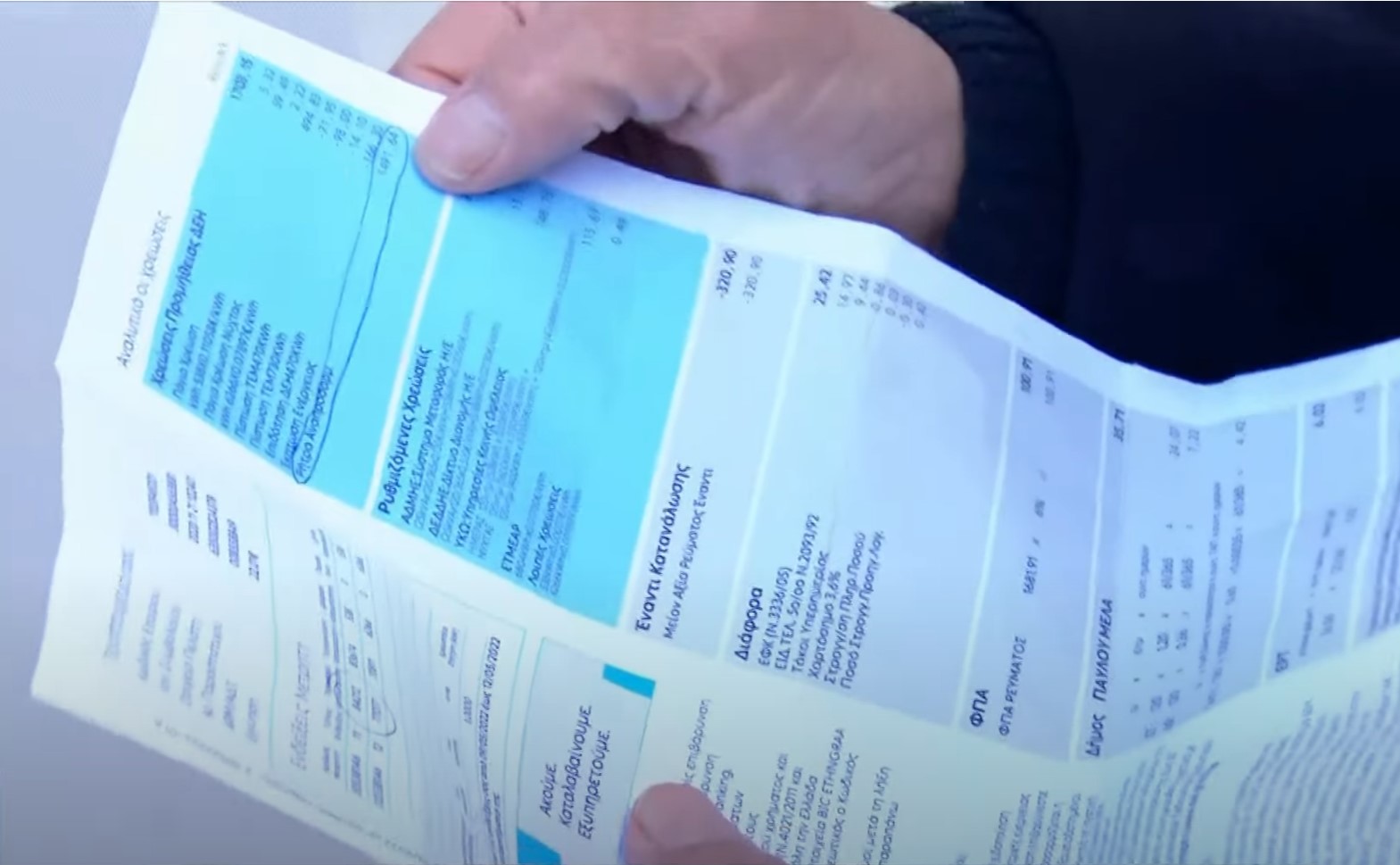
«The electricity tariffs, announced by energy suppliers as part of the incorporation of the indexation clause, are »red".
Specifically, close to 50 cents per kilowatt hour the nominal household electricity tariffs for August. It will be recalled that according to the leaks, the government had hoped that the final price per kilowatt-hour in August in electricity bills will be below 20 euro cents.
Indicatively the PPC which has the largest share in electricity supply announced that the tariff for August will be EUR 0.486 per kilowatt-hour (0.498 for consumption above 2000 kilowatt-hours per quarter). At 0,495Euro/kWh is the tariff for Heron for the next month, at 0.54913 Euro/kWh of Protergia, while the announcement of the tariffs of all suppliers is expected gradually. It should be noted that further variations in asset charges per supplier apply.
All of the above leads in essence to more than double the previous price of a kilowatt hour, which was between 18 and 20 minutes.
The subsidy will continue in August
For its part, the government, through the Minister of Environment, Kostas Skreka, after the announcements of the companies informed that the subsidy is extended for August. Specifically, in his statements, the minister said that the total subsidy for August will reach 1.136 billion euros, absorbing, as he claimed, 90% of the increase for all consumers for main and non-main houses.
According to a report by tvxs.gr, the government had budgeted 850 million to support energy bills. However, this amount was increased as the wholesale price of megawatt-hour, still drifted by gas prices. This amount cannot be covered by the resources of the Energy Transition Fund alone and is identified as outside the current capacity of the state budget.
The government could contain prices through the semi-state-owned PPC, the only producer with water and lignite reserves. But there it faces three obstacles, overcoming which requires political will.
► The first obstacle is the under-operation of the modern lignite plant in Meliti due to a lack of fuel. The lignite field for Meliti yields only 10% of its area due to incomplete mining, and a few days ago the contract with the dysfunctional contractor was terminated. Lignite is temporarily imported from Western Balkan countries. The Meliti plant could affect the national mix and prices, but according to ADMIE data, lignite power generation in the five months January-May 2022 remained at 10,65%, when in 2021 it was 10,96%. The Meliti plant stayed at a Utilisation Factor of 13.46%.
► The second obstacle is the clauses against lignite in the «green» bond loan taken out by PPC, which are still in force despite the pan-European shift to lignite.
► The third obstacle is PPC shareholders. The government, through the 38% stake held by the State Treasury, can use PPC to hold down prices, pushing the company's profits to zero. Will the government displease the funds that entered the company's shareholding last autumn, after lanterns and torches? Recall that the CVC Capital fund, holder of large stakes in key sectors of the Greek economy (food, insurance, health) owns 10% of PPC shares.