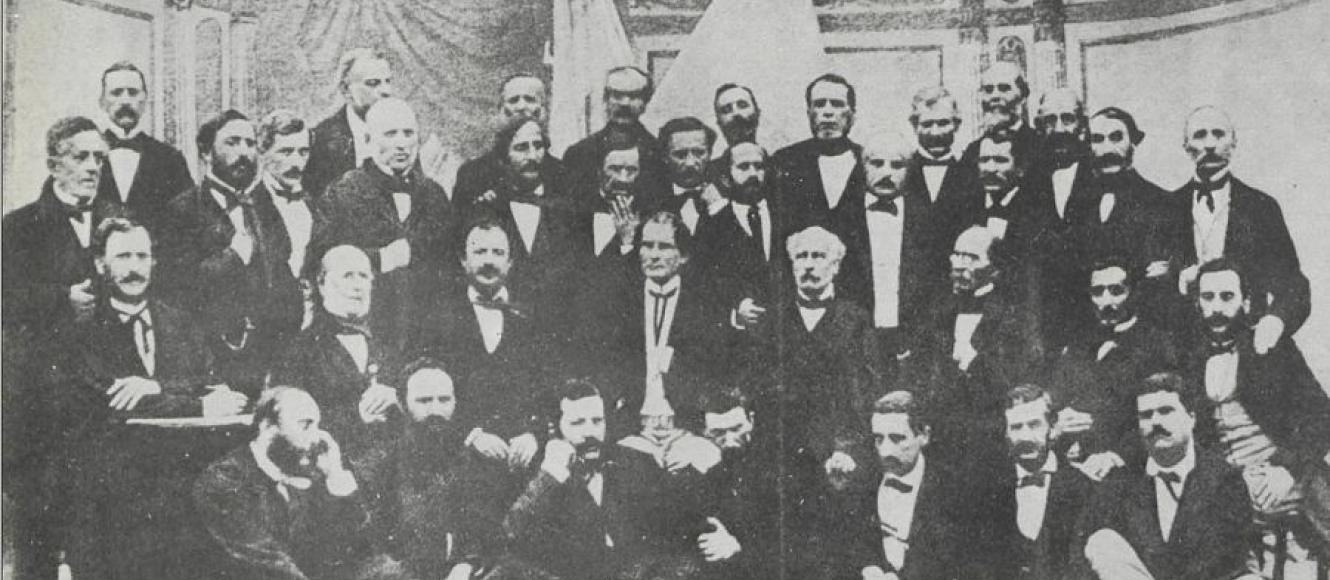
A brief analysis of the period 1800–1862 and the political developments in the Ionian Islands and the Autonomous Ionian State. The aim is to examine in depth the phenomenon of the Radical Party, the first political party in Greece, in light of its European influences as well as the social movements that developed in the region during the 17th and 18th centuries. An examination of its legacy in the Greek State following its incorporation in 1862.
The issue of radicalism in the Ionian Islands is one of the most fascinating topics in 19th-century Greek historyno century. The social development of the Ionian Islands differed markedly from that of mainland Greece, as the political regime of the islands, throughout the centuries that elapsed from the fall of Byzantium until the Union in 1864, inextricably linked this geographical region to Western Europe and the events unfolding there. The Renaissance of literature and the arts, the Enlightenment, and the active challenge to the political and social status quo that emerged from the French Revolution, the rise of the bourgeoisie to power, and the ’Spring of Nations« of 1848.
One of the factors that allows this connection to be substantiated is class structure and class struggle, as it was expressed. In the Ionian Islands, the researcher can observe a distinctly Western-style class stratification, fully compatible with and analyzable based on the model of the corresponding European system—a phenomenon that in the rest of Greece did not appear—or, at best, only faintly—until the early 20th century.no century. The aim of this study is to demonstrate these specific social origins and factors. It seeks to investigate whether the Ionian system actually resembles the European one, and if so, how it was influenced by its position at the crossroads of the two systems. A more specific subject of research will be the Radical Party, the first party based on principles to be founded in Greek political history. What were the conditions of its development, what paths it followed as it evolved, and how the major turning points in its history can be explained—always within the framework of an effort to ground its pivotal choices in social reality.
To enable the reader to gain a more complete understanding of the issue, I will structure this paper along two axes: one historiographical and one socially and politically analytical. The success of this first—historiographical—aspect will enable the reader to follow and understand the second aspect of this paper. The success of the second will allow the reader to grasp the mechanics behind the first aspect. The successful presentation and analysis of these two mutually reinforcing strands will allow for a deeper understanding of certain critical points that go beyond the narrative of the islands’ local history. On the one hand, the history of the Radical Party, a descendant of the European Enlightenment and a product of the social divisions of its era, reflecting the ideals it championed. The course of bourgeois reform and revolution in the Greek context. On the other hand, a framework for comparison with Greek society of the period. The convergences, divergences, and, in general, the differences presented by the Ionian phenomenon, and how it interacts with the political corpus of mainland Greece can yield particularly interesting conclusions for the researcher. Finally, the most interesting aspect is this: to demonstrate how such diverse interpretations and phenomena emerged from the common matrix of the Enlightenment and Romanticism. And if this is achieved, then the reader will have gained something truly significant from these pages.
Read the study by Andreas Tzanavaris, a graduate of the Department of Political Science at the University of Athens, written as part of the course «Modern Greek Political History»