Vassilis Kaptanoglou has never parted with his oud. Even a few hours before he died, he kept it on the steps of the entrance of his house in Keratsini. It was the one that saved his life, after all, shortly before he left Prokopi in Cappadocia in 1921 for Tabouria in Piraeus / Two stone fishing moulds, the songs of his grandmother Irene Boyatzi (Voyatzi) recorded by Melpo Merlier and a wooden icon of the Virgin Mary are Konstantinos Trecha's inheritance from his grandfather and grandmother, who were forced to leave Englezonesi in Asia Minor and settled in the refugee settlement of Drapetsona.
On their journey of refuge, expulsion and uprooting, the Asia Minor refugees tried to take with them objects with sentimental and utilitarian value, hiding many memories of their homeland. The stories behind the objects that the refugees of 1922 brought with them try to «unravel» and narrate the stories behind the objects that they brought with them in the digital exhibition «Objects in Motion». It is about 100 objects brought with them by refugees from Asia Minor, Pontus and Eastern Thrace, who later settled in Volos, Chania, Thessaloniki and Piraeus. Household items, pictures, work tools and a variety of personal items are on display in the exhibition «Objects in Motion», a research project of the Institute of Historical Research of the National Hellenic Research Foundation. So far, there are 51 objects in the exhibition, but every day one more will be added, reaching 100 in December.
Passed down from generation to generation, these objects «carry» tragic stories and indelible memories, stories of refugee and forced displacement. Apart from the dimension of a family heirloom or utilitarian object, the research project attempts to reconstruct the «cultural biography» of these objects and the life course of their owners.
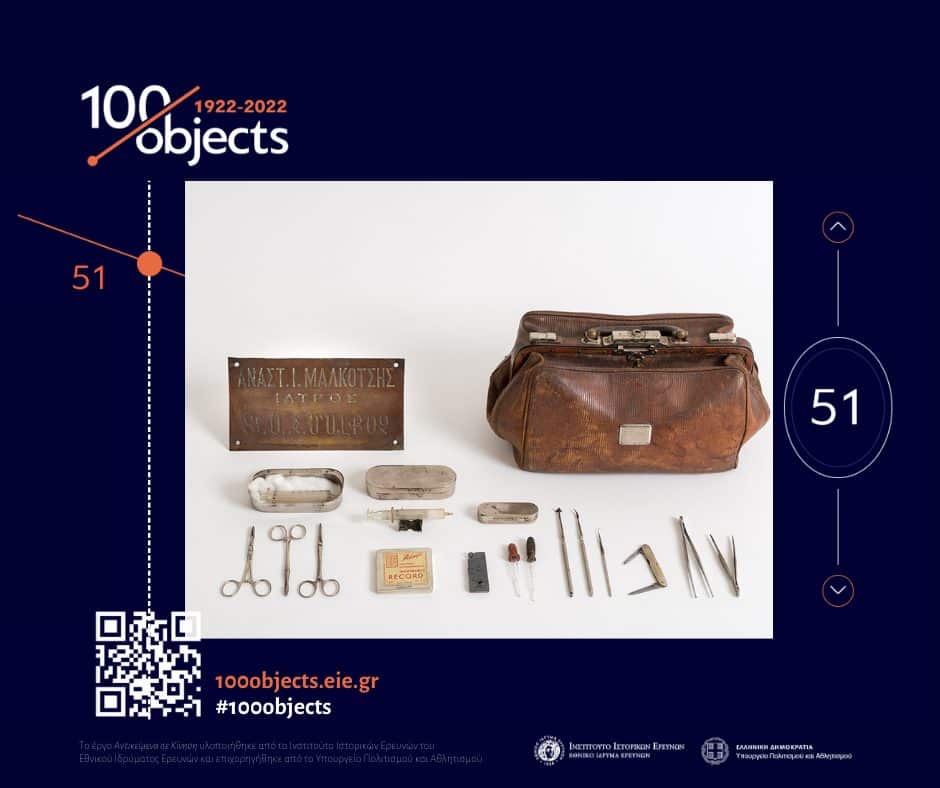
«There is a big difference between the refugees who arrived in 1922, hunted, and the refugees of the population exchange who arrived in a more organised way. The refugees of 1922 arrive with very little, clothes, valuables and if they have managed with a picture, unlike the refugees of the population exchange who arrived in a much more organized way and depending on their own ability to cover the cost of transport could bring their entire household baggage. Certainly they all brought an icon, as they had a great deal of religious faith, devotion and piety, so it is somewhat self-evident that they tried to salvage the symbols of their faith. These are icons that have been preserved to this day by their owners», explains to the Athens-Macedonian News Agency the scientific manager of the project and IIE/EIE Researcher, Eleni Kyramargiou. Apart from objects that had sentimental value for them, the refugees also brought with them things that might have been useful in the new reality they had to face, such as the paraphernalia of doctor Anastasios Malcotsi from Panormos of Propontis.
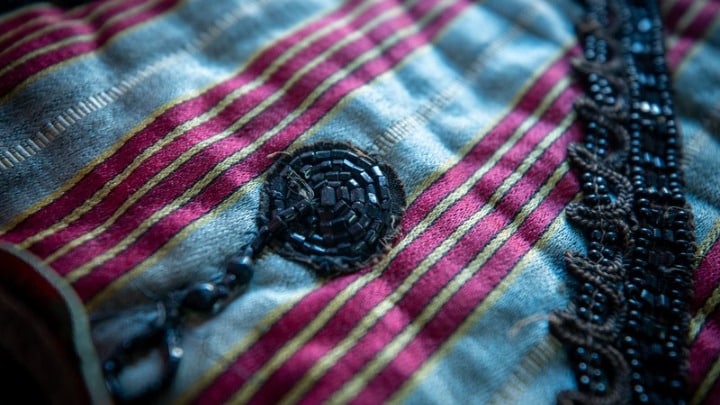
A silver flask embossed with the image of St. George, wedding dresses from Englezonia, embroidery and porcelain dinnerware from Bavaria, carpet and samovar from Sourmena of Pontus, sewing machines, traditional costumes, are some of the objects that can be found in the exhibition and are accompanied by short stories.
«The most interesting thing is the little stories that each person has to tell about their ancestors, their relationship with these objects and what they mean to themselves, to today, which is a part of their family's history and they deal with it in this way,» Ms. The idea, she says, began in the context of the research project «Objects in flight», through a fellowship implemented at Columbia University in 2020-2021 and funded by the Stavros Niarchos Foundation for Public Humanities Initiative (SNFPHI).
«There we did a project with objects brought by the refugees who settled in the neighbourhood of Keratsini. So then we thought of doing an exhibition of objects that refugees brought with them in 1922, refugees who settled in the four cities we work in, Volos, Chania, Thessaloniki and Piraeus,» he tells AP-MPA.
Among the objects are those that come from Sinaceous, such as women's costumes, archaic costumes and icons.
«The objects that are currently in our small museum of the association «Nea Sinassos» come from families of Sinasites. These people wanted to keep the memories of their ancestors through these objects, which they deposited in our association, which is the custodian of all the history of Sinassos and its tradition. Objects of daily use, costumes, shoes, musical instruments. Archaletsi, a piece of fabric that each woman, girl threw on their shoulder, each one is completely separate from the rest because each one put her own art on it,» says to APE-MPA the president of the association, «New Sinassos», Vaso Papadopoulou.
The project was funded by the Ministry of Culture and Sports in the context of research activities related to the concept of expatriation, on the occasion of the 100th anniversary of the arrival and integration of Greek populations in Greece after the Asia Minor disaster.
The oud and the icon of the Annunciation of the Virgin Mary of the Kaptanoglou family
Vassilis Kaptanoglou was born in Prokopi, Cappadocia in 1907. He was the second son of Georgios Kaptanoglou and his wife Magdalene. He was left an orphan as a boy and together with his brother Prodromos (born in 1897) tried to stand on their feet and help their family. Prodromos worked in Constantinople as a cook and Vassilis stayed in Prokopi with his mother, learned to play the oud and was very talented. A virtuoso on the oud, his fame reached the ears of the kaimakami of Prokopio, that is, the local governor, who invited him to his house and asked him to play and sing. «The caimakam was enchanted by my grandfather's amanuensis and urged him to get up and leave to escape conscription and forced labour. The oud, as my grandfather used to say, saved his life,» Vassilis Kaptanoglou's granddaughter and philologist, Eleni Kapetanidou, described to RES, adding that the oud always accompanied him throughout his life. «He always had it with him, there are photos from the period when they lived in the slums, where grandfather was a leader in entertainment gatherings holding his oud. He always accompanied him, at parties with his relatives» relatives, I remember him holding an oud,’ he says. In addition to the oud, Ms Kapetanidou has also donated to the exhibition the icon of the Annunciation of the Virgin Mary, which was placed on the iconostasis of the family's house, although she does not know whether it comes from Prokopi in Cappadocia or from Chili in the Black Sea, where her grandmother came from.
At the end of 1921, Prodromos Kaptanoglou and his pregnant wife were the first to arrive in Piraeus and settled in shacks in Tabouria. A few months later, Vassilis and his mother arrived in Piraeus and stayed with them in the same area. There he met his wife Eleni Dimou, who had been expelled with her father and two sisters from Chili of Black Pontos. After they married and their son George Kapetanidis was born, they received rehabilitation in the settlement of Eugenia in Keratsini and changed the family's surname to Kapetanidis. «The suffix -oglou referred to Asia Minor ancestry and, in the perception of the natives at the time, to Turkish ancestry. Experiencing at first, like all refugees, the social exclusion and marginalization, in order to get rid of this stigma of refugee, they were led to change their surname to Kapetanidis», says Ms Kapetanidou.
«They spoke little about how they left their homeland. They did not want to remember how they were forced to leave their homeland as for them it was a distressing memory. When my father was born in 1935 the memories and experiences were very recent and for several years they still did not want to talk. They began to “open up” in the 1960s so that they could come to terms with this trauma. I remember that they watched Laura on TV and they shook their heads in affirmation and said yes, that's how things happened, how would you know what we went through, what we lived through‘, Ms Kapetanidou told APE-MPA, adding that her grandmother managed to carry some valuables, but during the period of occupation she had to spend them in order to buy basic goods and survive.
For Ms Kapetanidou, the digital exhibition «Objects in Motion» is an «extremely original work» that tries to tell the story of these people in three phases.
«The first, life at home, what life at home was like as it was connected to these objects. The second, the phase of the expatriation process as the refugees carried them and carried them with them when they left and the third narrates the first conditions of arrival in the new homeland,» he notes in the AP-ME.
Vassilis Kaptanoglou did not part with his oud, even on the eve of his death, as he played just before he «passed away» on the steps of the entrance of his house in Keratsini. The oud then passed into the possession of Eleni Kapetanidou's brother, who has the same name as his grandfather.
You can see the report here: https://100objects.eie.gr/
Ioanna Kardara