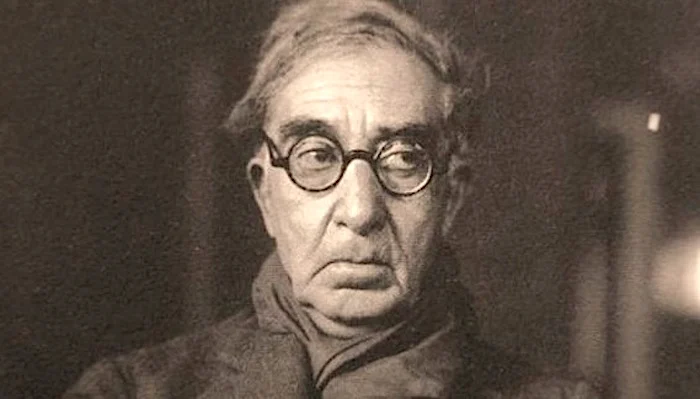
What is the great secret of Cavafy in our days? What makes us, and us and his countless admirers all over the world, read him again and again, and discuss him more and more often, with ever more intense attention and fervour? How did the Alexandrian manage to gain such a wide reputation, without once collecting his poems in a book (the pamphlets he distributed to acquaintances and friends are now one of the legendary elements of his artistic personality), without creating a single link with the literary scene in Athens, without staying a single moment away from incredibly passionate and sweeping criticisms? How did he not only stand on his feet, but also proceeded unscathed to the top, from where he now looks at the world, a poet whom so many (competent and unqualified) rushed during his years, and later, to send to the fire from the outer world, predicting with unquestionable certainty his future crushing?;
I think that what primarily brings Cavafy intact to our time, erasing from his words every sign of decay, is his anti-retortal manner. Not his low voice, which is never exactly low, nor his hidden or controlled emotion, which may prove to be controlled, but does not stand in any way hidden. The lack of grandiosity - the steady refusal to believe in a visible positive value or, the very opposite, to become a prisoner and subject of a blind and dissolving nihilism: here are the hidden cards which Cavafy suddenly opens in his poetry, in order to shock his reader underground and secure his emotional acceptance. The meaning of the dictum «this does not exclude the other» (the sense, in other words, of the double aspect of things), combined with a kind of bitter awareness of how far the limits are reached (in love, in the freedom of the ego, in the satisfaction of everyday needs or in the purposes of art), follows the Kavadi gaze everywhere, and is reflected in the smallest or the last detail of his poetry.
Years with double meanings, as well as without faith or enthusiasm, and ours, who seek a vital decoy in order to prevent the straight line from dominating their demands, and digest everything (major and minor) in the same indistinct pulp, discover in Cavafy an ideal companion and, above all, a brave supporter. Someone who knows how to fear, hurt or desire without surrendering to despair - someone who does not need to be incandescent with wandering visions or thrown into terrifying abysses in order to forget his loneliness for life or to get rid of his panic once and for all, and inexpensively.
And I don't want us, now that we have walked a little, to forget something else: that ambivalence and ambiguity, the swing between poles, presuppose a spirit of irony - a sharp and well-nourished ironic spirit, which distances itself from human passions (there is no irony without distance), in order to show as clearly as possible the fire that smolders them. And this is certainly Cavafy's other ace - the field in which he stitches with the ease of a highly experienced craftsman, working his materials from the outside and the inside, with immense persistence and will. And so subtle and weighty is Kavadi irony that we need to think about it not once, but five and ten times, in its various shades and versions, on its multiple semantic fronts and levels. And it is in this respect that our time is again the most favourable place for the reception of this multifaceted and complex ironic web. In an environment where nothing seems particularly stable, and where also no myth can sprout and establish itself, Cavafy's oblique gaze understandably claims primacy. Oesis and flattery, narcissism and idealism, or, more fundamentally, unshakable perceptions and impenetrable convictions have no place here. The only ’passages«, as we said before, are the double truths, the slow, internal rhythm and the hard awareness of the finite and the futility of any (great or insignificant) ambitions.
Moreover, Cavafy's historical figures also move in such a direction. Away from key events, somewhat sidelined and certainly in the shadow of events, they are called upon to understand fate in terms of a closed game: nothing serious and high is allowed to be hoped for, no prospect of true escape from their surroundings is easy to discern, no word, however encouraging and comforting it may seem, can warm their hearts. And do we not thus enter anew by a door open to our age? Does not Cavafy speak once more in this way in a whispering way in our ear, touching upon our inability to feel that we are participating in any critical stake or stake? Who, I think in closing, is in a position to say no to this, and to the other questions with which the Alexandrian ruthlessly bombards our time?;
Β. Hadjivassiliou