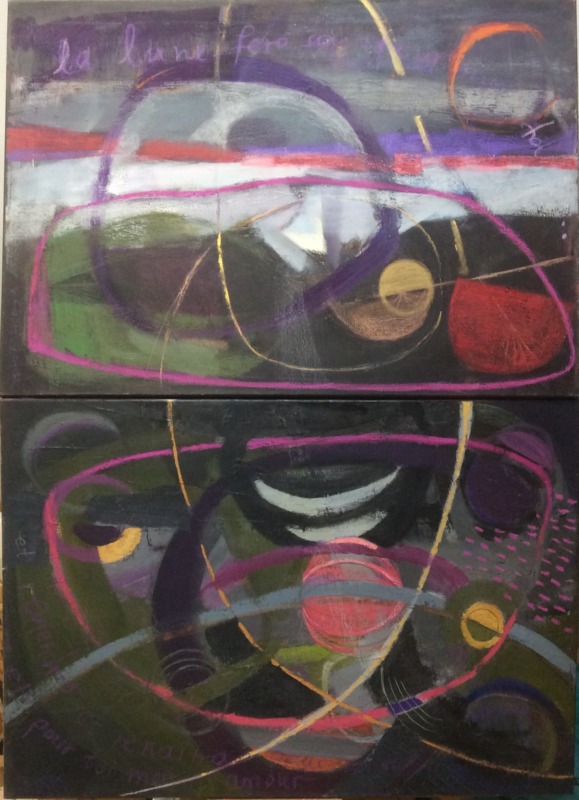
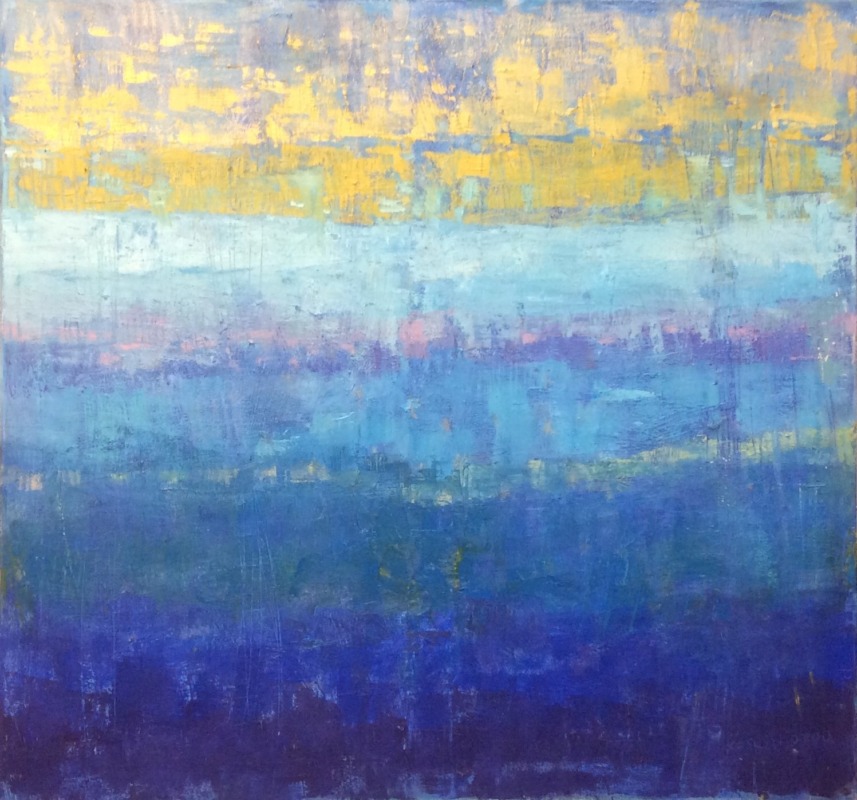
Η γνωστή εικαστικός Βασιλική Κοσκινιώτου φέρνει δύο ενότητες έργων στο νησί των Κυθήρων αυτόν τον Αύγουστο, και συγχρόνως προσκαλεί συναδέλφους καλλιτέχνες αλλά και επισκέπτες της έκθεσης να αλληλεπιδράσουν με την ποίηση του Νίκου Καρούζου, με συμμετοχές και δρώμενα που θα ανακοινώνονται κατά τη διάρκεια της έκθεσης στο νησί. Πρώτη φιλοξενούμενή της, είναι η Κυθήρια καλλιτέχνις Γεωργία Τσέρη.
Όπως σημειώνει στο επιμελητικό κείμενο της έκθεσης, ο ιστορικός τέχνης Konstantinos Th. Spyropoulos:
«Όταν η ποιητική ύλη συναντά τη ζωγραφική, ο κίνδυνος της εικονογράφησης ή της απλής περιγραφικής αναπαράστασης ελλοχεύει πάντα.Στην περίπτωση όμως της Βασιλικής Κοσκινιώτου, η ώσμωση με το έργο του Νίκου Καρούζου υπερβαίνει κάθε προφανή εικαστικό σχολιασμό, προσφέροντας μια στιγμή αυθεντικής αφαίρεσης. Με αφορμή τη συμπλήρωση των 100 χρόνων από τη γέννηση του μεγάλου έλληνα ποιητή-φιλοσόφου, η καλλιτέχνις οργανώνει στα Κύθηρα μια διπλή ατομική έκθεση-αφιέρωμα, χωρισμένη σε δύο διαδοχικές, συμπληρωματικές ενότητες: το “Μετεώρημα Ι” στη Χώρα και το “Μετεώρημα ΙΙ” στον Ποταμό. Για τη ζωγράφο, ο Καρούζος δεν αποτελεί απλώς μια εξωτερική θεματική αφετηρία, αλλά έναν “ιερό κοντινό πρόγονο”.
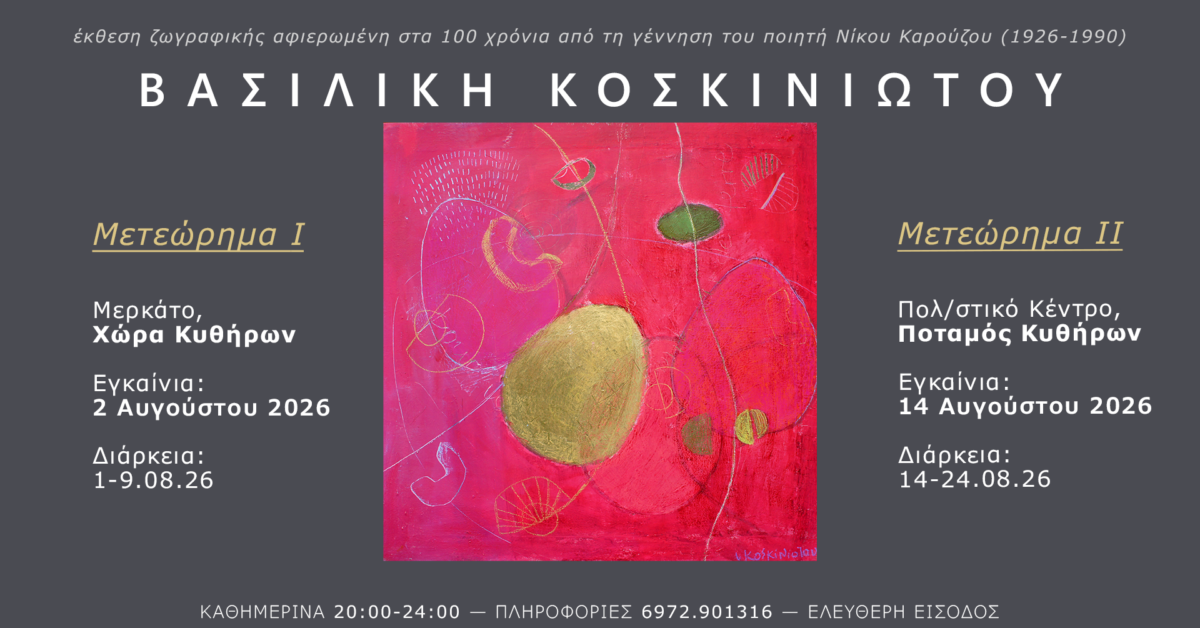
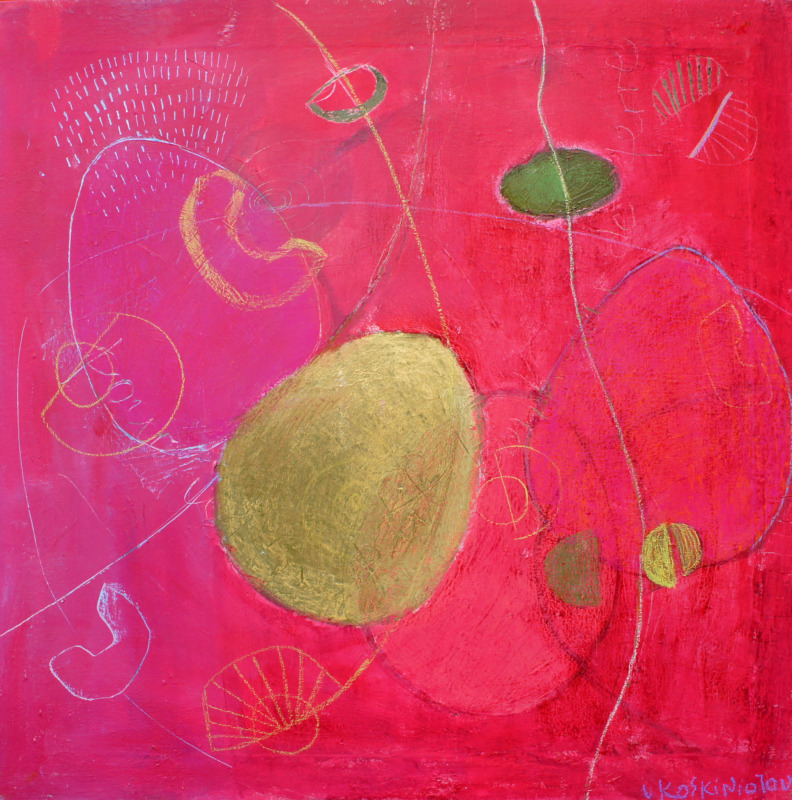
Στα έργα της η ζωγράφος συνενώνει παλαιότερες αναζητήσεις σε μια νέα, ενιαία κοσμολογία. Δεν εικονογραφεί τους στίχους, αλλά τους εγγράφει κυριολεκτικά ως πρωτογενή ύλη μέσα στο νωπό σώμα του τελάρου ή τους χαράσσει με λαδοπαστέλ πάνω από τη χρωματική επιφάνεια. Η λέξη παύει να λειτουργεί ως συμβατικό σημαίνον και μετατρέπεται σε καθαρή πλαστική αξία, ρυθμό και χειρονομιακή ενέργεια.(…) Η αφαίρεση της εικαστικού γίνεται ο ιδανικός καθρέφτης για την υπερβατική γλώσσα του Καρούζου, εκεί όπου ο ανθρωπισμός, η ελληνικότητα και το ανέσπερο φως συναντώνται>>.
Τοποθεσίες:
- Μετεώρημα Ι: Μερκάτο, Χώρα Κυθήρων 1- 9 Αυγούστου εγκαίνια: 2 Αυγούστου, 00
- Μετεώρημα ΙΙ: Ποταμός Κυθήρων, Πολιτιστικό κέντρο Ποταμού, 14- 24 Αυγούστου 2026
Πληροφορίες Επικοινωνίας & Διασύνδεσης:
- Tel.επικ:6972901316 / Email: vkoskiniotou@gmail.com, vbavetec@gmail.com
- Hours of operation: 20- 24.00 καθημερινά, και κυριακές: 11- 14.00
- Free entrance
Σύντομο βιογραφικό
Vasiliki Koskiniotou is a painter, [B.A. in Fine Arts, summa cum laude from the Athens School of Fine Arts (ASKT), 2006], a graduate of the School of Philosophy at the National and Kapodistrian University of Athens (EKPA), and has worked as a bilingual translator and educator. She has held 12 solo exhibitions [Kythira “underwater gardens””], Athens [ «Π»herb,« »small evergreens,", «Mavromichali,» «in between,», «tender jazziness,» «Places of Transition,», «Breastfeeding,» «Origins and Scales,» «Traces of Scale and Other Erotic Things…,»,], [Volos] «10 + 2 wind ladders for the summer,»,] and Tokyo [«Spring Studies» NroomArtspace]. He has participated in major international group exhibitions and art fairs, such as ’Escape Plan” at the Athens Printmaking Center, [Ek-staseis, depictions of Liberty, I.T. Tinos, Axios Estin, Tolstoy Museum in Russia, Artists' Books Project II, ASKT, «Metamorphosis: Beyond Shapes» ArtMoorHouse, London, The Open Mind of Lafcadio Hearn, Matsue, Japan, ArtAthens, Hope/kibou, Nerima Museum of Contemporary Art, Tokyo, Erysichthon, Eleusis, «Silent Dialogues» ACG, Panorama of Greek Printmaking, Museum of Contemporary Art, Thessaloniki], and her works are included in the collection of the Athens School of Fine Arts (ASKT), the Ministry of Education, the Toyota Collection, the American College of Greece (ACG), the Matsue Museum in Japan, and in private collections in Greece and around the world. Her email address is: vkoskiniotou@gmail.com and her Facebook page: Vassiliki Koskiniotou
Theorem:
The Plastic Transposition of the Karouzeios Discourse
When poetic material meets painting, there is always the risk of illustration or mere descriptive representation. In the case of Vasiliki Koskiniotou, however, the synergy with the work of Nikos Karouzos transcends any obvious visual commentary, offering a moment of authentic abstraction. To mark the 100th anniversary of the great poet’s birth, the artist is organizing a dual solo exhibition-tribute in Kythira, divided into two consecutive, complementary sections: «Meteorema I» in Chora and «Meteorema II» in Potamos.
For the painter, Karouzos is not merely an external thematic starting point, but a «sacred, close ancestor.» Her relationship with his work is organic, almost physical, dating back to the time of her thesis at the Athens School of Fine Arts, when poetic excerpts began to insistently claim a place among the structural components of her visual language. Koskinotou does not illustrate the verses, but rather inscribes them literally as raw material into the fresh surface of the canvas or carves them with oil pastels onto the painted surface. The word ceases to function as a conventional signifier and is transformed into pure plastic value, rhythm, and gestural energy.
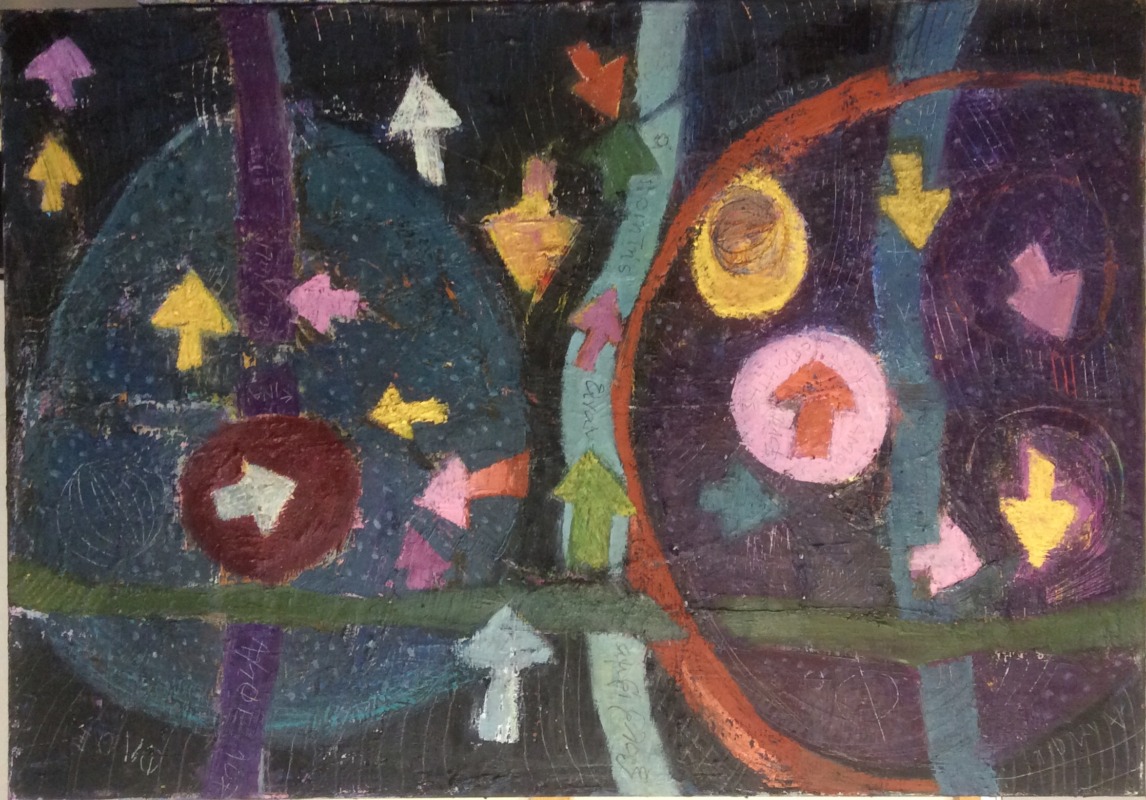
In «Meteorema I,» the artist presents medium- and large-scale works that convey a monumental, almost cosmogonic energy. The title of the exhibition, inspired by the poem Suspension, precisely defines this metaphysical condition: a state between a suspended question-theorem and a perpetual suspension of matter in a vacuum.
In these works, such as the large diptych The Night That Works in My Favor (reference to the poem from the collection Earthquake-resistantς Tomb(c) The painter brings together her earlier «nocturnal» explorations into a new, unified cosmology. Formally, dark, deep backgrounds dominate, against which bright, elliptical trajectories of phosphorescent violet and orange, creating energy fields of geometric motifs—circles, arcs, and intersecting trajectories—that enclose the written word.
The same existential vibration runs through the works Ancient Sea (inspired by the poem The Sea: The Origins of Geography) and Amphiflox (from the CREDO). The artist employs an anti-naturalistic, lyrical palette, in which color asserts its complete autonomy. Her forms, fluid and organic, suggest the presence of an inner, animistic energy. The highlight of this section is the large double portrait of the poet titled The Poet and His Idol, where the human figure is deconstructed, transformed into a spectral aura, into a spiritual trace that hovers in space.
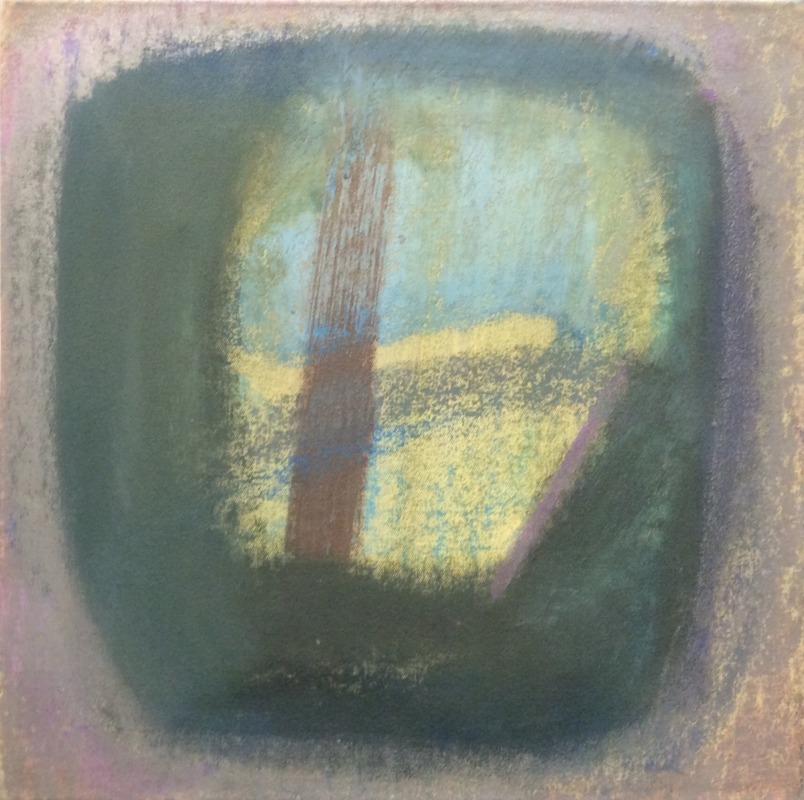
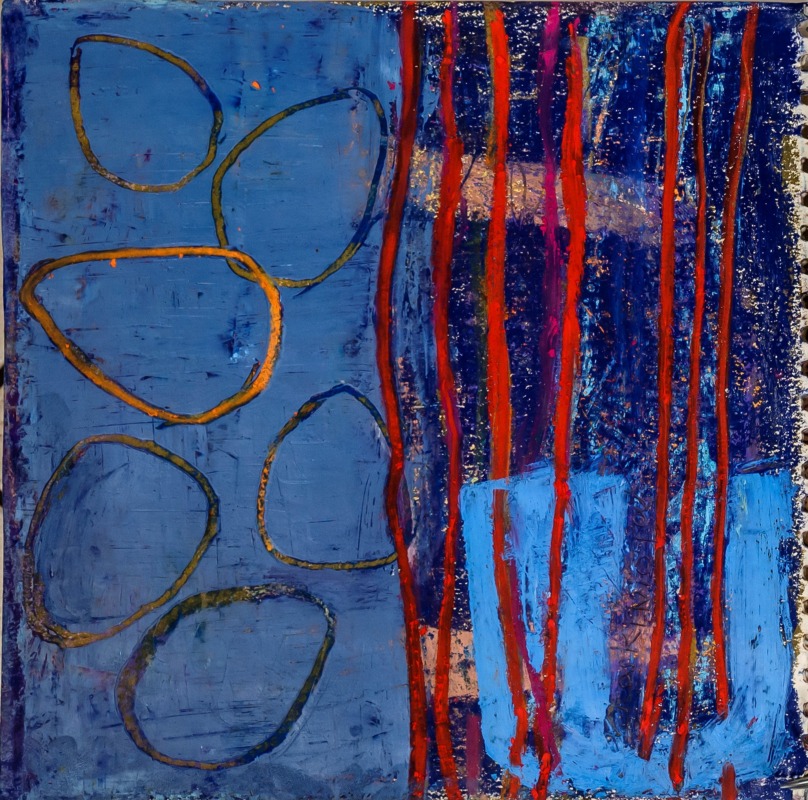
In «Meteorema II» in Potamos, the tone becomes more introspective, confessional, and tactile. Koskinotou employs smaller formats, compositions on paper, a drawing by the poet, and linocuts. The central piece of the series is the four-panel work titled after the heart-wrenching lines: «Contemplate death with me in solitude / joy voiced by the heavens and bitterness voiced by the lips / when you die, how far do you die? / You depart centripetally, you arrive centrifugally». Right here, her handwriting becomes denser and more spontaneous. The small works on paper, most of them untitled, function as visual diaries. The use of oil pastels lends a tactile quality, where the intensity of the hand is reflected in the roughness of the surface. The colors—dominated by a deep cobalt blue (inspired by Karouzos’s latest collection Discoveries of Cobalt Blue)– create interior landscapes, «windows» onto another dimension. The abstract forms, such as vertical beams of light or circular trajectories, resemble thought-forms pulsating with life.
With this exhibition, Vasiliki Koskiniotou achieves something exceptionally rare: she allows Karouzos’s poetry to «take root» in her paintings. Engaging with collections such as the Faretrion, the Erythrografe and the Large-Scale Logic, transforms reading into a purely visual act. This is not a mere tribute, but a lively, intellectual dialogue. The artist’s abstraction becomes the ideal mirror for Karouzos’s transcendent language, where humanism, Hellenism, and the eternal light converge.
Adopting the poet’s own definition, Koskiniotou reminds us in the most powerful way that «art is the emotion that always lifts you into the air.» This exhibition is such a leap; a leap into the future of our visual and poetic consciousness. An opening toward what is to come.
Konstantinos Th. Spyropoulos,
Art Historian
ΣΤΟΙΧΕΙΑ ΕΡΓΩΝ -ΜΕΤΕΩΡΗΜΑ- ΚΟΣΚΙΝΙΩΤΟΥ