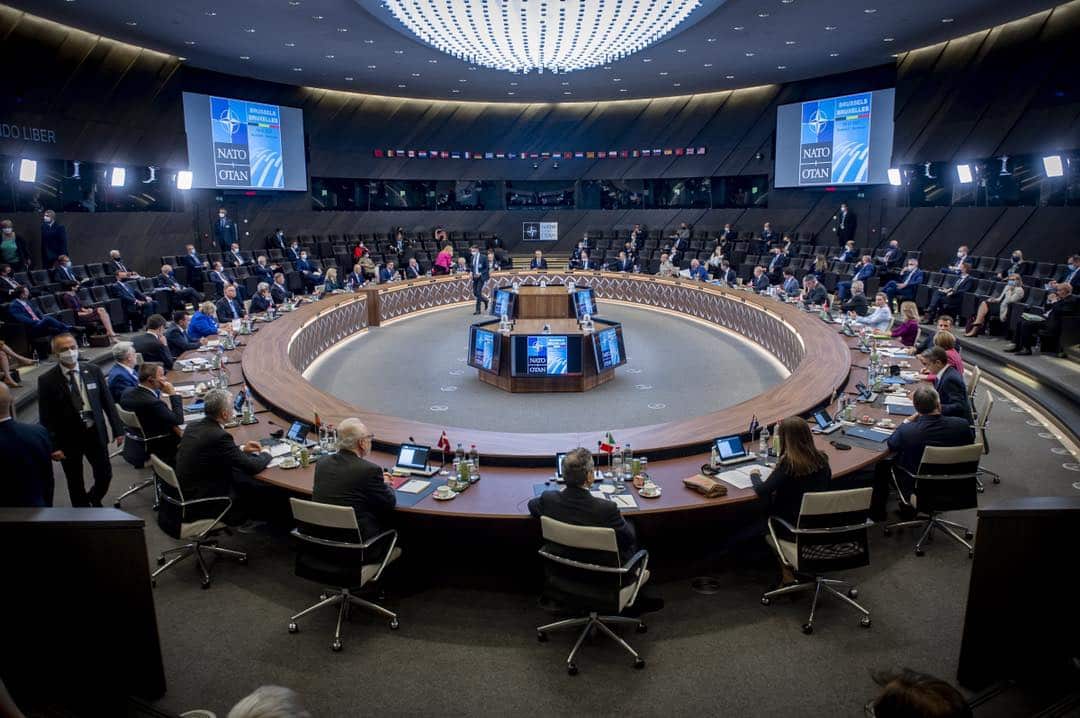
The NATO Summit in Ankara reflected the strategic shift that has been taking place within the Alliance in recent years regarding the allies’ approach to security, deterrence, and collective defense in the 21st century.
The main message of the Summit is captured in a quote from the text of the Declaration of the results of the. Specifically, it is noted that: «NATO’s deterrence and defense are based on an appropriate mix of nuclear, conventional, and missile defense capabilities, complemented by capabilities in space and cyberspace. We are committed to maintaining our combat advantage. We are investing in our ability to develop, support, and sustain our armed forces, as well as to achieve the operational capability goals set for all areas of operations, including precision strikes, integrated air and missile defense, unmanned systems, cutting-edge technologies, and intelligence capabilities. »We are developing an interoperable transatlantic warfighting cloud and adopting powerful artificial intelligence models.”.
In other words, for NATO, security and deterrence are no longer based solely on possessing strong military capabilities, but also on constant readiness, production capacity, technological superiority, and resilience.
Essentially, the report: «We Invest our ability to we are developing, to We support and to we maintain our armed forces, as well as to we achieve the operational capability goals that have been set for all operational sectors, namelystates that NATO is transitioning from an alliance based on deterrence through strength (Deterrence by Power), in an alliance that seeks deterrence through readiness (Deterrence through Readiness).
This is understandable and normal, given that in today’s hybrid operational environment, the Alliance faces not only the possibility of a conventional military conflict, but a complex environment that combines conventional military threats, hybrid operations, cyberattacks, attacks on critical infrastructure, information operations aimed at influencing public opinion, and technological competition.
Also, NATO is not abandoning its combat platforms (Platform-Centric Warfare), but integrates them into a network-centric business ecosystem (Network-Centric Warfare).
In other words, it is shifting from a concept in which strategic advantage was based primarily on the possession of advanced weapons systems, to a concept where that advantage stems from the integration of sensors, platforms, data, networks, technologies, and command and control (C2) systems, which operate as a single operational system.
The Declaration's reference, however, to the creation of a «interoperable transatlantic battle cloud» (Interoperable Transatlantic Warfighting Cloud) confirms that this is indeed the case.
In this context, in order to understand the transition that is taking place toward the NATO's evolution into a «Readiness Alliance» (Alliance of Readiness), it is necessary to present certain structural elements that will make it possible to understand this fundamentally important adaptation strategy in today’s highly competitive operational environment.
Table: NATO's Strategic Transition: From the Alliance
Deterrence in the Readiness Alliance
| BEFORE Alliance Prevention (Deterrence Alliance) | NOW Alliance Readiness (Alliance of Readiness) |
| v Collective Defense | v Persistent Readiness |
| v Deterrence through strength | v Deterrence through Comprehensive Power and Constant Readiness |
| v Military Capabilities (Forces) | v Military Capabilities and the Defense Industry (Forces + Defense Industry) |
| v Crisis Response | v Ongoing preparation for strategic competition and high-intensity operations |
| v Military Capability | v Military Capability and National Resilience (Military Capability + National Resilience) |
| v Defense Planning | v Whole-of-Society Defense |
| v Logistics Support | v Strategic Logistics |
| v Weapons Systems / Combat Platforms | v Weapons Systems / Combat Platforms and Data, Artificial Intelligence, and Networks (Data, AI & Networks) |
Consequently, the major change is not that NATO is abandoning deterrence through strength.
It redefines deterrence through readiness, resilience, and the capacity for sustained competition, as well as the development of a comprehensive ecosystem of national and allied power.
Specifically, In NATO's new strategic concept, deterrence It is no longer exclusively a product of military power. It is the result of the combined operation of military, industrial, economic, technological, and informational power, as well as national resilience.
In conclusion, deterrence for the Alliance is no longer a static state of power, but a state of continuous production, renewal, and maintenance of power.
In this context, NATO today (following the conflicts in Ukraine and the Middle East) is no longer limited to preparing to deter a conflict.
At the same time, it is preparing for the eventuality that deterrence fails and the capability to conduct and support prolonged, high-intensity operations is required.
With regard to Greece, this strategic shift by NATO is of particular importance, both operationally and geopolitically.
From an operational standpoint, the Alliance’s new philosophy must be leveraged as an opportunity for the strategic transformation of the country's national defense, in order to develop a new defense strategy that will meet the demands of an operational environment characterized by prolonged and high-intensity conflict.
Specifically, operational effectiveness will no longer be assessed solely on the basis of the number of weapon systems available and their quality, but also by the the country’s ability to maintain a high level of force readiness, to quickly replenish critical equipment stocks, protect its critical infrastructure, secure its supply chains, and leverage advanced technologies, such as artificial intelligence, unmanned systems, and integrated digital command and control networks.
From a geopolitical perspective as well, NATO’s strategic transition to a «Readiness Alliance» is of particular importance both for Greece and for all Alliance member states, since The way in which the strategic value of each country is assessed is changing.
Specifically, criteria such as geographic location and military contributions to NATO operations remain essential, but are no longer sufficient.
Within the new strategic framework, the defense industrial base, technological innovation, the resilience of critical infrastructure, energy security, the capacity to support allied operations, and a country’s ability to serve as a reliable hub for the transport of forces, materiel, and information.
In this light, Greece can play an important role, as it possesses significant comparative advantages; furthermore, a significant opportunity for its geopolitical advancement is emerging, provided that it adapts its national defense planning in a timely manner to the Alliance’s new requirements.
In particular, its geographic location and its role as a pillar of stability in the Eastern Mediterranean, its port and airport infrastructure, its energy interconnections combined with its new energy role in the Mediterranean and Europe, as well as its participation in European and allied defense and technological cooperation programs, all contribute to its heightened strategic importance.
At the same time, the initiatives being developed by NATO to promote the defense industry provide a significant opportunity for the Greek defense industry to become more fully integrated into transatlantic production and supply chains.
Furthermore, Greece’s participation in programs that harness the potential of the Greek technology and research community, combined with actions that strengthen the Alliance’s resilience, can serve not only as a driver of economic growth but also as a factor in strengthening the country’s geopolitical influence.
Therefore, What Greece Really Needs After the NATO Summit in Ankara, is not merely to monitor the structural changes taking place within the Alliance, but to understand their strategic significance in a timely manner and to adapt its national defense planning accordingly to the principles of the «Readiness Alliance.».
This is because, in NATO’s new strategic environment, a state’s power will not be determined solely by the quantity and quality of the military equipment at its disposal, but by how prepared it is to endure, adapt, and continue to operate, as well as to generate, maintain, and renew its power in an environment of constant strategic competition.
Author of the article:

Political Scientist – International Relations Specialist
Former Director General - Directorate General
National Defense and International Relations Policy (GDPAAD)
Ministry of National Defense (YPETHA)