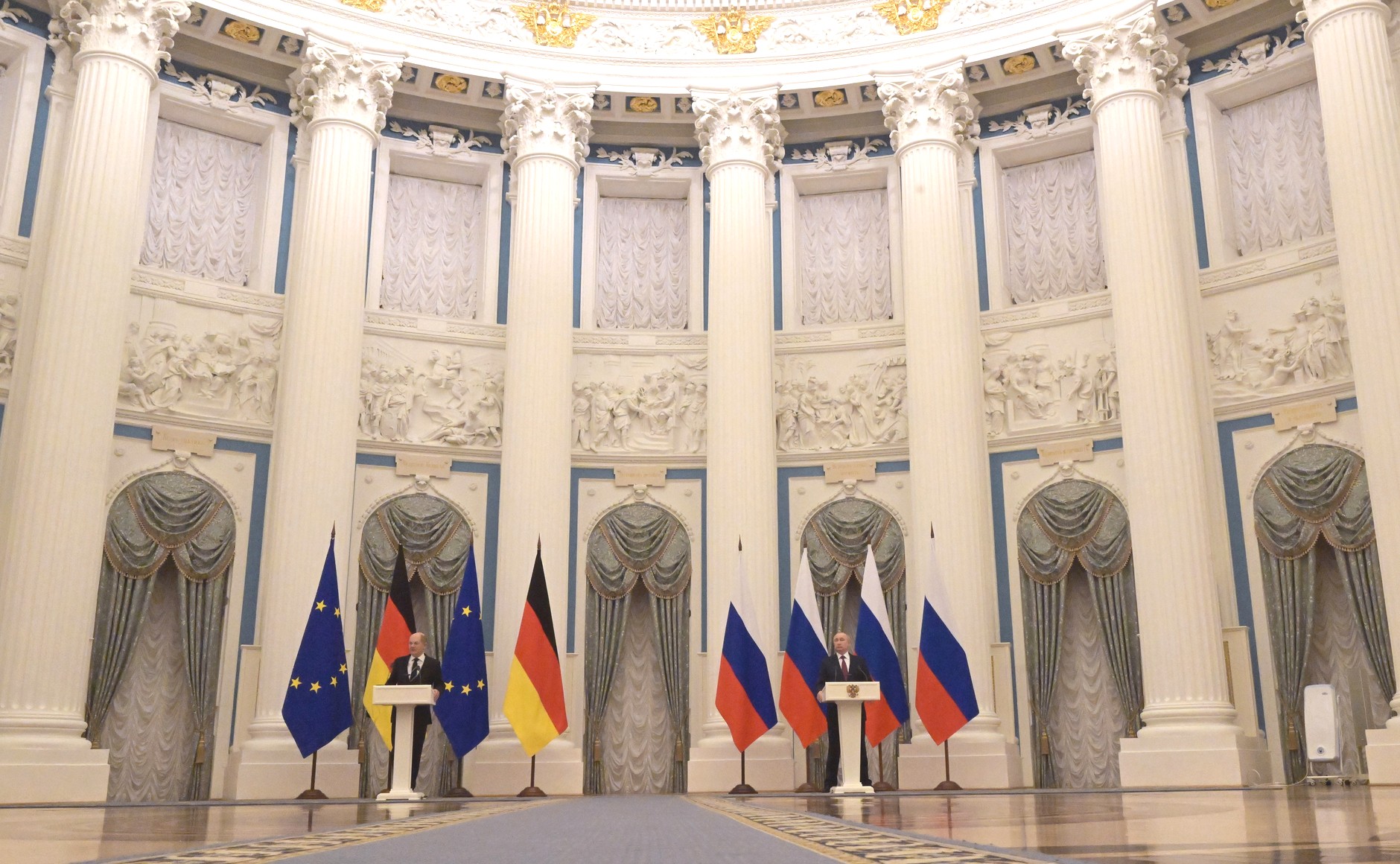
Paris and Berlin aligned themselves with the United States and thus pushed Russia to negotiate directly with the US. And they let the Old Continent become again a field of confrontation between the two powers.
*David Teurtrie is a researcher at the National Institute of Oriental Languages and Cultures (Inalco), author of «Russie. Le retour de la puissance», Armand Colin, 2021. The article in French can be found on the website of Le Monde Diplomatique.
The sounds of boots at the gates of Europe caused panic in the Western chancelleries. In an attempt to obtain assurances about the protection of its territorial integrity, Russia presented the Americans with two draft treaties aimed at reforming the security architecture in Europe, while at the same time concentrating troops on the Ukrainian border. Moscow is demanding a formal freeze on NATO's eastward enlargement, the withdrawal of Western troops from Eastern European countries and the repatriation of US nuclear weapons deployed in Europe. These demands, as they are impossible to meet as they stand, take the form of an ultimatum and constitute the threat of Russian military intervention in Ukraine.
There are two opposing interpretations. For some, Moscow is bidding in order to obtain concessions from Washington and the Europeans. Others, on the contrary, believe that the Kremlin wants to be able to use the refusal as a pretext to justify a move in Ukraine. In any case, the question arises as to the timing of Moscow's choice of engagement in this contest of forces. Why should it play this risky game and why now?;
Since 2014, the Russian authorities have significantly increased the capacity of their economy to withstand a severe shock, particularly for the banking and financial sector. The share of the dollar in the central bank's reserves has declined. A national payment card, the Mir, is now in the wallets of 87% of the population. And if the US carries out its threat to disconnect Russia from the Western Swift system, as it did with Iran in 2012 and 2018, financial transactions between Russian banks and companies could now be conducted through a local communication system. Consequently, Russia feels better equipped to face severe sanctions in the event of a conflict.
On the other hand, the previous mobilisation of the Russian army on the Ukrainian border in the spring of 2021 led to the revival of the Russian-American dialogue on strategic and cybersecurity issues. Again, the Kremlin apparently felt that a strategy of tension was the only way to be heard from the West and that the new US administration would be willing to make more concessions in order to focus on the growing confrontation with Beijing.
Vladimir Putin seems to want to put an end to what he calls «the Western plan to turn Ukraine into a nationalist “anti-Russian” country» (1). Indeed, he was counting on the Minsk agreements, signed in September 2014, to gain access to Ukrainian politics through the Donbas republics. The opposite has happened: not only has their implementation been frozen, but President Volodymyr Zelensky, whose election in April 2019 had given rise to the Kremlin's hopes of renewing ties with Kiev, has reinforced the policy of rupture with the «Russian world» initiated by his predecessor. Worse still, military-technical cooperation between Ukraine and NATO continues to intensify, while Turkey, itself a member of NATO, has delivered drones, which make the Kremlin fear that Kiev may be tempted by a military takeover of Donbass. Moscow is therefore urged to take the initiative while there is still time. However, regardless of the contextual factors at the root of the current tensions, it should be noted that Russia is merely repeating the demands it has been making since the end of the Cold War, without the West considering them acceptable or with a legitimate basis.
The misunderstanding dates back to the collapse of the communist bloc in 1991. Logically, the disappearance of the Warsaw Pact should have led to the dissolution of NATO, which was created to counter the «Soviet threat». New forms of integration would have to be put forward for this «other Europe», which aspired to come closer to the West. The time seemed right, as the Russian elites, who had probably never been so pro-Western, had accepted the dissolution of their empire without a second thought (2). However, the proposals, particularly from France, were buried under pressure from Washington. Not wanting to be deprived of its «victory» over Moscow, the United States pushed for the eastern enlargement of the Euro-Atlantic structures, a legacy of the Cold War, in order to consolidate its dominance in central Europe.
Violation of international law
As early as 1997, NATO's eastward enlargement began, even though Western leaders had promised Mikhail Gorbachev that this would not happen (3). In the United States, leading figures expressed their disagreement. George Kennan, who is considered the architect of the USSR's containment policy, foresaw the consequences of such a decision, which were both logical and harmful: «NATO enlargement would be the most fatal mistake in American policy since the end of the Cold War. It is to be expected that such a decision would revive nationalist, anti-Western and militaristic tendencies in Russian public opinion, rekindle the Cold War atmosphere in East-West relations and steer Russian foreign policy in a direction contrary to our wishes» (4).
In 1999, when NATO was celebrating its 50th anniversary with great fanfare, it carried out its first enlargement to the east (Hungary, Poland and the Czech Republic) and announced that the process would continue up to the Russian border. Above all, the Atlantic Alliance simultaneously went to war against Yugoslavia, transforming the organisation from a defensive bloc into an offensive alliance, in violation of international law. The war against Belgrade was waged without UN approval, preventing Moscow from using one of its last remaining instruments of power: its veto in the Security Council. The Russian elites, who had staked so much on their country's integration with the West, felt betrayed: Russia, then presided over by Boris Yeltsin, who had worked for the collapse of the USSR, was seen not as a partner to be rewarded for its contribution to the end of the communist system, but as the big loser of the Cold War, who had to pay the geopolitical price.
Surprisingly, Putin's assumption of power the following year corresponded rather to a period of stabilisation of relations between Russia and the West. The new Russian president multiplied acts of goodwill towards Washington after the attacks of 11 September 2001. He accepted the temporary establishment of US bases in Central Asia and, at the same time, ordered the closure of the bases inherited from the USSR in Cuba and the withdrawal of Russian soldiers in Kosovo. In return, Russia wanted the West to accept the idea that the post-Soviet space, which it defines as its near abroad, falls within its sphere of responsibility. But while relations with Europe were quite good, especially with France and Germany, there were growing misunderstandings with the United States. In 2003, the intervention in Iraq by the US military without UN approval was another violation of international law, denounced in unison by Paris, Berlin and Moscow. This joint opposition by the three major powers of the European continent confirms Washington's fears about the dangers to American hegemony of Russia's cooperation with Europe.
In the years that followed, the United States announced its intention to install parts of its missile shield in Eastern Europe, in violation of the Russia-NATO agreement (signed in 1997), which guaranteed Moscow that the West would not install new permanent military infrastructure. Moreover, Washington has challenged nuclear disarmament agreements: the United States withdrew from the Anti-Ballistic Missile Treaty (ABM, 1972) in December 2001.
Whether it was justified fear or illusions of persecution, the «colour revolutions» in the post-Soviet space were perceived in Moscow as operations aimed at establishing pro-Western regimes on its doorstep. Indeed, in April 2008, Washington exerted strong pressure on its European allies to ratify Georgia and Ukraine's invitation to join NATO, even though the overwhelming majority of Ukrainians were opposed to this. At the same time, the United States was pushing for recognition of Kosovo's independence, which was a further violation of international law, as it is legally a Serbian province.
After the West opened Pandora's box of interventionism and border disputes on the European continent, Russia responded with a military intervention in Georgia in 2008 and then with the recognition of the independence of South Ossetia and Abkhazia. In doing so, the Kremlin sent the signal that it would do everything to prevent further eastward enlargement of NATO. But by challenging Georgia's territorial integrity, Russia in turn violated international law.
Russian irritation reached a point of no return with the Ukrainian crisis. In late 2013, Europeans and Americans supported the protests that led to the overthrow of President Viktor Yanukovych, whose election in 2010 was recognised as being in line with democratic standards. For Moscow, the West supported a coup in order to achieve, at all costs, the annexation of Ukraine to the Western camp. Since then, Russian intervention in Ukraine - the annexation of Crimea and the unofficial military support of the Donbass separatists - has been presented by the Kremlin as a legitimate response to the pro-Western takeover in Kiev. For their part, Western capitals are denouncing an unprecedented challenge to the post-Cold War international order.
The Minsk agreements, signed in September 2014, enabled France and Germany to take the lead in finding a negotiated solution to the hostilities in Donbass. It took the outbreak of an armed conflict on the continent for Paris and Berlin to abandon their passivity. But seven years later, the process has stalled. Kiev still refuses to grant autonomy to Donbas, as provided for in the text. Faced with a lack of reaction from Paris and Berlin, which are accused of aligning themselves with the Ukrainian positions, the Kremlin is seeking to negotiate directly with the Americans, whom it sees as Kiev's real guides. In the same way, Moscow is surprised that the Europeans have accepted without reaction all US initiatives, even the most controversial ones. Typical was Washington's withdrawal from the Intermediate-Range Nuclear Forces (INF) Treaty in February 2019, which should have provoked their reaction, as they are potentially the first targets of this type of weapons. According to researcher Isabelle Facon, Russia «firmly believes, noticeably annoyed, that European countries are hopelessly incapable of gaining strategic autonomy vis-à-vis the United States and that they refuse to assume their responsibilities in the face of the deteriorating strategic and international situation» (5).
Observers of Atlantism
Even more surprising: when the Russians and Americans were again talking about strategic issues, with the five-year extension of the New Start nuclear arms reduction treaty, following the Biden-Putin summit in June 2021, the European Union, instead of pushing for a de-escalation of relations with Moscow, rejected a possible meeting with the Russian president. For Poland, which torpedoed the initiative along with other countries, «this would have strengthened the authority of President Vladimir Putin instead of punishing an aggressive policy» (6). The refusal to engage in dialogue contrasts with the attitude of the Europeans towards the EU's other big neighbour, Turkey: despite its military activity (occupation of northern Cyprus and part of Syrian territory, sending troops to Iraq, Libya and the Caucasus), the authoritarian regime of Recep Tayyip Erdogan, who is also an ally of Kiev, is not subject to sanctions. In the case of Russia, by contrast, the Europeans have shown no policy other than to regularly threaten new sanctions, depending on the Kremlin's actions. As far as Ukraine is concerned, they are limited to repeating the NATO open-door doctrine, even though the major European capitals, led by Paris and Berlin, have expressed their opposition in the past and have, in fact, no intention of including Ukraine in their military alliance.
The crisis in Russia-West relations shows that the security of the European continent cannot be guaranteed without Russia, let alone against it. On the contrary, Washington favours exclusion, as it reinforces American hegemony in Europe. For their part, the Western Europeans, with France leading the way, lacked the vision and political courage to block Washington's most provocative initiatives and to propose an inclusive institutional framework that would prevent the re-emergence of rifts on the continent. And for this pro-Atlanticism, Washington, instead of rewarding them, ignores them. The uncoordinated withdrawal from Afghanistan and the creation of a military alliance in the Pacific without the approval of Paris are the latest episodes of such behaviour. The Europeans are now watching as spectators the negotiations between the US and Russia on the security of the Old Continent, against the background of the war in Ukraine.
Footnotes
(1) See Vladimir Poutine, «Sur l'unité historique des Russes et des Ukrainiens», from the isotope of the Embassy of the Russian Federation in France, 12 July 2021.
(2) Hélène Richard, «Quand la Russie rêvait d'Europe», «Le Monde diplomatique», September 2018.
(3) Philippe Descamps, «“L'OTAN ne s'étendra pas d'un pouce vers l'est”», «Le Monde diplomatique», September 2018.
(4) George F. Kennan, «A fateful error», «The New York Times», 5 February 1997.
(5) Isabelle Facon, «La Russie et l'Occident: un éloignement grandissant au cœur d'un ordre international polycentrique», «Regards de l'Observatoire franco-russe», L'Observatoire, Moscow, 2019.
(6) Statement by Polish Prime Minister Mateusz Moraviecki, press conference in Brussels, 25 June 2021.
**The translation was edited by Nikos Svergos