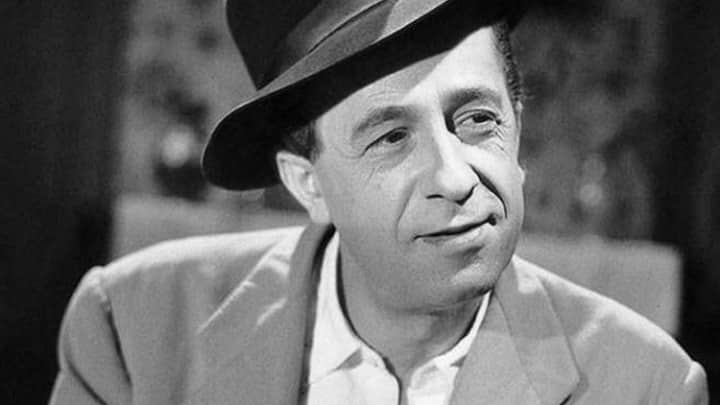
It is already 35 years since his death. For at least three generations, our beloved “Our Uncle Mimis”, the leading comedian, the sweet man, the deep-thinking artist, the unyielding dude, in life, in struggle, in art, in national resistance,
Mimis Fotopoulos will always live on, through his films and his writing, while the older ones will always remember with emotion his acting abilities in the theatre, and those who knew him will always remember his outward heart, the revelry, the authenticity of his character, his passion, the pure ideologist.
The legendary “Petrakis” of the classic comedy “Laterna, Poverty and Philotimo”, the most beloved “Soferaki” of the cinema, the sweetest “beggar” in the immortal “Kalpiki Lira”, is never forgotten. With the immediacy of his charismatic style, the warm tone of his voice, his sense of humour and his popular spontaneity, he will evoke the source of laughter and emotion, he will continue for many, many more years to put the salt and pepper that life needs and the sugar to sweeten us in the most difficult times.
From Zatuna and orphanhood to the theatre
He was born in a well-known village, today, in Zatouna, Arcadia. It is well-known not because Mimis Fotopoulos was born (8 April 1913) but - as he himself wrote in his autobiography “The river of my life” - because it was there that the junta exiled Mikis Theodorakis. Due to the premature death of his father, he was left an orphan and had a difficult childhood. But they would not be the only ones, because there would be worse to come. He would study for two years at the Athens School of Philosophy, only to give up and follow his dream, studying at the Drama School of the then Royal Theatre.
From the National Resistance to El Daba
The difficulties, however, would not end and after the war, came the occupation and his participation in the National Resistance. He joined the ranks of the EAM, fought for the liberation of his homeland and after the 1944 December riots - and after British troops burned the house where he lived with his brother - he was arrested by the British, only to be sent to the infamous El Daba camp. His family would lose track of him and he would eventually return to Greece in 1945. His bitterness from his detention experience will be captured in his book “Homer of the English - El Daba”. Survival conditions were very difficult, especially for Greeks who could not endure the inhuman climate of the African desert, and the prison guards did everything they could to further complicate the lives of the prisoners. Many lives were lost; fortunately, Fotopoulos was one of those who returned from hell.
The reboot of the reboot
However, he will find the courage to pick up the thread again that would make him perhaps the most beloved actor in the country. Before the war, he had been baptized at the age of 19 in the performance “Locadiera” with the Kounelakis troupe, while two years later, in 1934, he would begin his first tour with Themistocles Nezer's “Boluki”.
Art Theatre and Don Camillo
Upon his return, he will be lucky enough to work with the emerging Art Theatre, with works such as Chekhov's ‘Cherry Orchard“, Ibsen's ”Wild Ducks“, Shakespeare's ”A Midsummer Night's Dream“, and the Royal Garden Theatre. His success was enormous and in 1952 he would create his own company, with which he toured many foreign countries and even America. Somewhere there came his spectacular breakthrough in the craft of Greek cinema, although he never abandoned the theatre, making huge successes, often with his friend Dinos Iliopoulos, but also in many other performances, such as in the famous ”Don Camillo“ which he also transferred to television.
Adorable little soffer
In 1848 he would first appear on the big screen, with “Madame Susou”, he would play and stand out in the well-known comic satire “The Germans are coming back”, in the delightful comedy “Come to Uncle”, next to Nikos Stavridis and in the excellent melodrama “Groussouzis” with Orestis Makris. His first huge success will come with the classic romantic comedy “The Soferaki” by Giorgos Tzavellas, where he will uniquely embody the car driver, the party dude, who will be inspired by his love with Smaroula Youlis.
Pound, Vassiliadou and Philotimo
In 1954, the time will come for the “Beauty of Athens” who gives his best as the pimp of Georgia Vassiliadou, with Nikos Stavridis by his side again. Shortly afterwards he will play in “Kalpiki Lira”, in the unforgettable role of the supposedly blind beggar who is in conflict with the “coquette” Speranza Vrana. And in 1955 would come his iconic role in Sakellariou's immortal comedy “Laterna, Poverty and Philotimo”. Although Vassilis Avlonitis would give the performance of a lifetime, Fotopoulos is equally enjoyable and, more importantly, would keep the measure, bringing out the subtle social commentary on a society not living in paradise and, of course, the film's touching elements. He will do the same in the -one of the few sequels in Greek cinema- “Laterna, Poverty and Carnation” and again with the same cast. In 1956 he would star in the unforgettable romantic comedy “The Coffee Girl”, alongside the stunning Georgia Vassiliadou, in the role of a poor coffee drinker with a degree in dentistry.
From glamour to decadence
For five or six years the huge successes in cinema will continue, as he stars in and participates in beloved films, some of which have artistic merit. Indicatively some of these were ’Neither Cat Nor Damage’ with Logothetidis, “Phanouris and His Family”, “The Yellow Gloves” again with Logothetidis, “Poor Kids and Money”, with Stavridis and of course his last great personal hit “Theodore and the Dikanos”. The continuation was not what was expected, as the old commercial cinema had begun to decline from the mid-60s, and with the junta it almost reached complete collapse.
The... blackness and the collage
During the black seven years Fotopoulos, who was left alone with his two daughters, as his wife Margarita Tsala had been exiled to Gyaros, found a way out in painting, showing off yet another of his talents, using the technique of collage with stamps and holding a total of ten exhibitions. Furthermore, he always found time to write poetry (four poetry collections), he was also involved in trade unionism, in the difficult field of theatre, as a member of the Board of Directors of the SEI and a member of the Panhellenic Union of Free Theatre, while he was also president of the pioneering mobile theatre “Chariot of Thespis.
Mimis Fotopoulos, who left us his beloved figure in more than 100 films, would suddenly “pass away” from a heart attack on October 29, 1986, causing a shudder of emotion to all Greeks - even to his ideological opponents. After all, “Uncle Mimis” was one of those whose existence united the Greek people.
Harry Anagnostakis
Photo from the film “Laterna, Poverty and Philanthropy”. .