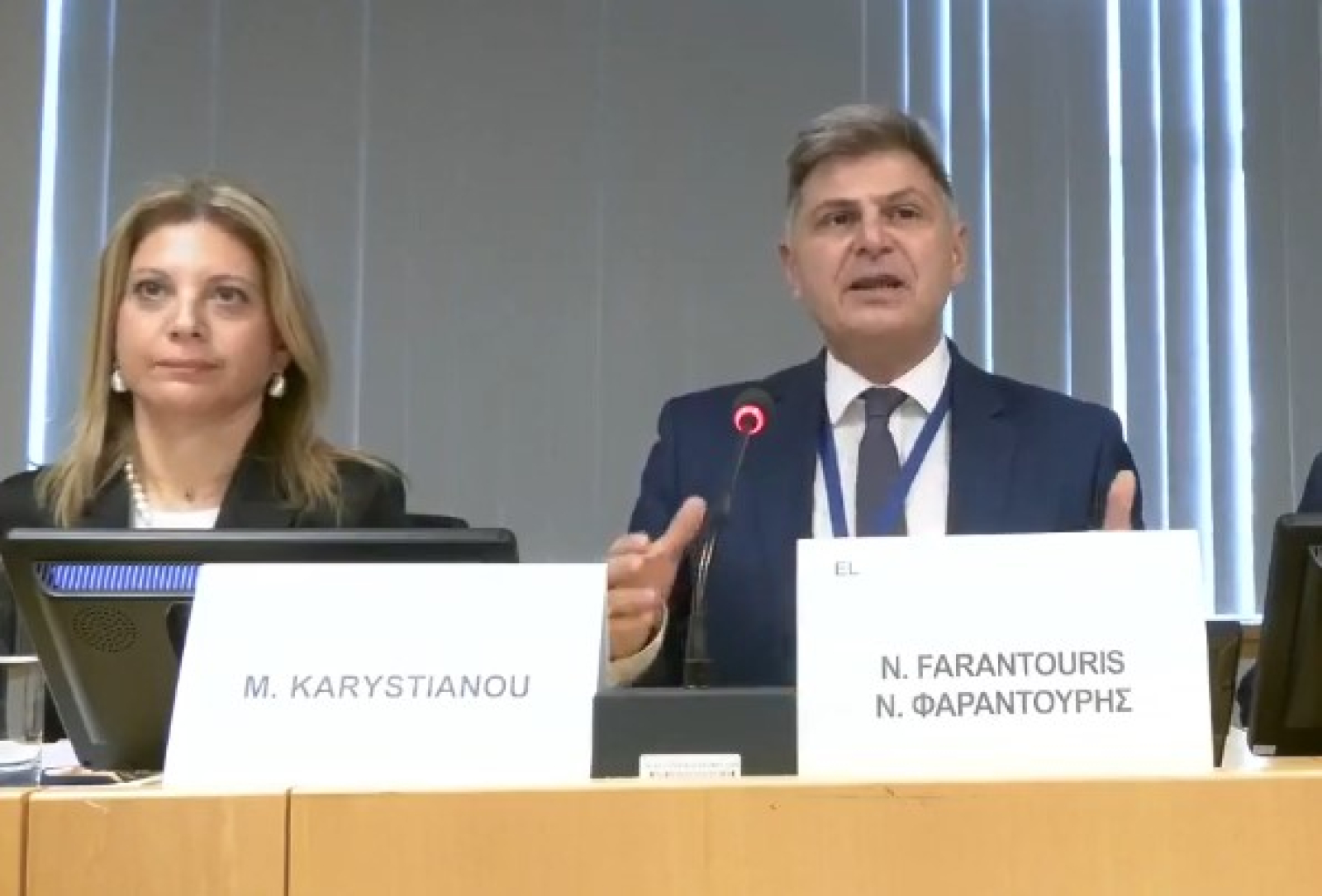
Maria Karistianou was emphatic in her speech to the European Parliament on “The primacy of European law and the Constitution in corruption cases,” arguing that EU law takes precedence over national law and that the European Public Prosecutor's Office (EPPO) should also investigate the criminal liability of politicians. At the same time, in her speech she highlighted a number of institutional gaps and omissions which, she said, shaped the landscape of the Tembi case, emphasizing the need for effective oversight, effective enforcement of European law, and greater accountability at both the national and European levels. She made special reference to the way in which the competent national and European authorities approved the operation of the railway, despite the known gaps and serious safety deficiencies. As he pointed out, oversight was inadequate and interventions were limited, with the result that the risks, which, as it turned out, had dramatic consequences, were not addressed in a timely manner.
They are financing a railway that is «hanging in the air.».
According to what Ms. Karistianou said in her speech, the Railway Regulatory Authority (RAS) was aware of the gaps, shortcomings, and risks in Greek trains—and yet it issued operating licenses as normal. Despite the findings, it limited itself to ’recommendations« and fines, which are ultimately paid by citizens, without revoking a single safety certificate. The same applies to the European Commission's DGMOVE: although it was aware of the situation, it turned a blind eye. It did not demand, it did not press, it did not intervene. Thus, neither ERA nor DGMOVE exercised their duties to prevent a fatal accident — nor afterwards to ensure that something similar would not happen again. Instead, they continued to fund a railway that was »hanging in the air.«.
She pointed out that, after the tragedy, Mr. Tzitzikostas, who was from the party that was in power when the accident happened, was appointed as commissioner. His intervention was limited to «what's done is done,» confirming that there was neither accountability nor willingness to investigate. The picture is one of an abandoned railway and a Europe that does not control where its citizens' money goes. According to Ms. Karistianou, this policy has led Greece to be among the most corrupt countries in the EU, pointing out that when we talk about corruption, we are talking about the actions of the powerful, not ordinary citizens. In fact, she recalled that the Association of Accident Victims collected 1.3 million signatures, made reports to the European Parliament, and took to the streets. Ms. Karistianou did not fail to mention that they had placed their last hopes in the EPPO — hopes that were dashed in the harshest way possible.
Article 86 does not prevent the criminal prosecution of politicians.
Ms. Karistianou expressed the view that in Greece, the EPPO did not apply European law, as it did not conduct the critical investigation of the politicians who supervised or were involved in contract 717. She believes that this move violates the core of the rule of law: no minister was held accountable and no politician was effectively investigated for their responsibilities.
The EPPO limited itself to a simple memorandum on Article 86, even though this article does not constitute an obstacle to the criminal prosecution of politicians, according to Ms. Karistianou. In other words, it does not provide immunity; it merely establishes a procedure through Parliament. Invoking it as an «obstacle» has no legal basis. Thus, with its stance, the EPPO perpetuated a system where power remains untouchable, allowing its criminal activity to continue without consequences.
Therefore, based on what Ms. Karistianou said in the European Parliament, when the European accountability mechanism is limited to a misinterpretation of an article that does not constitute an obstacle, then Europe is not protecting justice—it is abandoning it.
Responsibilities also lie with the European authorities
Maria Grazia, lawyer for the families of the victims of the Tembi tragedy, speaking at the European Parliament, stated characteristically
”We already had a flawed system in the railway network, for which Greece and the European authorities responsible for supervising compliance with EU legislation in this area were responsible. We also had a series of violations of EU law on multiple grounds after the Tembi tragedy. So, a range of issues has emerged that fall within the exclusive competence of the European authorities, which have been repeatedly alerted and yet have not intervened, except for the Committee on Petitions, where a report on the issues raised has been pending for years. The Transport Committee has initiated infringement proceedings, which have been frozen for many months.”
resulting, according to Ms. Gracia, in no tangible outcome.
She went on to say, “The EPPO, which is responsible for investigating criminal liability for offenses against the interests of the EU, in a decision taken on 2/6/2023, invoking a statute of limitations that does not exist in the legal world, which was invoked by the 11th department of the EPPO, decided not to investigate financial crimes that harm the interests of the Union and for which it has exclusive jurisdiction, and to refer the entire case file, i.e., the investigation and, by extension, the prosecutions, to the Greek Parliament. This raises the question of whether or not European Regulation 1939/2017 on the EPPO, which has exclusive competence and responsibility for ensuring the proper management and allocation of European funds, has been complied with.”
In closing, Ms. Gracia raised the question of whether European legislation is being complied with or remains a dead letter.