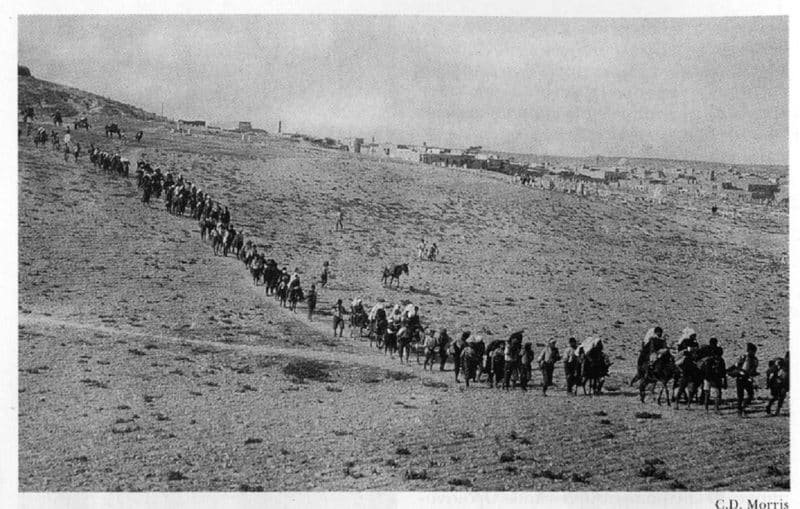
In these days when we recall more intensely how the heroes of the Greek Revolution threw themselves with self-sacrifice in the Struggle «for the Holy Faith of Christ and the Freedom of the Fatherland», we owe eternally a candle to the memory of the hundreds of thousands of victims of the Greek Revolution. Genocide of the Greeks of the East who sacrificed themselves for their faith.
The issue of the organized persecution of the Orthodox Church in Pontus, through the extermination of priests of all ranks - from bishops and bishops to clergymen -, monks and seculars, but also through the looting and disgrace of sacred places of Christian worship, is dealt with in Theodora Ioannidou's new book entitled «The extermination of the Orthodox Church of Pontus».
The author of Those Who Never Laughed, now in its 4th edition and also available in English translation, comes again to contribute to the Pontian literature with a careful edition, which presents evidence not only of the barbaric events (massacres, hangings, crucifixions, burnings) against the Church in Ottoman Turkey, but also of the later fate and action of the surviving clergy and monks in Greece. A separate chapter is also devoted to the priestly relics of Pontus.
Thedentist Theodora Ioannidou, who is a third generation Pontian, with origins from Oinoi, Matsouka and Chaldia from her grandparents, includes in her book several unpublished photographs and primary material, since in the context of her research she came into contact, apart from foundations and associations, with descendants and relatives of clergymen, monks and members of the missions, such as the great-grandson of the volunteer American doctor in Makronissos Olga Stasny, William Skocpol.
From the «testimony» of Theodora Ioannidou, as we have already mentioned, there is no lack of ordinary believers who sacrificed themselves in the name of Christ, such as the inhabitants of the village of Karapunar who were set on fire inside the church of St. Charalambos. The 75 girls who were in the temple before they were burnt were abused by the barbarians. One of them was the sister of the teacher and researcher George Antoniadis, Sevasti. The family of Kyriaki Poimenidou preserves the memory of the horrible event, since the seventeen-year-old girl was saved from the burning of Agios Charalambos and the abuse, because she was in the fields.
Obviously, the book could not have missed the beacons of Orthodoxy in Pontus, the monasteries of Panagia Soumela, St. George Peristeriotas and St. John Vazelona.
The author is shocked in the following extract from the chapter on Basilona:
«...Vazelon is desolate and mute.
»Never have trees, never birds, never wild animals heard a more plaintive wail than the forests around Vazelon. Inside and outside the monastery the knives were lit, slaughtering the innocents of Christendom and, once again, uncivilized people trampled on centuries of civilization. Together with the people, they destroyed antiquity, Byzantium and the Orthodox Church. It has been over a hundred years since then. The blood of the innocents of the Basilona was not justified. Did the powerful of the world realize that some powerless people were there to save human dignity and spiritual property? And if they did, did they respect it? Power usually inactivates codes of understanding or uses them selectively. This is why the 1916 sacrifice at Vazelon sank into oblivion.
»Kyriaki Tsironidou and the other thirteen girls, who were horribly abused before they were killed, along with the hundreds of other victims in the region, are the eternal pillars of good, who, being attacked by evil, choose the path of martyrdom...»
One realizes that the goal of Theodora Ioannidou is not only to study, record and present the chronicle and the implications of the «extermination of the Orthodox Church of Pontus», but primarily to awaken consciences.
Her goal, in the face of the «main target of the genocide unleashed at the beginning of the last century against the Pontians», was their faith, as the author states on the back cover of her second book.
«Christianity was sown in Palestine, but it grew and flourished in Greek lands. In places where, as in Pontus, the necessary spiritual conditions had existed for hundreds of years. The expatriates, dramatically cut off from metropolitan Greece, supported with self-denial their racial and Christian origins, being persecuted hard. and, in many cases, the end of their earthly journey was marked by bullets, spears and axes. They can be a model for an attitude of life, since anything left standing in our pilgrim times will be directly linked to the concept of sacrifice.».