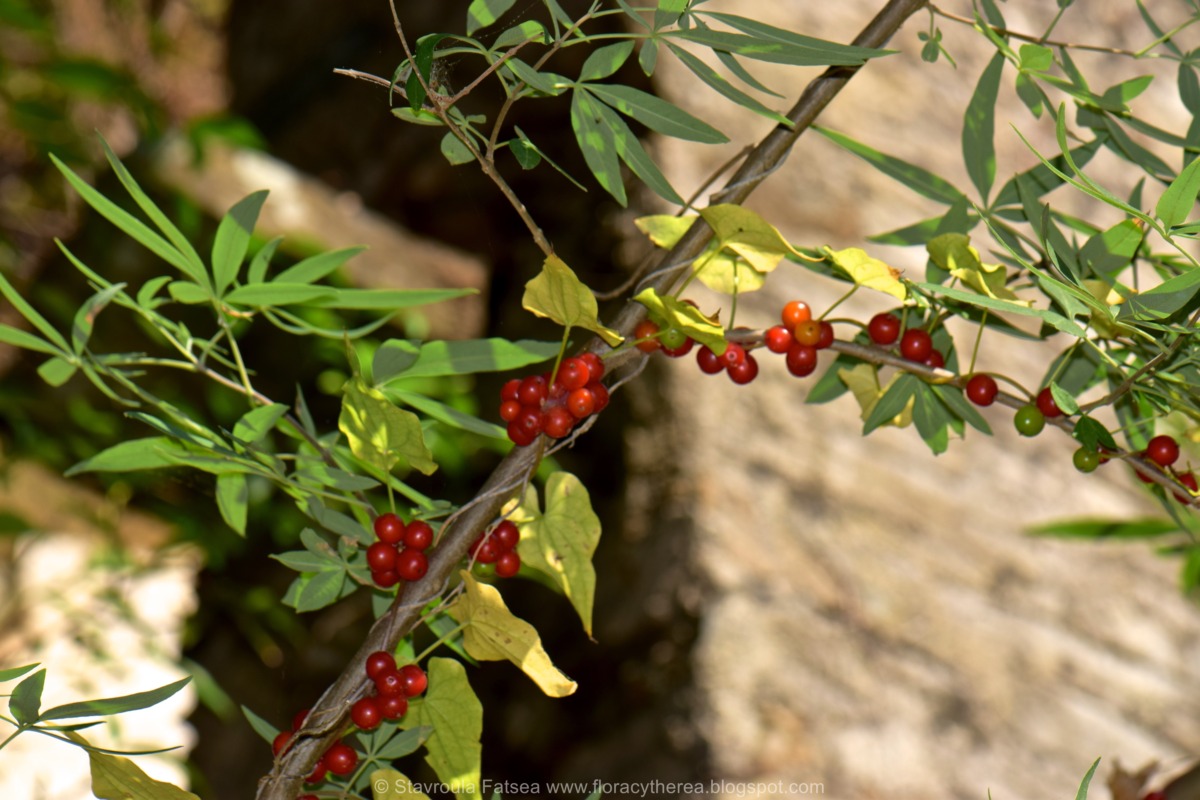
Dioscorea communis (L.) Caddick & Wilkin
Syn. Common tamarisk L.
Dioscoreaceae
Αa climbing, winding plant that can reach a height of 3 m. Native to the Mediterranean basin, it has spread over much of Europe and Western Asia. It occurs in a variety of habitats, from scrub and woodland to hedgerows and roadsides, usually in soils with good drainage and adequate moisture (Tutin et al., 1980; Pignatti, 2017).
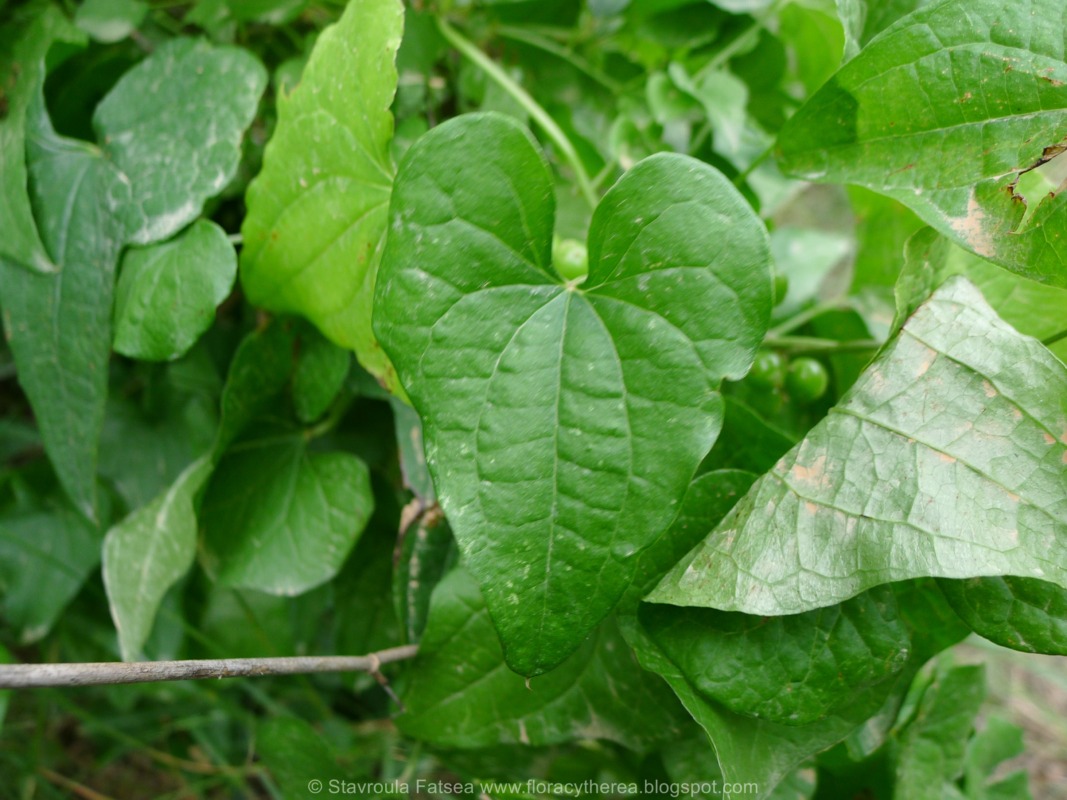
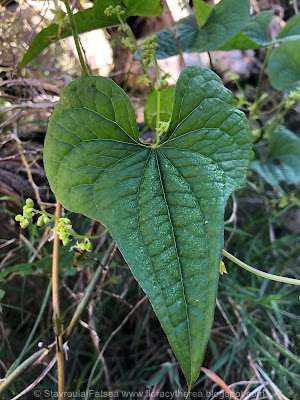
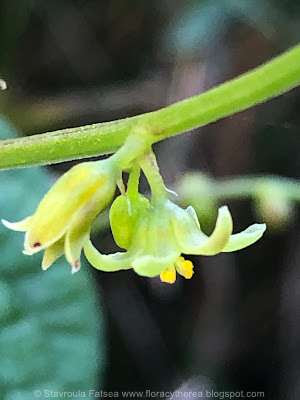
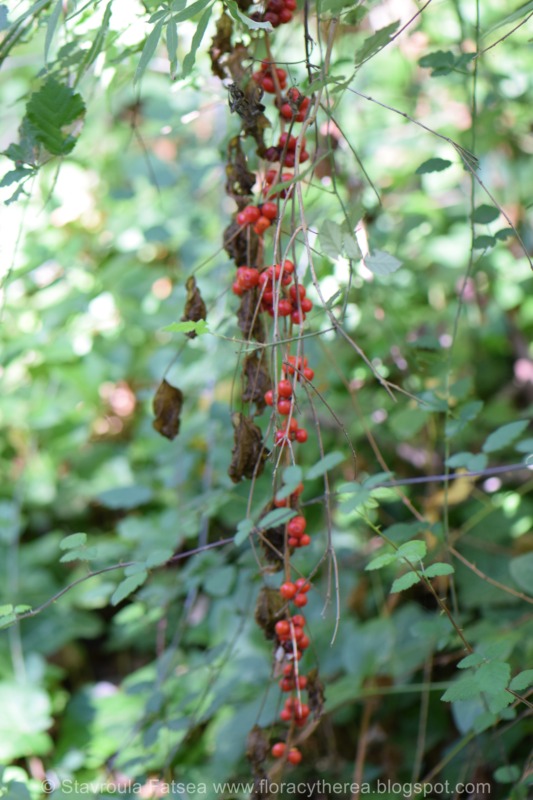
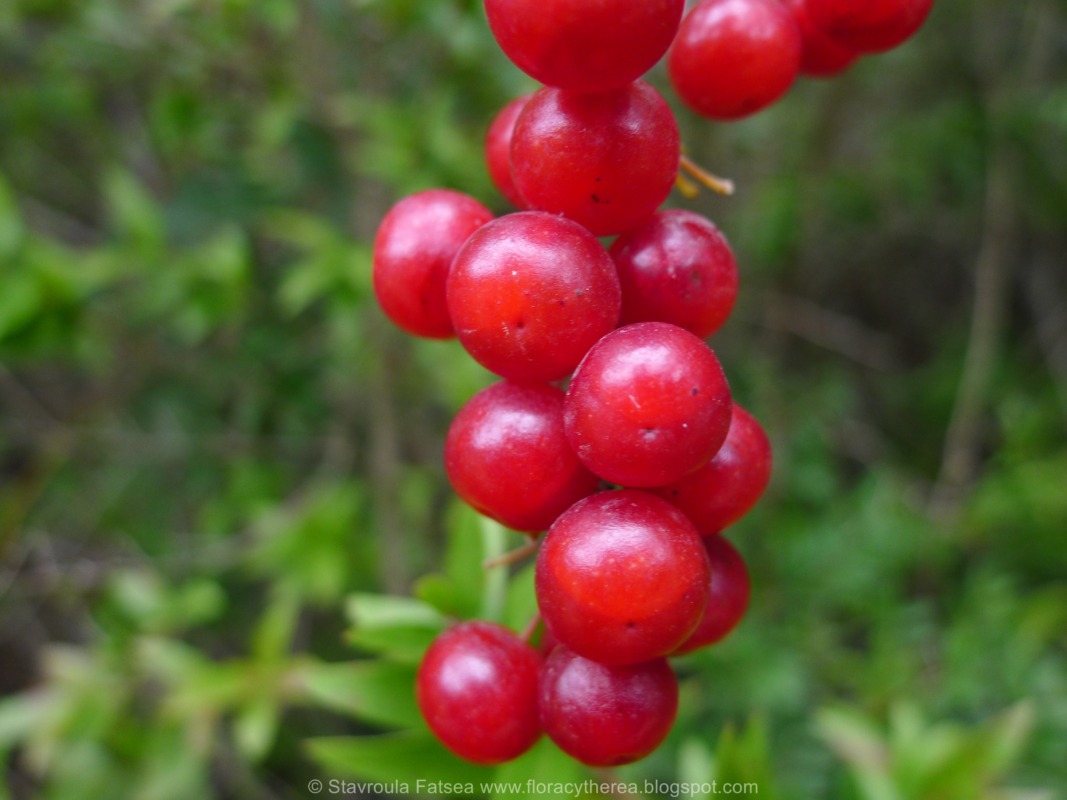
Its large, shiny leaves have a characteristic heart-shaped shape, while the fruits are bright red berries. The tiny, pale yellow flowers are male and female on different plants (dioecious species) and occur in loose herbaceous clusters. Unlike other climbing plants, it does not bear tendrils but climbs by winding around other plants.
Its large tuberous root has a dark, almost blackish sheath and, although it is considered one of the oldest laxatives, it contains toxic substances (mainly saponins and steroid derivatives) and its use carries risks (Mabberley, 2017).
All parts of the plant are toxic to humans, especially the fruits and the root, and although medicinal properties (diuretic, emetic, anti-arthritic, anti-burns, laxative, etc.) have been reported since antiquity, it is recommended that its internal use should be avoided completely (RHS, 2023).
Several researchers have speculated that this is the plant that Pedaenius Dioscorides describes as the «melina vine». However, more recent studies show that this identification is probably incorrect, as Dioscorides' description refers to a plant with tendrils and black fruits, characteristics that do not correspond to the Dioscorea communis, but are more suited to the species Bryonia alba (Renner & Scarborough, 2008).
.... vine of melina; [and the bryony melina,] and the chironion, [and the bucranion, the Romans ova tamina, and the ova tamnuta, and the vitis alba, the dacia triad, and the patrina, the afroi laoua]; the leaves are like unto the leaves of the vine, and the leaves are like unto the leaves of the milacos, and the hot ones ; and they are like unto them. And this also is taken from the trees to the olives; and the fruit is pale and pale at first, and the thorns are turned to honey; the root is honey outside, and the inside is piceous. {And of this also the horny ones are panting at the first budding; and the tickets are diuretic, and the tickets are of a diuretic nature, and of a catamenial motility, and of a splenic spleen, and are fit for the epileptic, and for the paralytic, and for the scotomous. And the root hath a power like unto the white one, which is fit for them, and worketh them; and it doeth also to the hills of the sub-hills, wherein the leaves, when they are waxen, are also covered with the leaves, and likewise to the acres.
Dioscorides, On the Matter of Medicine, 4.183
In the same way, the plant retained common names associated with bryony (avronia, avronies, obrioi, avrines in Kythera, black bryony in English etc.). The French name herbe aux femmes battues («herb for bewitched women») is attributed to the popular use of poultices from the root to treat bruises and ecchymoses.
The former name Tamus probably related to the Latin taminia uva mentioned by Pliny the Elder about a related climbing plant, but the identification is not certain. The modern name Dioscorea was given in honor of Pedanios Dioscorides, while the surname communis means «common».
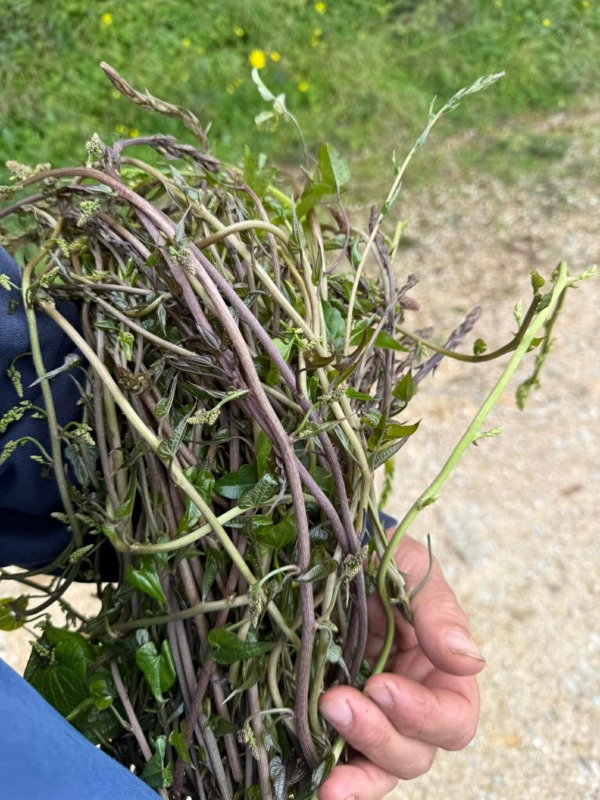
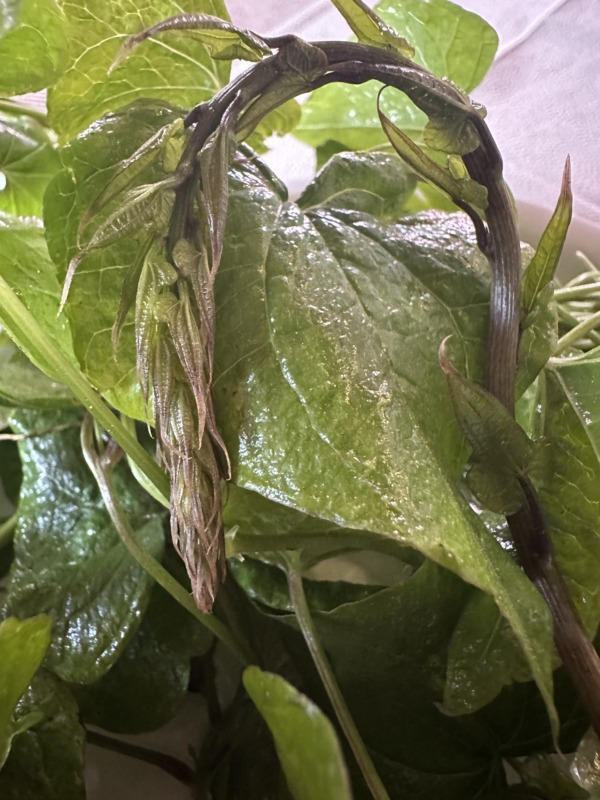
In Kythera, the young shoots of the plant, known as avrinei, are harvested in spring and eaten as a salad, often with wild asparagus. They are always eaten boiled, with coarse salt and oil lemon. It is a very popular dish, especially for those who like bitter flavours. Several people have told me that they even drink the juice in which they boil the asparagus, which changes colour dramatically when lemon is added (from brown to orange-red). They consider it an excellent remedy for the kidneys and for detoxifying the body in general. Some people, especially in the south of the island, eat them fried in an omelette.
This practice is based on traditional knowledge, as the plant is toxic in its raw form.
Many thanks to my compatriots Mike, Panagiotis and John for their help and to Dimitris for providing me with the photo of the Avrinians.
CAUTION! PLANT IS TOXIC TO POISONOUS IF CONSUMED RAW OR USED UNPROCESSED.
Bibliography - Sources
- Tutin, T.G. et al. (1980). Flora Europaea, Vol. 5. Cambridge University Press.
- Pignatti, S. (2017). Flora d'Italia. Edagricole.
- Mabberley, D.J. (2017). Mabberley's Plant-Book. Cambridge University Press.
- Renner, S.S. & Scarborough, J. (2008). “Black bryony and Dioscorides reconsidered”.
- De Materia Medica - Pedanius Dioscorides
- Naturalis Historia - Pliny the Elder
- Royal Horticultural Society (RHS) Plant Database
Find out more about the flora of Kythera on Stavroula Facea's blog:
https://floracytherea.blogspot.com/