Galactites tomentosus Moench
Galaktitis ο granular
Synonyms: Galactites elegans Nyman
Centaurea galactites L
Carduus galactites (L.) Chaub.
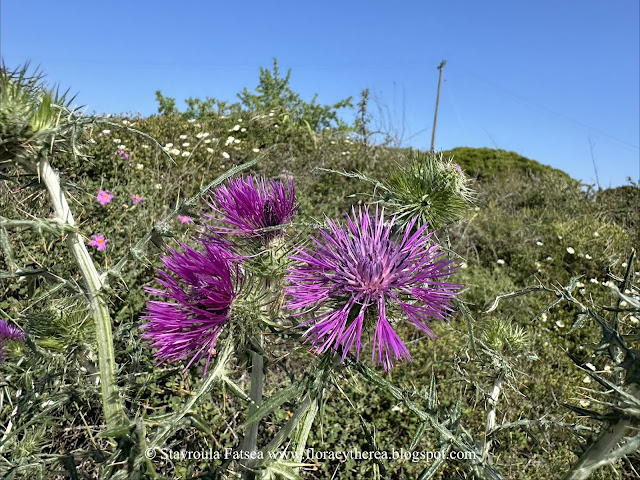
The Galactites tomentosus It is one of those thorny Mediterranean plants that are hard to miss. The silvery-white veins of its leaves, its pink flower heads, and its almost velvety texture make it stand out even amid the spring profusion of Mediterranean flowering plants. Although often considered merely a «thistle,» this species is a characteristic feature of the southern region’s phryganic and disturbed ecosystems, while also being associated with a long tradition of folk names and therapeutic beliefs surrounding «milky» plants.
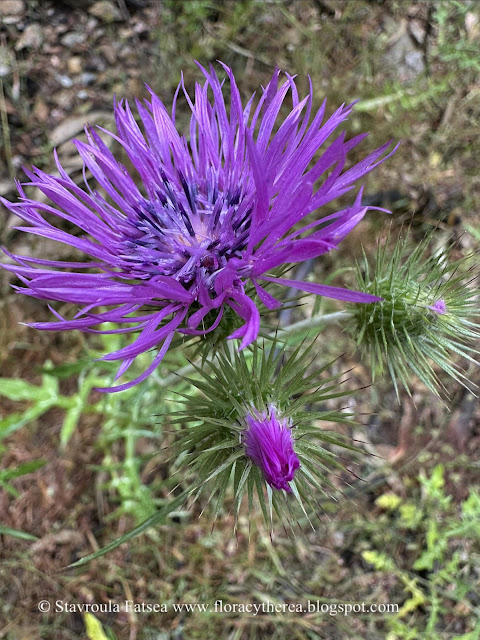
The plant is an annual or biennial and initially forms a rosette of large, deeply lobed leaves. The leaves are characteristically white-green, with prominent silvery veins and sparse to dense pubescence; the epithet tomentosus refers precisely to this downy, «clay-like» surface. The stems are erect, branched toward the top, and bear spiny bracts. The flower heads, usually purple to pink, are surrounded by spiny bracts and appear from spring through early summer. The fruits are achenes with a pappus, adapted for dispersal by the wind. A diagnostic feature of the species is its marbled leaves and its relatively soft, downy appearance, which distinguish it from other, more glossy or intensely spiny thistles.
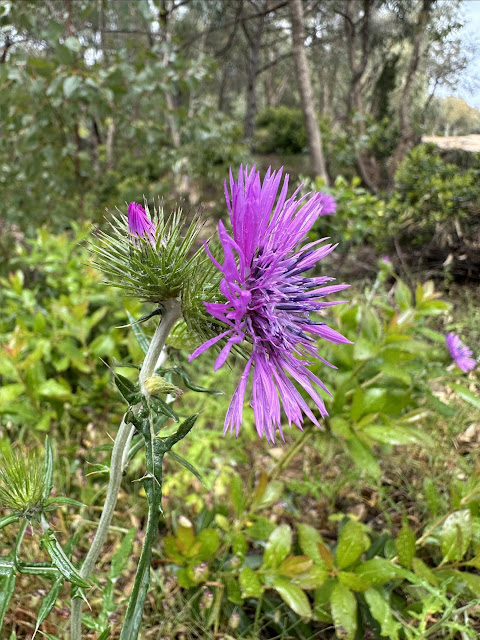
Its natural range covers a large part of the Mediterranean. It is found in Greece, Italy, the Iberian Peninsula, and North Africa, and has also been introduced elsewhere as an imported or naturalized species. It grows mainly in scrubland, along roadsides, on fallow land, in olive groves, on uncultivated fields, and generally in areas disturbed by human activity or grazing. It thrives in dry, sunny environments, from sea level up to relatively mountainous areas, usually below 1,200 meters.
In folk tradition, the plant is classified among the various «thistles» or «koufagatha,» names that are often applied indiscriminately to many related species in the Asteraceae family. In some regions, the young leaves or shoots are reported to be used as edible greens after the thorns have been removed, although the species does not appear to have had as significant a nutritional value as other thorny plants of the Mediterranean, such as the Scolymus or the artichoke. Like other plants with white veins or milky sap, it has been associated in folk tradition with promoting lactation, in line with the old belief that a plant’s form indicates its properties—the so-called «Doctrine of Signatures.» .
The scientific name of the genus is derived from the Greek word «γάλα,» from which the Latin adjective was derived galactites = «milky» or «relating to milk.» This reference most likely pertains to the white marbling on the leaves, a characteristic that, in many Mediterranean plants, has been symbolically associated with the milk of the Virgin Mary or with lactiferous properties. Similar beliefs have been known since antiquity, and Pedanius Dioscorides and later botanists describe various «milky» thistles with medicinal uses, although the exact correspondence with the modern species is not always certain. The characteristic adjective tomentosus derives from the Latin adjective tomentosus, –a, –um, which means «downy,» «fluffy,» «covered with thick, soft hair.».
The Galactites tomentosus is often confused with species of the genera Carduus, Cirsium or even with the Silybum marianum, mainly because of its white-veined leaves. However, the latter has larger flower heads and distinctly different bracts. Evolutionarily, the white spots and dense fuzz of the Galactites These are likely related to adaptations to arid and hot environments, helping to reduce water loss and reflect the intense Mediterranean sunlight. Despite its rough and thorny appearance, the plant attracts a multitude of pollinators and is part of the distinctive spring vegetation that characterizes Mediterranean landscapes before the summer drought.
Learn more about the flora of Kythera on Stavroula Facea's blog Flora Cytherea.