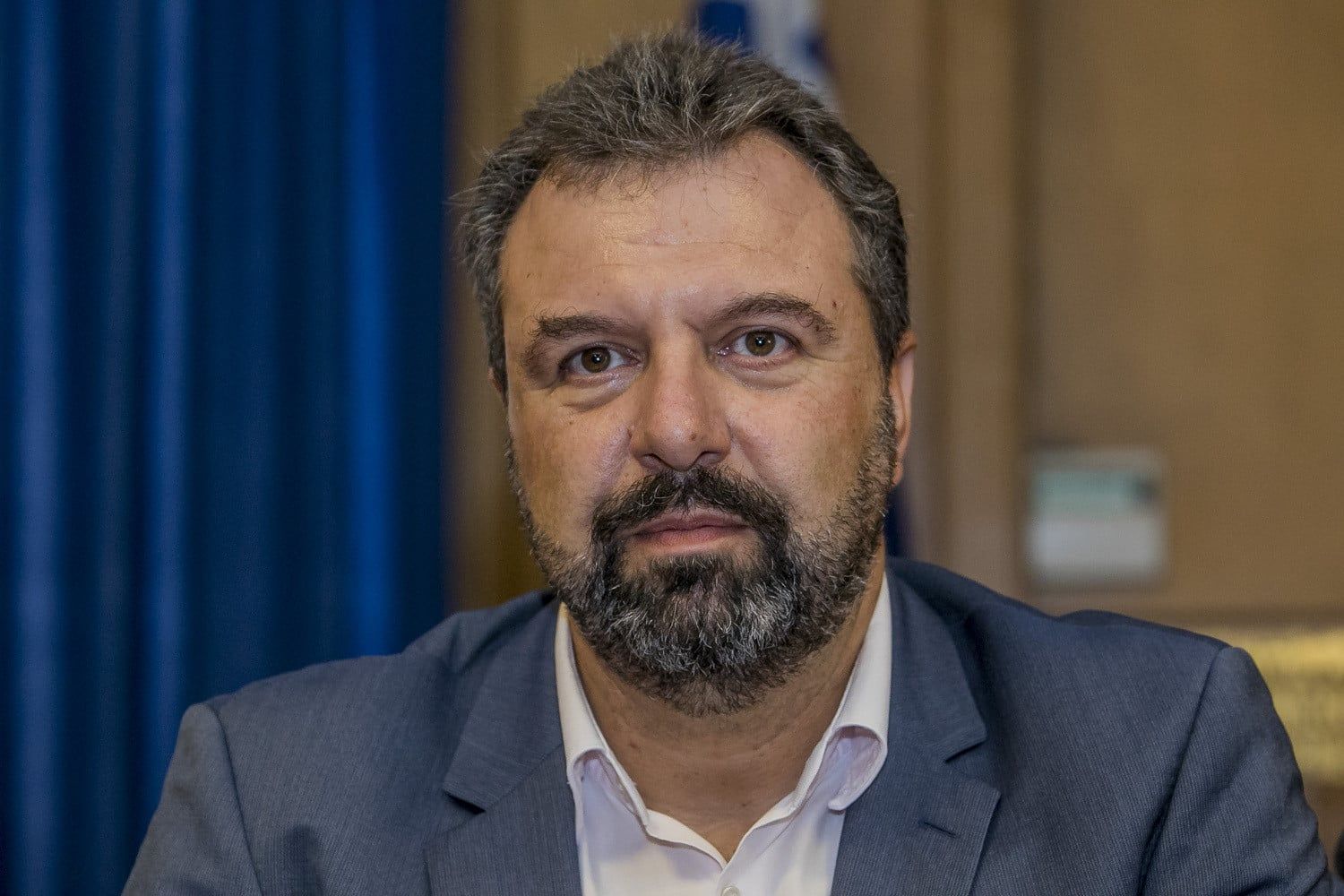
The profound changes that bring for Greek producers the new CAP and the National Strategic Plan prepared in secret by the New Democracy government is referred to by Stavros Arachovitis, Minister of Rural Development of SYRIZA-P.S., former Minister of Rural Development and Food, in an interview with Sunday AIGI. He talks about the problematic points in the National Plan, the incomplete and inadequate preparation of the competent services, the low level of information of farmers, the serious problems of the primary sector from the soaring production costs, the inability to take effective measures by the government and the bailing out of OPEKEPE and ELGA and analyzes the framework of the new agricultural policy of SYRIZA-P.S.
Only a few hours remain before the new Common Agricultural Policy (CAP) comes into force in our country. What are the big changes coming for the agricultural world and how do they affect the income and activity of producers? How do you assess the corresponding National Strategic Plan (NSP) of the Ministry of Rural Development?;
The CAP is the oldest and only common policy in Europe and the most important financial instrument for primary production and our country, ensuring 19.4 billion inputs, and covers the period until 2027. It obviously exceeds the mandate of the current government and the entire productive world of the country.
The government of the New Democracy preferred to formulate an ESS in secret without the effective involvement of farmers, farmers, beekeepers, beekeepers and fishermen, cooperatives and processors, without integrating the proposals of the opposition, the scientific community and the collective bodies.
The ESS brings tectonic changes in the distribution of subsidies and affects all producers. In short, we can expect a widespread redistribution of money that small and medium-sized enterprises, mountain and island producers, pastoralists and traditional crop farmers will suffer reductions, as a study by academics has shown.
As the SYRIZA government we had started a serious preparation for the consequences of the new CAP in cooperation with the public universities of the country. Unfortunately, the New Democracy government of the «aristocrats» did not take the preparation into account and bears full and sole responsibility for the distribution of subsidies until 2027. Our proposal for «Redistributive Aid» as compensation to farms whose viability is affected was not utilized.
The first and biggest losers are the mountain pastoralists, since they lose almost all the support of the «greening», currently amounting to 185 million.Similarly, the government of the New Democracy has treated the olive sector without a strategy. The horizontal reduction due to convergence and the simultaneous non-replacement of the «greening» will put producers, especially in mountainous and island regions, in a very difficult position.
Instead of «Eco-schemes» being simple and targeted to areas and crops based on environmental protection and comparative losses due to the loss of «greening», they are becoming a bureaucratic, labyrinthine and costly mechanism. At the same time, the achievement of the targets that are set, are a criterion and must be met as Member States, so that the country is not threatened with fines/charges, is called into question.
Coupled aid is the only type of aid that is directly linked to production. It should therefore be treated as a tool to help shield production of critical products, ensure much-needed food security and support domestic processing. Instead, we see that, under the ESS, we are seeing the loss of coupled support for a number of crops such as maize in dynamic areas, the plain of Thessaly, while issues of high prices have arisen since the war, non-PDO apples, nuts and sugar beet.
«Redistributive aid», the key tool that can be used to support the sustainability and resilience of micro and small farms threatened by the changes of the new CAP, is not sufficiently exploited.
The data on the investment pillar are no better. The amount foreseen for public investment is tragically low given the needs of Greek agriculture. The promising AKIS system remains unclear and vague, while no innovative measures are envisaged to deal with the multiple crises the country is experiencing and those that may follow.
Once again a right-wing (or clumsy) government is planning and a progressive government will implement the CAP. With the proposals we are working on, we are discussing with society and planning changes where politically and temporally feasible.
You have recently spoken, also in Parliament, about delays, incomplete preparation on the part of the competent services both in terms of the new CAP provisions and guidelines and in terms of information for farmers. What are the main issues in view of the implementation of the new framework?;
The level of preparation is incomplete both in terms of the services of the ministry and in terms of OPEKEPE services, the platform for receiving the measures, the institutional framework and the corresponding human resources. At the same time, the low level of information of those directly involved, the farmers and their technical advisors, creates great insecurity as to the extent to which they will be able to cope with the new, complex procedures included in the CAP. It is characteristic that, based on a nationwide agricultural survey, 73% of the respondents stated that they were little or not at all informed about the new CAP.
A large number of producers have already started sowing without being sufficiently informed about the eligibility requirements under the new framework. This is a «blind date», with unforeseen consequences for producers' rights and a failure to absorb the relevant resources of the new CAP.
The combination of an unprepared administrative machinery to receive an admittedly heavy, complex and novel NAP, a sketchy and inadequate institutional framework and technical applications and a lack of information, understanding and ultimately the inability to make the right choices by the farming community create conditions of a «perfect storm» over the heads of producers.
The main issues for us as SYRIZA-P.S. are, in broad terms:
- The viability of micro, small and medium-sized farms and those with natural handicaps and constraints, such as mountainousness/insularity.
Shielding domestic production against multiple crises (economic, climate, health).
Changing the production model to focus on people, producers and consumers, with the production of higher quality and healthier products, without depleting natural resources, with sufficiency and affordable prices for all.
After three and a half years of the New Democracy government, how would you describe the current situation of Greek producers? What are the main problems they face and how do they affect the primary sector of our country as a whole?;
According to a recent survey, 91% of farmers are frustrated, feel unprotected and marginalized by the agricultural policy of the ND government (Metron Analysis).
A brief account of the works and days of the New Democracy government in agricultural policy starts with the soaring costs of production in feed, fertilizers, energy and agro-food, long before the war started. The particularly problematic point is the inability to understand the mechanisms of rising production costs, hence the inability to intervene effectively. It is indicative that the part of the new budget for the Ministry of Agriculture and Rural Development is reduced by EUR 59 million compared to the previous budget, which was also reduced by EUR 109 million compared to 2021.
The lack of working hands, which is clearly due to the far-right ideologies of the South-Democratic government, is perhaps the biggest headache of the farmers. The abolition of the provision of AMKA to migrants (July 2019) and the SYRIZA legislation on the employability of irregular residents has led to the exodus of thousands of farm workers.
Since November we had reported on the serious problem of low prices to the producer, which was dramatically confirmed by Eurostat data, according to which our country has been ranked, steadily for the last year now, as the worst in the EU in terms of the price enjoyed by producers. At the same time, retail-consumer prices are reaching a «cap» of more than 300%!
Under these circumstances, the sustainability of domestic production and the retention of the population in the countryside are at stake, threatening regional cohesion and ultimately regional security.
Are there solutions and answers to these critical issues? How can we address the precision and energy crisis that affects all activities of the Greek economy? Do you think that domestic production is at risk and to what extent are we all threatened by a food crisis?;
Only a progressive governance with a humanitarian and productive orientation can provide answers to the impasse in which the government of the complex is pushing. Alexis Tsipras has outlined the axes on which agricultural policy will move when - we believe very soon and before it is too late - SYRIZA-P.S. is called upon to form the core of progressive governance.
The diagnosis of the mechanisms that cause the agricultural production crisis and the consumption crisis, which together threaten society with a food crisis, not as a lack of food, but as a failure of domestic production and final consumption, requires the formulation of a new model of production and consumption.
In our programme, farmers, stockbreeders and fishermen, as well as manufacturing, are at the forefront, because we believe that they are a key element in the development of a country.
Immediate priorities include interventions to reduce production costs through non-payment of VAT on agricultural oil, reduction of electricity, support for the purchase of feed and fertilizer, change of the ELGA regulation, and resolution of the issue of farm workers.
At the same time, we are proceeding with the redesign of financial instruments such as the Growth and Resilience Fund and the ESF of the new CAP.
We are developing strategies to support important productive sectors, such as livestock farming, support for agricultural and fishing activity in mountainous, disadvantaged and island regions of the country, investment in the food and beverage industry, investment in rural education, knowledge transfer and promotion of innovation in agricultural practice, investment in infrastructure and green-digital modernisation of the primary sector.
What has been happening to key organisations and services in the agricultural sector in recent years? Have there been substantial policy cuts for reorganization and development in OPEKEPE and ELGA?;
It is an undeniable fact that the government of the New Democracy in the last three and a half years has undermined the operation of OPEKEPE as the competent body for the payment of agricultural subsidies, resulting in one worse payment than the previous one and the threatened fines now exceeding 600 million euros. Direct awards have become the norm here too, with the scandalous preference for certain companies. And the worst thing is that, by the political leadership's own admission, the mechanism of the ministry and OPEKEPE is not yet adequately prepared for the implementation of the new CAP, which starts within days.
At the same time, due to climate change, the damage in recent years has been extensive. In 2019, the previous administration and political leadership of the Ministry of Agriculture and Rural Development had initiated the preparation of an actuarial study by an actuarial consultant, which would provide guidelines for changes to the insurance regulation with a view to a public, solidarity-based, socially just and sustainable ELGA. The study was delivered, but it remains and is waiting in a drawer in the ministry. At a time when producers have not been paid for losses from the previous year, advances are being distributed on a case-by-case basis, outside of any scientific logic, based solely on petty party interests. The result, of course, is that in the end they are claimed back from the producers.
The New Democracy government is heading rapidly towards the exit, trapped in its ideologies and inefficiency. The change of three ministers and four presidents in the OPEKEPE show a lack of policy.
The new progressive governance with SYRIZA-P.S. as its core comes as a «mature child of necessity», as our great poet Kostas Varnalis says. The Greek people have a benchmark in honesty, transparency, social sensitivity, accountability and justice. We are confident of their choice.