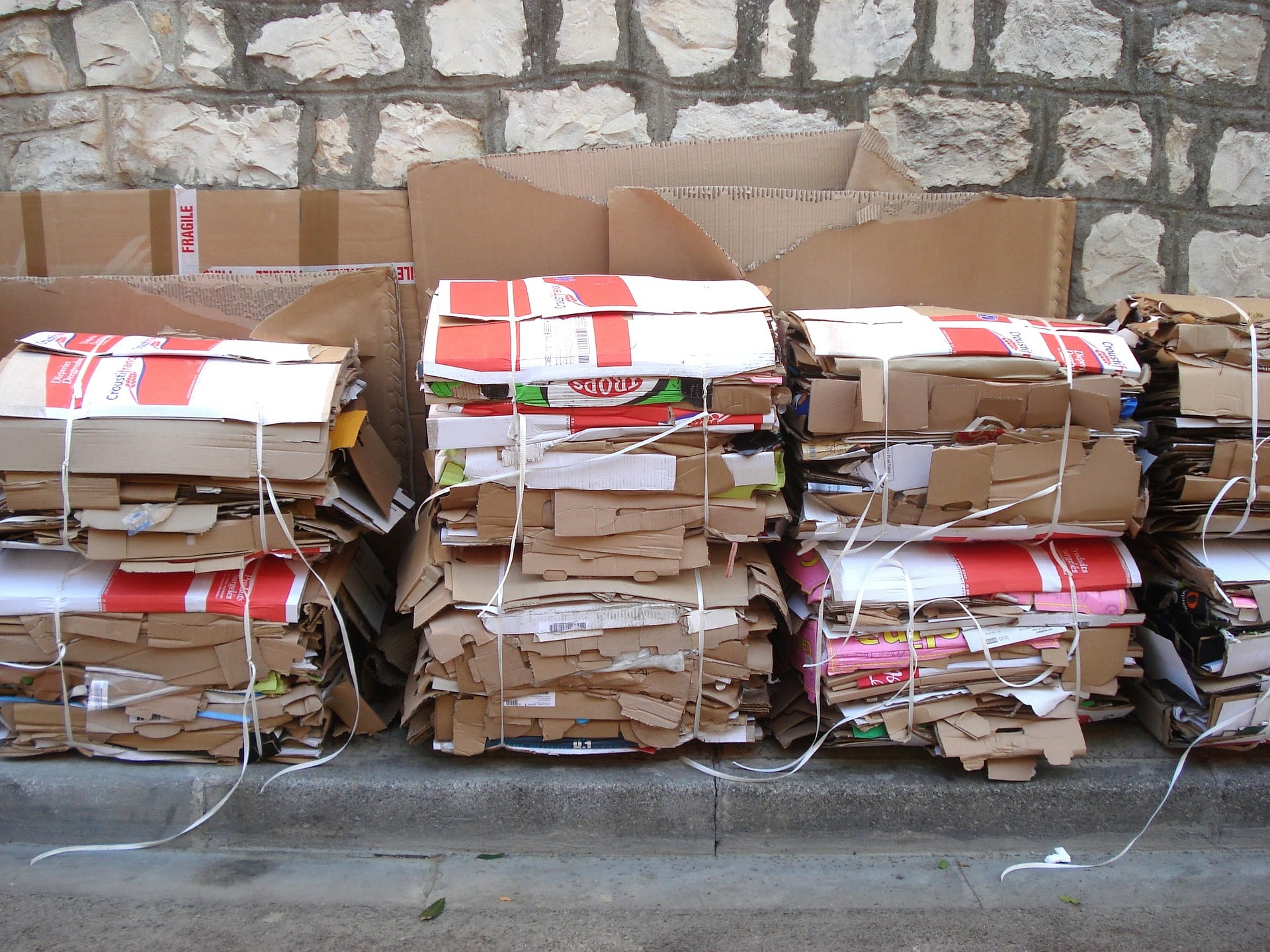
Trucks unload hundreds of tons from morning until late at night. Workers tirelessly sort recyclable products before they are sent for baling. The machines run at full capacity, and production almost never stops... This has been the daily reality for the waste management and circular economy sector for four decades. One of the fastest-growing sectors, it has given rise to some of the strongest industries in the Balkans. The decade-long crisis that followed, changing the industrial landscape of the country, was to drag many of the biggest names in the sector into a future very different from what had been predicted: The economic hardship that would prevail at all levels would bring financial problems, closures, mergers, court applications for protection from creditors, and rescue plans, tearing companies apart like a page of paper. It is characteristic that in 2012, when the crisis was raging, the 52% (the 29) of the 92 largest companies in the recycling sector, with total sales of close to €1 billion, were loss-making.
Back to 2022. The coronavirus health crisis and rising material prices on the market are enabling large companies in the sector to increase their real value by 40% and, in addition, to make several high-profile acquisitions and investments.
The Swiss guy who buys paper... like crazy
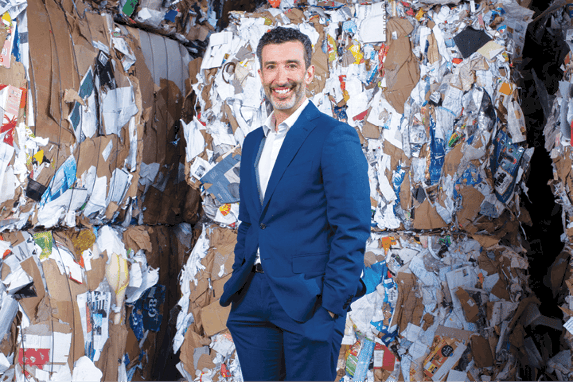
The multinational VIPA group entered the Greek market at a rapid pace and, in 2020, began a barrage of investments and acquisitions aimed at strengthening its position in the sector. The company has invested in a 20-acre plot of land in the industrial area of Aspropyrgos with the aim of building a factory for sorting, processing, and baling recyclable materials. In addition, it acquired Cosmotrade Recycling S.A. and Recycling Experts in Thessaloniki and Athens, while taking over the operation of the Recyclable Materials Sorting Center in Elefsina from E.E.A.A., thus displacing a major competitor, the Greek company Mari Recycling.
Perme: A leader that passed into new hands
One of the oldest recycling companies in the country, Perme Environmental Transport S.A. (Perme) has been on a steady upward trajectory since its establishment in 1999, becoming one of the largest companies in Attica. In 2009, it separated from its then parent company Lobbe Tzilalis and began operating independently, headed by its co-founder Andreas Karouzos. The company, with a large fleet of 700 waste transport containers and 70 vehicles, gradually expanded to serve municipalities and industries throughout the country.
However, as time passed, Athanasios Polychronopoulos became very interested in acquiring it in 2022. This was preceded by new large-scale projects undertaken by the company and, with the emergence of strong competition, its founder decided to sell it. The new owner, Ath. Polychronopoulos, son of the owner of Polyeco, founded Polygreen in 2018 with the aim of entering the family into the collection and processing of non-hazardous waste. In addition, Polygreen also acquired Vasilakopoulos S.A., owned by the well-known veteran basketball player.
Kostoulas Recycling: He went to hell and came back
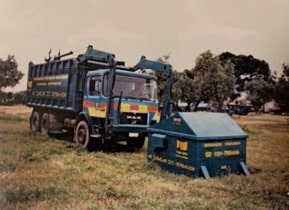
In 1984, Konstantinos Kostoulas established Hellenic Recycling S.A. and K. Kostoulas S.A. in Aspropyrgos with the aim of trading and processing metals for recycling. Each year, the company expanded its fleet of machinery and vehicles and undertook several factory dismantling and ship demolition projects. The continuous growth of the company founded by Kostoulas led to a race for growth and investment in a market that did not exist until then. In 1992, when the Municipality of Piraeus was forced to turn to a private waste collection company to clean up the port and the city after major strikes, the only company with the appropriate equipment was this one. After the project was completed, more and more municipalities and industries were looking for solutions for the collection and recycling of their waste, as they did not have the appropriate equipment. It was then that he established waste sorting plants in Athens, Larissa, Thessaloniki, and Crete with the aim of serving local industries and municipalities.
In early 1999, Kostoulas Recycling went from paradise to hell in just a few months. The arrival of the German Lobbe Group in Greece and the rise in competition foreshadowed a difficult situation for the company, which, despite its high profitability and large loans, would find itself unprepared for what was to follow. The departure of executives and numerous complaints from competitors would result in heavy penalties for environmental violations, bringing the company to the brink of collapse. The past decade has seen it with a low profile in the market, with fewer contracts, and it now operates its Athens plant through Hellenic Waste Recycling S.A. and its Larissa plant through Thessalia Recycling S.A., while the Thessaloniki branch closed in 2020.
General Recycling: The end credits were definitive

Dimitris Lazopoulos began working in his father's waste paper trading business in 1995. When he took over the reins in early 2000, he made major pioneering investments for the time in the operation of recycling sorting plants in Athens, Volos, Tripoli, and Ioannina. This enabled the company to process more household recyclable materials than any other company in the sector, with a turnover of approximately €25 million and assets of €92 million!
In 2013, in the midst of the crisis, Lazopoulos invested in the handball department of AEK together with D. Melissanidis, while the commercial value of recyclable materials had fallen dramatically and borrowing exceeded €50 million. At the same time, the company was blamed for two fatal accidents involving employees, while debts to approximately 500 employees throughout Greece exceeded €3 million. In the summer of 2015, at a time when the company's main factory was underperforming, a major fire broke out, burning down the entire factory and taking more than two weeks to extinguish. As a result, the company was also fined €5 million by the regional authorities for the continuous black smoke that choked Attica, while most of its assets in machinery and trucks were destroyed and then stolen.
…And the players who endure
Siakandaris Brothers, Antipollution, Watt. In the midst of the crisis that hit Greece in recent years, not all manufacturers in the sector collapsed. Some saw an opportunity in the crisis, seized it, and grew enormously. A typical example is Vaste Eco Evolution, a company founded in 2007 by the Siakandaris family with the aim of sorting recyclable materials. The company, with facilities in Schimatari, took advantage of its distance from the Oinofyta Industrial Area and managed to become the main player in the region within a decade. Another example is V. Vassiliadis' Antipollution, which achieved after-tax profits of €3 million and a turnover of €14 million in 2020. Last August, it inaugurated a new plant for the production of alternative fuels from waste in Ritsona. A. Katris, with Watt, a partner of Helector, has now grown into a large unit with 160 employees and a significant presence in the recyclable materials market in Eastern Attica, as well as in the construction of waste treatment and disposal facilities in various parts of the country. Elite – Patraiki Chartopoiia S.A., which was founded in 1972 by Andreas Triantafyllopoulos and is now run by his son, George, remains in Greek hands and is one of the few companies that produces its own raw materials for its products.
Gregory Fotopoulos