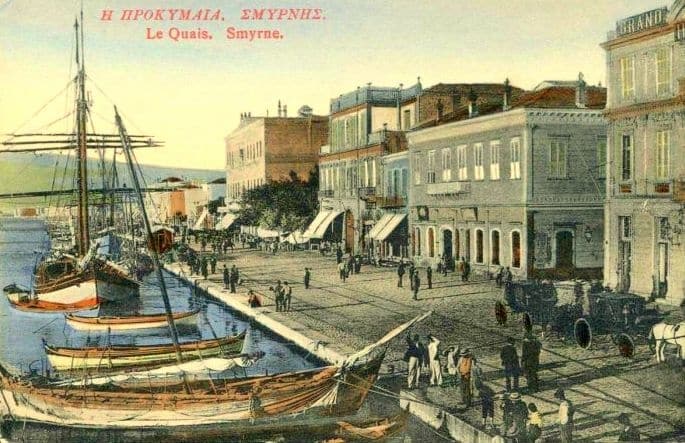
The recent agreement between Mitsotakis and Erdoğan on the ferry service between Thessaloniki and Izmir It evokes memories of a time when Greek ports and Asia Minor formed a single economic and social space. Back then, Kythira (or, as it was known by its older Venetian name, Tsirigo) was an indispensable stop on the route to the cosmopolitan port of the East.
The signing of the seven new cooperation agreements in Athens, focused on connectivity and trade, is not merely a step toward political normalcy. In many respects, it marks a «return» to the major maritime routes that flourished a century ago. The Joint Declaration on the Thessaloniki–Smyrna connection seeks to revive routes that older generations knew well.
The «Golden Age» of Steamships
In the 19th century, steamship travel transformed the Aegean. Due to its strategic location between the Ionian and Aegean Seas, Kythira became a crucial transportation hub.
Around 1840–1850, the major shipping companies of the time, such as Austrian Lloyd (Osterreichischer Lloyd), launched routes that departed from Trieste and ended in Smyrna. Kythira (centered on Kapsali and Avlemonas) was not merely a rock at the edge of the Peloponnese, but a bustling supply and postal hub.
The schedule for this season:
Trieste: The starting point of the line on the Adriatic.
Ancona: A stopover in Italy.
Corfu: First stop in Greece.
Patras: Connection to the Peloponnese.
Piraeus: Athens' main port.
Syros: The commercial hub of the Cyclades.
Kythira (Avlemonas or Kapsali): Seasonal refueling station.
Smyrna: Final destination.
Immigration
This connection served not only trade but also the need for survival. The agricultural crisis in Kythira (1850–1860) drove the inhabitants to Smyrna, where a strong Kythirian community had existed since 1776, known for its trade in medicinal plants. The steamships of Messageries Maritimes and later of Panhellenic Steamship Company carried thousands of “Tsirigotes” seeking a better life in the economic capital of the Eastern Mediterranean.
From 1922 to 2026: The Restart
The heyday of this route was cut short by World War I and the catastrophe of 1922. For decades, communication between the two shores of the Aegean remained limited.
Today, the signing of the agreement for the Thessaloniki–Izmir line signals a desire to return to that high level of mobility. The seven agreements on investment, technology, and civil protection show that the «positive agenda» is striving to pick up where it left off, using the sea not as a border but as a bridge.