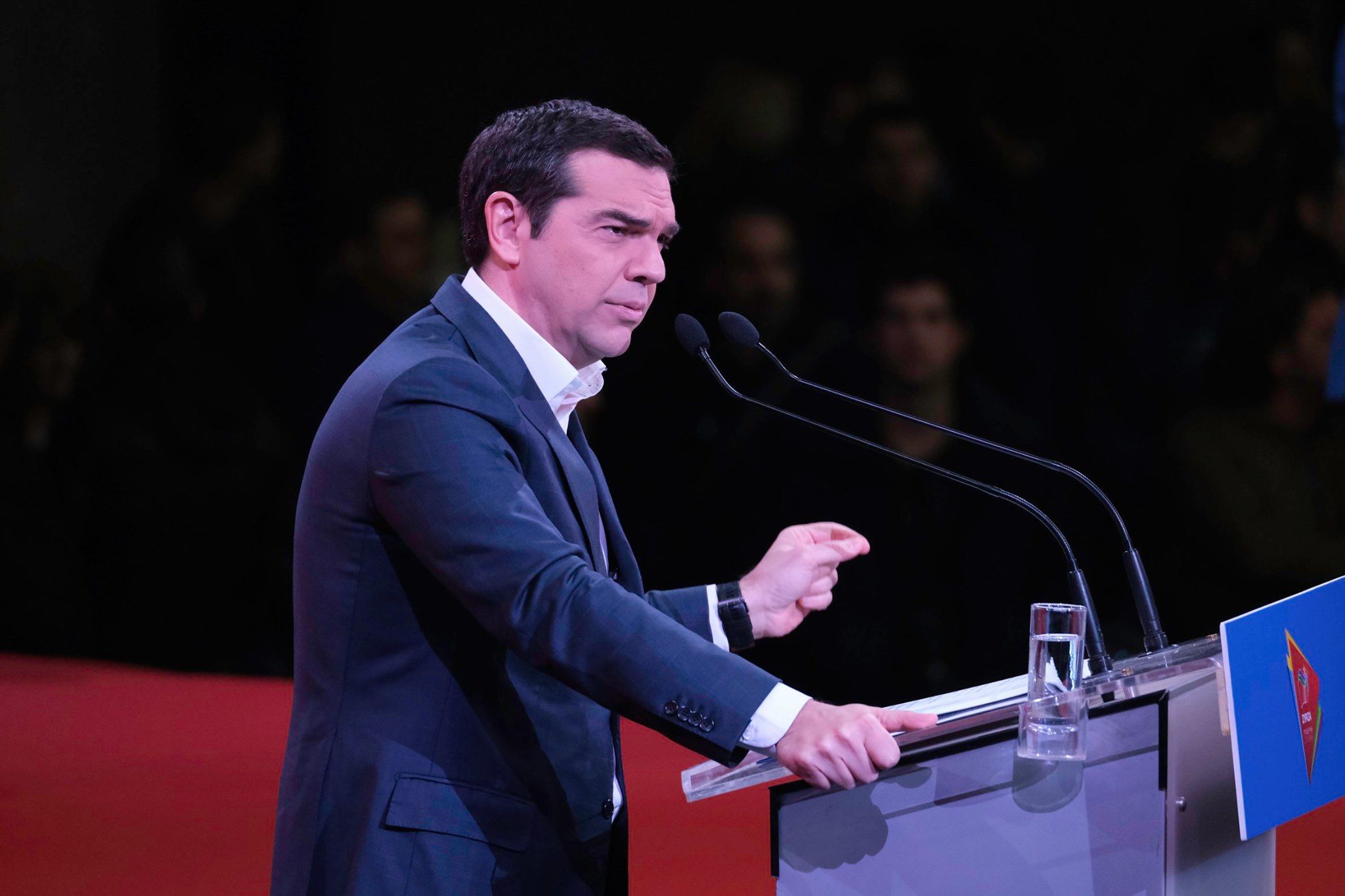
The need for the Hellenism to stand united on the critical fronts facing the Greece "moving forward," regardless of the existing political differences within the country, said the leader of the official opposition at the session of the 13th General Assembly of the World Hellenic Inter-Parliamentary Union (PADEE).
In his remarks, Alexis Tsipras also emphasized the need for our country to emerge even stronger from the health crisis. «We need a dynamic Greece, with clear and realistic goals for the 21st century, one that will support and harness the valuable strengths of the Greek diaspora, such as those represented today by PADEE,» he said.
The leader also spoke about adopting a radically different vision for the future, noting that We must rely on a «dynamic realism» to manage the critical developments that affect us and not for the pandemic crisis to serve as a respite that would allow Greece to return to the economic and geostrategic models of the past.
In elaborating his position, he noted the need to build an economic and social model, based on sustainable development and the reduction of inequalities:
«Through active support for the vaccination program in Greece and globally, as well as through initiatives to lift patent restrictions on vaccines. Through dynamic economic policies—which we see being promoted on the other side of the Atlantic—for the supporting employment, reducing inequalities, and [strengthening] labor rights. Through a concerted effort to revision of the Stability Pact, so that it aims for economic convergence and makes use of the Recovery Fund »to support innovation and small and medium-sized enterprises.".
Furthermore, «by reversing the scourge of the brain drain through policies on wages and labor rights, and will make Greece a more attractive destination for workers. By connecting Greeks who are successfully pursuing careers abroad with outward-looking Greek companies. By actively supporting a fair green transition and a summary digital transformation». He noted that at the same time, «we must fight for rights at all levels, whether we are talking about the rights of children, women, and the LGBTQ community, or the rights of the Muslim minority or refugees and immigrants in our country.».
Mr. Tsipras stated that «21st-century Greece can be strong only if »if it bases its development on social cohesion and solidarity,", stating that on this basis, «a nation in the throes of a deep economic crisis was able to cope with Europe’s largest refugee crisis» and «Greece was able to emerge from the economic crisis and the bailout programs, and indeed with a strong economic reserve.».
As the second key element of the «dynamic realism» that, as he said, we need, he identified the «promotion of a proactive, multidimensional foreign policy that aligns our national interest with the enhancement of our international role as a pillar of peace and stability. One that defends our sovereign rights and actively seeks solutions to the disputes that concern us, based on international law.».
For Greek-Turkish relations and the diaspora
«That was the struggle we waged to resolve the name issue through the historic Prespa Agreement,» he said. «And the struggle we waged together with President Anastasiades—and which we continue to wage today as a country—against the Turkish provocativeness in actions that violate international law.
»That was the struggle in his conversations as well." Crans-Montana where, for the first time, the United Nations endorsed the obligation for occupying forces to withdraw from Cyprus and for the guarantees to be abolished. This is the country’s objective through the establishment of the Strategic Dialogue and the 3+1 format with the U.S., the founding of the Summit of Southern Countries, the strengthening of multilateral cooperation frameworks together with the Republic of Cyprus, and the conclusion of agreements delimiting our country’s EEZ with neighboring countries,» he noted.
In particular, the former prime minister emphasized that «Greece must—taking advantage of the pressure Turkey is currently facing—chart a medium- to long-term strategy with Cyprus to return to the prospect of a just and sustainable solution to the Cyprus problem based on the UN Resolutions. That is, to »a bi-zonal, bi-communal federation with political equality, a single sovereignty, a single citizenship, and a single international representation, with the withdrawal of the occupying forces and the abolition of the guarantees.".
He noted that, especially in light of the latest negative developments in Cyprus, Greece—in coordination with the Republic of Cyprus—«must link progress on the revision of the EU-Turkey customs union to the Cyprus issue and Greek-Turkish relations, with Turkey being obligated, in other words, to suspend it the illegal opening of Varosia and with an obligation to file an appeal, together with Greece, to the International Court of Justice in The Hague for the »delimitation of the continental shelf and the EEZ.".
Furthermore, he said that Greece must actively support the unblocking of the Western Balkans’ European perspective in order to establish its role as the strong a European force for stability and peace in the region and «to fight for a European migration and asylum policy that respects international law and fairly shares responsibilities, as well as for effective EU-Turkey cooperation.».
In this context, he said that his government had launched a constitutional review, «we have opened the discussion on granting voting rights to Greeks living abroad» and «we have proposed establishing an electoral system that aligns with best European practices —the French and Spanish models—so that Greeks abroad not only vote, but »to be able to elect their representatives in large overseas districts.".
«Although we consider our proposal to be the best from an institutional standpoint,» he added, «we supported the parliamentary compromise »-because that is how democracies move forward—the recent law, so that Greeks living abroad may finally obtain the right to vote.".
The President of the SYRIZA He said that «for our country to develop a soft power strategy in the areas of diaspora, public, economic, and cultural diplomacy, it must also have a strong national strategy for its central objectives in the 21st century,» and went on to emphasize: «The experience of this unprecedented global health crisis we are facing, the increasingly severe climate crisis, and the realignment of the global balance of power, must lead us to adopt a radically different vision for the future.».