
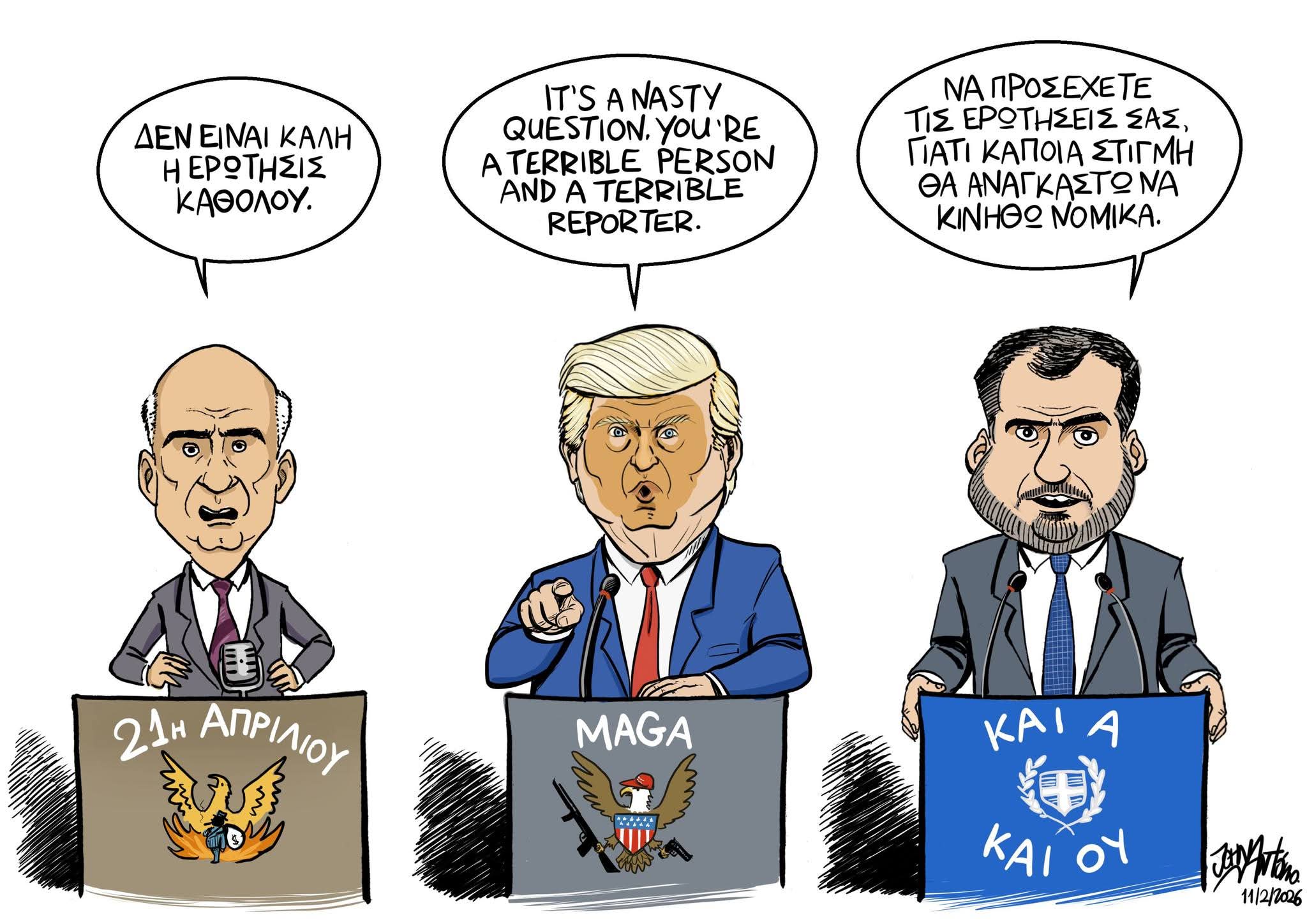
It was 26 January 2019. Donald Trump was losing his temper when CNN reporter Jim Acosta questioned him about his racist statements about «apostate» countries. Instead of answering, the American kicked him out of the oval office of the White House!
It was November 27, 2025. Donald Trump attacked New York Times reporter Katie Rogers, calling her «ugly» and «second-rate» for writing an article in the paper that the 79-year-old Republican was following a more relaxed schedule because of his age.
It was February 4, 2026. CNN reporter Caitlin Collins, citing Jeffrey Epstein's records, asked for Trump's comment on his close allies, Ilon Musk and (Commerce Secretary) Howard Lutnick. Donald Trump, instead of responding, preferred to call the CNN network dishonest, while about the reporter he «limited himself» to telling her that «she never smiles because she doesn't tell the truth» and that «she's the worst reporter»...
It was 10 February 2026. Government spokesman Pavlos Marinakis was asked a question (during the official briefing...) by journalist Christos Avramidis about the tragedy in Chios and the handling of the Coast Guard. Instead of answering, Marinakis threatened legal action and attacked the journalist with extreme characterizations. He then attacked media in general and indefinitely for «propaganda», going so far as to talk about «a circuit that operates in various media and serves various interests» and whose «goal is to destabilize»...
It was February 12, 2026 when the Mayor of Kythera, in response to what the surveyor-engineer Mr.Syrmalis claims, spoke of «pithy heavy-handed titles, with the sole aim of increasing toxicity in our local society, toxicity from which they themselves are sustained by defiantly disregarding the tranquility of the local community and protecting it from slander and unproven occasional accusations».
I could go on listing thousands of attacks by top (or not so top...) actors of the global and Greek public life against journalists and media. Perhaps the above are not the worst examples. In Gaza, they are killing press representatives who are simply seeking to do their job, to inform... According to the annual report of the International Federation of Journalists (IFJ), «one hundred and eleven journalists, including seven women, were killed in 2025». Fortunately in Greece, those journalists who still seek to do their job are not shot...
But there is something common to all of the above: many «leaders» cannot stand public criticism. They are intolerant of public scrutiny. Instead of answering questions, they attack those who ask them... In this way they are in effect challenging (to varying degrees each) the free press.
Let's get something straight: Article 14 of the Greek Constitution guarantees freedom of the press, explicitly stating that «the press is free» and prohibits censorship, as well as any preventive measure. Everyone may express and disseminate his thoughts in compliance with the laws of the State, this freedom being the foundation of democracy. Censorship is clearly prohibited, with the only exceptions being cases involving extreme actions (e.g. insulting the Christian religion, obscene publications, or revealing secrets of national defence). Nothing else...
Freedom of the press is included in the UN Universal Declaration of Human Rights. It does not only concern journalists and press officers, but first and foremost citizens, to whom we must provide comprehensive, objective and complete information.
Finally, the European Union has taken important measures to strengthen freedom of the press, with the landmark European Media Freedom Act (EMFA), which came into full effect on 8 August 2025. This legislation was introduced to protect pluralism, media independence and journalists from state interference and digital surveillance. Perhaps EU legislation is something that those who ardently wish to «serve» should be aware of...
The behaviour of some leaders and rulers is in fact an attempt to avoid public scrutiny. When a journalist asks a question, the interviewee can answer in any way he or she chooses. When a media outlet carries a piece of journalistic information (much less when it refers to a public document), it does not mean that it endorses what that information or document claims. It simply asks...
Moreover, it is a mockery to talk about «toxicity» by those whose practice includes constant lawsuits and threats of lawsuits, constant attacks with derogatory labels on anyone who criticizes them, a total lack of moderation and self-criticism. Some people who have never known what «private sector» means, who have always been state-owned, cannot be allowed to wag their finger at us. After all, it is our money that is being managed...
We are all aware of the effort to control the media. No public figure wants to be controlled. Much more so for those who have «soiled their nest». We saw it recently on a global scale with the Epstein files. We saw it in Greece with the tragedy of Tempi, the scandal of OPEKEPE, the Panagopoulos case of the GSEE and many others. In order to avoid scrutiny, some people are trying to buy up media. Others prefer to threaten journalists with SLAPP-type lawsuits (see PS 1).
Let me make something clear: Of course the judges are judged. Journalists and the media cannot go unchecked. But for this there are laws that can be used. Here we are referring to authoritarian behaviour by controlled leaders. We are referring to attempts to influence the media not to publish information negative to them.
It is something that cannot be accepted. Public scrutiny is an element of democracy and freedom of the press. Journalists on this point are firm and determined. No one will intimidate us, no one will force us to stop asking questions about what concerns citizens and democracy. Full stop...
PS 1: The term Strategic Lawsuits against Public Participation (SLAPP) refers to lawsuits filed by a powerful person or organisation (for example a company or a high-ranking official) against non-governmental persons or organisations that are critical of them on an issue of social or political interest. The purpose of such lawsuits is not to win the court case, but to intimidate those who criticize through moral and financial debasement.
Author of the article:

Journalist, member of ESIEA, member of the Board of Directors of R/S Athens 984













Dude, Greece doesn't have its match. Here, the «pissed off» channels are monolithic and investigative journalism is in the hands of the prosecutor and the fire.