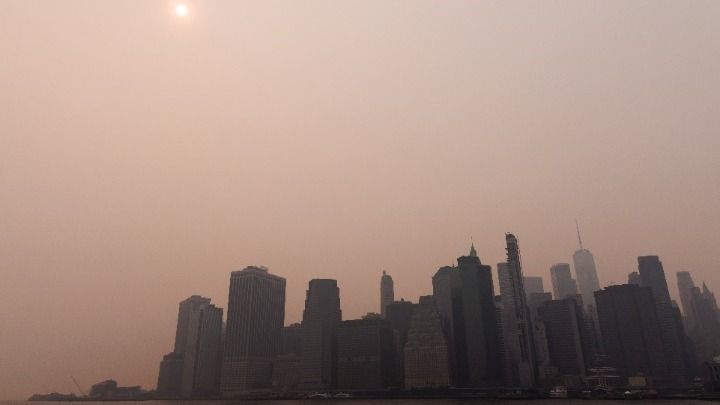
On the morning of June 7, the skies of the northeastern United States of America were covered in an orange haze and a cloud of smog covered the sun and moon for an entire 24 hours, creating an atmosphere the likes of which the inhabitants of these regions had never experienced before.
That morning, 54-year New York City resident Tina Glikou stepped out of her home in Queens to head to work and saw an apocalyptic scene as the sun was covered in an orange haze and a smell that made her think that the fires burning across Quebec, Canada were only a few miles away from her neighborhood. In reality, the fire was more than 8 hours from the border, but the situation was stifling and suffocating.
«It was a revealing picture. It was all blurry and when I came out, because I had already arrived at the office, it smelled like the fire was next door. I was saying it's not possible that it could have come down from Canada and you think the fire is in your neighborhood. The sun again from the cloud and fog was not visible,» Ms. Glikou told the Athens-Macedonian News Agency, adding that there was a strange silence in the streets.
Most New Yorkers stayed home or dramatically reduced their travel by closing the windows of their homes and offices. «It was mysteriously quiet. There were generally no people on the streets and those who did go out were going from home to the office and back again. It really disturbed the atmosphere. You didn't want to inhale the smell. It was a dull orange color, like you'd turned on orange lamps. It had even changed the way the rooms were lit even though it was daytime,» he says, adding that what also struck them that day was that the temperature dropped quite a bit. «We were expecting 24-25 degrees and we actually had 15-18 degrees. The size of the sun was how the full moon is. It was terrible. All the way to the Carolinas the atmosphere was exactly the same,» he explained to the AP.
New York City's air quality index set an all-time negative record as the wildfires raging in Canada pushed it above the 200 level of pollution that is extremely dangerous.
As Apostolos Voulgarakis, Associate Professor of Chemical and Environmental Engineering at the Technical University of Crete and holder of the AXA Chair on fires and climate change, points out to the Athens-Macedonian News Agency, New York City had the worst air quality in the world last weekend. «We see such records in places like, India, Pakistan, Indonesia, China etc. In a city like New York that we have seen such a record, that is, being at the top of the world in terms of worst air quality has clearly to do with the fires in Canada and the change in the atmosphere in states in America that caused this episode,» he said. Voulgarakis told APE-MPA, adding that on the first day the levels of air pollution were particularly dangerous for vulnerable groups, while on the second day they were at «unhealthy levels».
Why New York City was covered in orange smog
The path and diffusion of smoke and particles emitted from forest fires is unpredictable, as according to Mr Voulgarakis it is related both to how low in the atmosphere the pollutants and suspended particles will travel and to wind circulation. «An important role is played by the large amount of pollutants released by fires, namely suspended particles. We have to see whether they travel very low in the atmosphere i.e. in layers close to or touching the earth's surface or whether they travel to somewhat higher layers of the troposphere. If it travels at 5 kilometres altitude it will affect visibility, brightness, temperature but will not affect air quality. In this particular case because it travelled in the lower layers everything contributed to maximise all the effects, i.e. the effects on visibility, on temperature, on health, on air quality and therefore on health. It was to an extreme degree compared to other cases we have seen», explains Mr Voulgarakis.
According to Mr Voulgarakis, in the case where the pollutants released are so continuous from many fires, as has now happened with hundreds of fires affecting Canada, this automatically increases the chances of them being transported thousands of kilometres away. «There are so many pollutants circulating in the atmosphere that it increases the likelihood that they will travel very far. In this particular case, the wind circulation favoured the wind to reach towards populated areas,» he noted to the APM.
However, what has scientists concerned is that the mega fires in Canada have occurred very early this summer.
As the climatebook page points out, more than 3.8 million hectares of land have already been burned by wildfires across Canada, an area 12 times larger than the 10-year average for this time of year.
«There is a clear trend towards a rapid increase in fires due to higher temperatures and longer droughts. The trend is towards more fires and indeed this is being attributed to climate change with some certainty. There are other areas where this correlation is still being investigated. For the region where this huge phenomenon is happening, we have strong evidence through the analyses that are being done that generally North America is heading towards more fires and more fire pollution and that climate change is responsible for this,’ Voulgarakis stresses to APPE-MPA.
Similar situations in Europe are not excluded
According to Mr.Voulgarakis, given that the distances between European countries are shorter and the borders are closer, it is not excluded that if similar conditions prevail, European citizens will face a similar scenario, despite the fact that the fires will not reach the size of those in Canada. «The phenomena may not reach this level but given that distances are shorter, borders are closer and populations are more densely populated around the European continent even if the fires do not reach the huge magnitude that are occurring in Canada they could still affect communities of people possibly in the same way if similar conditions prevail. 13 years ago a similar thing happened in Moscow where fires in neighbouring areas created similar conditions in the city of Moscow. It is not that these things cannot happen in Europe. And then it was something that happened after a long period of heat waves and droughts in the region of Western Siberia,» Voulgarakis said, adding that Europe could have more intense pyrometeorological conditions in the future due to climate change. At the same time, he notes that with the Mediterranean being one of the clear epicentres of climate change, research he and his team are conducting predicts that in the future both the Mediterranean region and more northerly areas of Europe will have a higher risk of fires in the future.
How long pollutants stay in the atmosphere
As Mr Voulgarakis explains, once particles remain in the troposphere they usually have a lifetime of days to a few weeks. «This depends on whether they encounter conditions that remove them from the atmosphere faster. As it moves away from the source and the fires start to subside we are talking about a more manageable situation where the pollutants reach concentrations that are not as high as on days when there is very intense burning and in areas where the air masses coming from the fires converge and create that concentration,» he stresses.
Ioanna Kardara