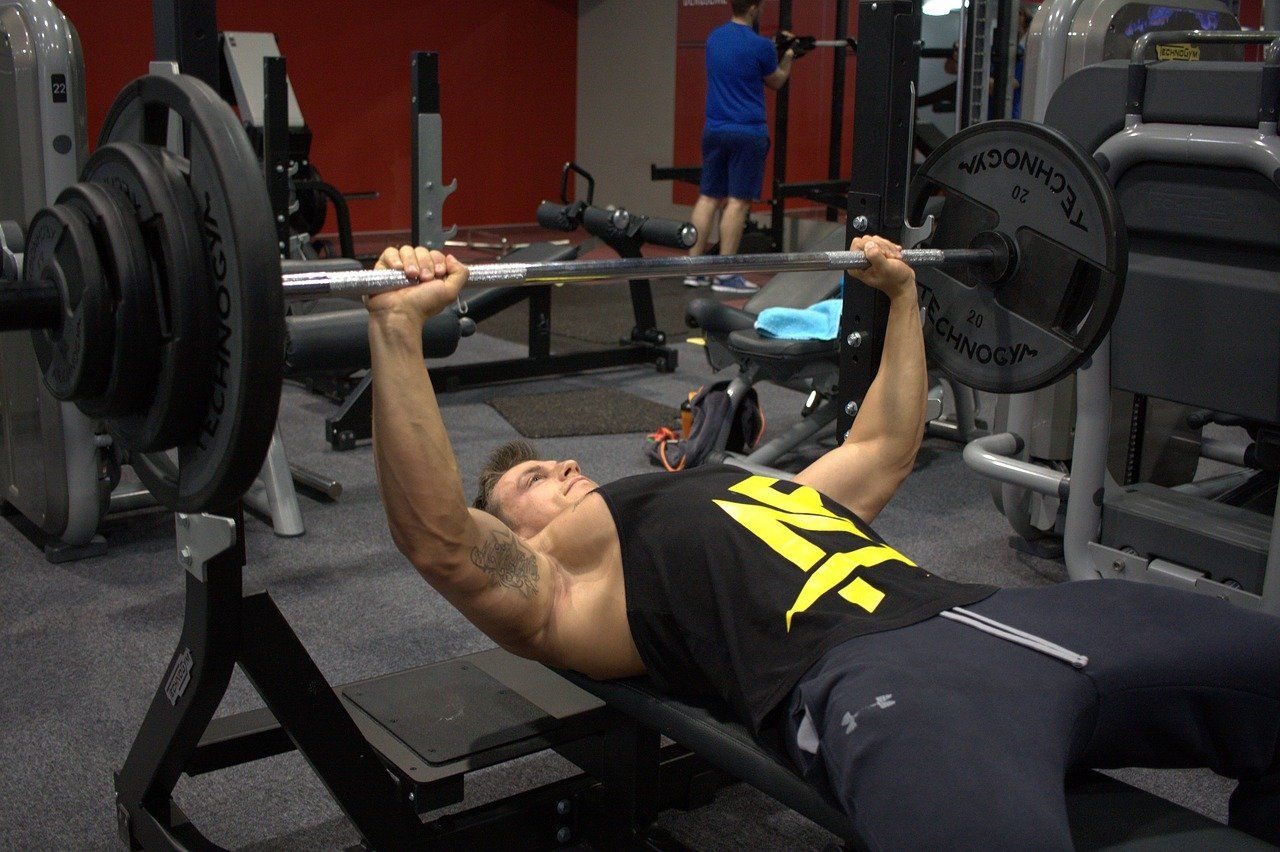
The chest is a part of the body that most people—especially men—like to devote a fair amount of training time to. It is indeed quite attractive to have a well-toned chest.
Which are the main muscles involved in chest exercises?;
The thorax is formed by the 12 thoracic vertebrae, the sternum, the 12 pairs of ribs, and the clavicle. However, in resistance exercises, the humerus, the shoulder joint, and the elbow joint are also involved. In chest exercises, the movements performed are adduction and abduction of the humerus, elbow flexion and extension (not in all exercises), scapular adduction and abduction, and shoulder flexion and extension. The main muscles involved in chest exercises are:
- The pectoralis major, consisting of the clavicular (upper), sternal (middle), and abdominal (lower) portions of the chest.
- The anterior deltoid
- The triceps brachii
- The anterior serratus
- The lesser pectoral muscle.
So we can see that chest training isn’t as simple as it seems. That’s why we often see people making mistakes.
Below, you’ll find the most important ones, so you can understand how to structure your own workout with the goal of achieving a truly well-defined and aesthetically pleasing chest. So let’s get right to the point:
The Biggest Mistakes in Chest Workouts:
- You don't use different angles when applying pressure
If you work only on the flat bench, or only on the incline bench, or only on the decline bench, or on two of the three, you might NOT be placing as much emphasis as you’d like on one of the three segments of the pectoralis major that you read about above. In other words, you wouldn’t want a muscular lower chest and a relatively underdeveloped upper chest, mainly for aesthetic reasons. Be sure to do bench presses on both a flat and an incline bench; for the lower chest, you can work it either on the decline bench, with dips, or with the crossover machine using the appropriate setup.
- You're spending way too much time on the bench
Undoubtedly one of the best-known and most effective exercises. Excellent for building strength. But, between us: On the bench press, every time you train, is your goal to feel your chest work better and improve any aspect of the intensity… or just to add more weight?;
When we talk about hypertrophy, increasing the load—as a progressively greater stimulus—is a good variable…. But it’s not the only one!
Did you read the mistake above? Try reading it backwards now...:
- You're not emphasizing your strength!
A solid foundation of strength is a key factor in achieving greater gains in muscle hypertrophy later on. Don't be afraid of low reps and heavy weights during your chest workout. Make sure to warm up properly; to start with, focus on building strength, primarily through bench presses. When you take advantage of everything the gym has to offer beyond your foundation—which is strength—you’ll soon hit a plateau.
That’s why, to start with, you should focus on building strength. A 5×5 program would be helpful, but it won’t work forever! Periodization will help you achieve your goal. And periodization aimed at chest development includes for starters strength.
- You can't “feel” your breasts
The mind-muscle connection is a key factor in muscle gains. If, during a chest exercise, you feel your shoulders more than your chest, something isn’t quite right. This phenomenon is due either to an inadequate or missing warm-up, an imbalance in muscle strength, a lack of focus on strength as you should have, or, of course, poor form! To be able to feel your chest working, you need to focus your attention on the movement your chest produces.
It's really up to you! However, we'll try to show you a different way to do it. Just do squats. Slowly, and focusing on the lower body. As you lift, imagine that your thumbs should come closer together, like a loving couple. The chest acts as the mediator in this relationship. It wants to, but the exercise setup won't let it.
The arm movement required to finally bring the couple together comes from the chest. So tighten your chest when you’re about to lift, so that your thumbs might (though they never will) touch each other.
Also, Isometric contractions are helpful (e.g., bends and holding the position at the bottom) However, don’t overdo it, especially as beginners, because isometric exercises are demanding on the central nervous system (2 sets of squats, 5–10 reps each with a pause at the bottom, as a beginner at the start of your workout, is a good option).
- You don't use pulleys during chest workouts
Do you do flyes with dumbbells? Good for you—we never really liked that exercise. However, with proper form, we’ll admit that it can give your chest a nice boost. Try doing flyes with pulleys or a nice, classic crossover instead.
You’ll feel the chest being ‘loaded’ quite differently from other exercises, since the angle is such that the load on the chest is continuous, rather than being interrupted by the force of gravity acting perpendicular to the ground at the start of the fly movement, which causes the chest activation to stop and increases the intensity only in the forearms and shoulders.
So, on your way to a more attractive chest, keep the above in mind—and, above all, trust a fitness professional!
By Pavlos Kothonidis, gymnast, Kavala