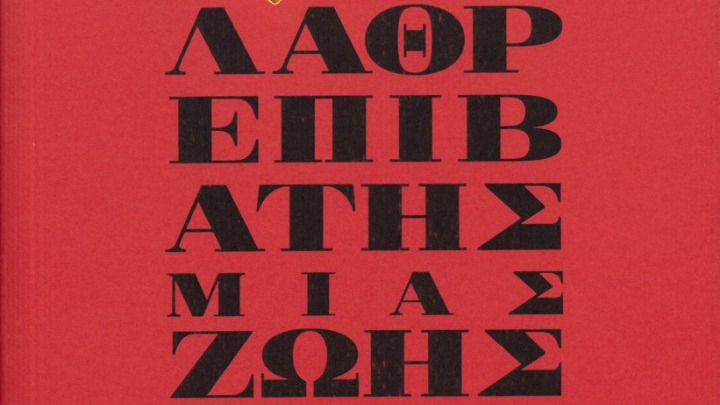
Vasilis X. Spiliotopoulos developed a dialectical relationship with cancer through his historical novel «Stowaway of a Lifetime.» As he stated to the Athens-Macedonian News Agency, «With a dose of exaggeration, my illnesses evolved into a bright spotlight that illuminated ”life itself” a little more...» In fact, he emphasizes that «The Stowaway of a Lifetime,” from one point of view and to a large extent, is the genuine expression of my dialectic with cancer, in short, a balance of life.” Regarding the choice of title, he points out that »The title marks the journey of a man who seeks to interpret and navigate life and the world by breaking down the barriers of origin, social and spiritual reality.« Furthermore, he notes that »The narrative attempts to penetrate the backbone of the social reality of an era in which the facts were shaken by the harsh delegitimization of their logical basis, reduced to symbols of worn-out practices, and ended up as fossils of the past. Through his narrative, the hero expresses the contradictions, dilemmas, and disappointments he faces, but also his commitment to his moral values, which he strives to uphold as fundamental elements of his attitude and course of action.«.
Below is the interview-confession of the author's thoughts to APE-MPE:
-Let's start with what writing the book «Stowaway of a Lifetime» meant to you...
Most of the research, but especially the writing, was not an escape for me, but rather a process during my successive bouts, attacks, and treatments for two primary cancers. Although I had enjoyed writing since my early teenage years, during my illnesses it became a method that ultimately pushed me to develop a dialectical relationship with cancer.
Something I would like to clarify is that despite the general definition of «cancer,» in the event and the corresponding treatments, we are talking about independent diseases, each with their own specific characteristics and degrees of difficulty. Essentially, I followed a varied and turbulent path of struggle, which lasted around five years in total, if one takes into account the time it took to return to my previous level of physical, if not mental, strength. I must admit that even today, almost two years after completing my treatments, I have not fully regained the vigor of my previous condition.
And yet cancer was a great teacher and guide, as it was the catalyst and starting point for a transformative journey that instilled in me a new kind of resilience, especially in the face of inner guilt and commitments that subjugated «being» to meaningless and futile choices, as well as social imperatives. With a dose of exaggeration, my illnesses evolved into a bright spotlight that illuminated «life itself» a little more...
The relationship I developed with the «Stowaway of a Lifetime» played a key role in all of this, as through the plot I «opened up new paths,» approached unexplored destinations, and ultimately overcame challenges, both mental and physical. In a sense, and to a large extent, «The Stowaway of a Lifetime» is the genuine expression of my dialectic with cancer, in short, a balance of life.
-How did you choose the title of the project and what does it signify?;
I'll be honest with you: choosing the title didn't bother me at all. In short, it came almost naturally, as if it had emerged from the writing process itself. It was obviously the fruit of an inner struggle that took place during an intense intellectual effort.
Beyond that, however, the title marks the journey of a liberated former musician, and more. A man who seeks to interpret and navigate life and the world by breaking down the barriers of origin, social and intellectual reality.
Furthermore, the narrative of the main character is, in a sense, a reflection of the path taken by most, if not all, of us, who either waste our time in a state of mechanical passivity or, at best, struggle hard at the limits of knowledge.
Kant's phrase comes to mind: «The starry sky above me, the moral law within me.».
In the end, who ever really had the ticket for this exciting journey between the two eternities? In a sense, aren't we all traveling clandestinely, some more than others, on the rails of life, from which we retain only fleeting, blurred impressions of the subjective?;
Who ultimately managed to clarify the ambiguity of life?;
The «Stowaway of a Lifetime» does not aspire to answer, but to assist in formulating questions such as these, which somewhat dispel the fog of our fragmented perception...
-What prompted you to write a book about the history of Russia from 1881 to 1918?;
I have always been interested in Russia's unique character. The combination of the impetuosity of the «northern» Rus, with the mystical paganism of the primitive tribes of Eurasia and the Christianity of Byzantium, with the unbridled vigor of the Mongol hordes, and finally with the unrelenting ferocity of the steppe winds and the tranquil flow of the rivers—but how charmingly noble the Volga is.
This blend of profound poetry and primordial authenticity exuded by the course of this centuries-old empire, which in essence spans more than a thousand years, has fascinated me since my youth. Mainly the dual nature of both a European and Asian version, the oscillation between the boyars and the aristocracy, but also the captivating character of the Russian muzhiks. The history of Russia is a fundamental and integral part of our Western civilization, which it has indelibly and unquestionably shaped, no matter how much some people want to distort the long-standing and reciprocal relationship between Russia and the West. Is it an exaggeration to say that Russia was ultimately the «silk road» between European and Asian culture, no matter how much Peter the Great and Catherine the Great tried to consolidate their orientation?.
In particular, however, the period of pre-revolutionary and revolutionary Russia is imbued in an almost uniquely clear way with the forces of evolution and history, to such an extent that time and meaning seem to be condensed at the edge of Schwarzinger, on the edge of a «black hole.».
The historical period between at least 1881 and 1918 is a clear reflection of the eternal tightrope walk between order and chaos, the two cardinal states of existence. It is a time when human narcissism, and arrogance seem to have grown enormously during the rapid decline of the tsarist reality into the remnants of yet another socio-political system that had fulfilled its historical role and ultimately sank without a trace, without any real reaction.
On the one hand, the death knell of centuries-old data and certainties, and on the other, the sweeping winds of change and the new.
Lamentation and primitive, boisterous enthusiasm.
-Do you consider that the present has references to the past that you describe?;
I think Hegel said that if history teaches us anything, it is that people learn nothing from it.
The entire period of pre-revolutionary Russia, Europe's march toward the merciless slaughter of World War I, and the Russian Revolution reflect and summarize the short-sightedness of the human perspective, as well as the inability of our intellect to seek a meaningful interpretation and management of coexistence in terms of humility and moderation. We are driven and behaved by the egoism that pervades our individual ’heroes« and our society as a whole. It may sound rude to some, but our course is determined by the enormous forces of »gravity« developed by our mass egotism, which alienates, poisons, and decisively shapes the character of what we complacently call culture.
It is not wisdom that guides us, the eternal instinct together with the Word, but the impulses and pride of an unjustified hegemony of the «ego,» and, for the last two hundred years or so, the unrestrained tradition of deifying a deterministic logic that remains fragmentary, with inherent flaws and pathologies. The intoxication of our utterly materialistic culture subjugates us to totalitarianism, to the supposed freedom of choice between a plethora of meaningless and trivial offerings. In short, we like to multiply our incurable egoism with so many trivial challenges, so many zeros; as we know, the result will always be zero...
Are we ultimately victims of our own laziness, or does the system want us to be unsuccessful?;
-The book seems to touch on many worlds: history, philosophy, psychology. How did you manage to balance these levels without disrupting the semantic unity of the work?;
The narrative attempts to penetrate the backbone of social reality in an era when the facts were shaken by the harsh delegitimization of their logical basis, reduced to symbols of worn-out practices, and ultimately became fossils of the past. Through his narrative, the hero expresses the contradictions, dilemmas, and disappointments he faces, but also his commitment to his moral values, which he strives to uphold as fundamental elements of his attitude and course of action.
Referring to a period when destiny reserves major upheavals, the narrative is structured on multiple levels in order to present as complete a picture as possible of both social reality and the personal vicissitudes of the characters. I am glad you mention the balance of the narrative; this arose from the story of obvious contradictions and confrontations, but also from the actions of silent protagonists who shaped striking events.
-If you could talk to one of the characters in your book, who would you choose and what would you ask them?;
First of all, as the author, the characters in the book are all my children, so I wouldn't want to single anyone out. Beyond that, however, and as I mentioned, the book aims to provoke thought and questions, not to offer specific answers, even though it has a clear semantic orientation. So even for me, it is the characters in the book who pose questions, not the other way around. I can assure you that every time I return to the text, I discover new aspects of thought, other versions. Why not say that, in a way, the narrative is inspired by Heisenberg's uncertainty principle, which I consider to be of paramount importance even for these human measures.
However, if I wanted to identify historical figures in such a turbulent era, I could not fail to include intellectuals such as Radishchev, Chernyshevsky, Kropotkin, as well as politicians such as Witte and crowned heads such as the reformist Tsar Alexander II. But can I omit the fateful Kerensky or the tormented, fatalistic Nicholas II?;
Of course, I must make special mention of the exceptional Vera Zasulich and the «special» man, Rachmedov of Chernyshevsky.
Finally, what outside observer can ignore the greatness of Lenin's personality, he who, with his unyielding will and unwavering fanaticism, formed a minority, which the course of history took by the hand and placed on the throne of circumstance, ultimately shaping the history of the 20th century.
-What were the biggest challenges you faced while writing «The Stowaway of a Lifetime»?;
Many, but mainly the confrontation with my personal demons, the vicissitudes of a long but turbulent journey. Recounting a period that has irrevocably been relegated to the past is a risky and laborious endeavor, to the point where the danger of discouragement and ultimately resignation is ever-present. In short, I was confronted not only with my own physical and mental endurance, but also with inhibitions, which stemmed mainly from moral scruples. I constantly have Heisenberg in mind: the observer becomes part of and a factor in the measurement...
-What is the main message you want the reader to take away when they close the book?;
I know that the narrative is difficult in places. The book is voluminous and requires dedication. It is a depiction of an era of tectonic changes, conveying the sounds and rhythms of the «Big Bang.» And yet, its messages are ultimately simple, as well as fundamental. Mainly humility towards every manifestation of life, in every form of faith, but also an attempt to approach the harmony of the transcendent.
In a sense, let us immerse ourselves in the rhythms of primitive, traditional music, but also of Baroque music, let us seek the chords that harmonize the human in the ambiguity that defines our existence. Let us stop waving the banners of egoism and grandiloquence and let us fall silent in redemptive reflection, even if only for a moment.
In closing this book, I would like to see the questions that lie beneath our pathologies and weaknesses brought to light...
-What made you decide to donate most of your writing income to ELPIDA, the Association of Friends of Children with Cancer?;
Due to my life experiences so far, I have a particular weakness for cancer patients, but also for all those who are fighting the battle of life. That is why the book is dedicated to all those who have approached the limits of existence and consciousness. So when I came into contact with the owner of KAPA Publishing, the kind and dignified Thodoris Koulidakis, while we were discussing our collaboration, spontaneously, without a second thought, I decided that the majority of my proceeds from the book should go towards the fight against cancer.
It was obvious to me that I should offer something, even if small, yet a product of the most important contribution of my life, to the Association of Friends of Children with Cancer «ELPIDA.» I hope that this personal and original creation of mine will strengthen the amazing contribution to the fight against childhood cancer. It is my own contribution to authentic purity, essentially human greatness, which in this particular case was personified by the benefactor, the late Marianna V. Vardinoyannis.
-Since the plot involves twists and surprises, did you actually consider the possibility of adapting «The Stowaway» for film or television while you were editing and writing it?;
Never! My involvement in research and writing has been, from start to finish, a wholly personal journey, shaped essentially by the circumstances of my life, but also by my dialectical relationship with history, the plot of the book, and its heroes. Once again, the words of another great man, Hugo von Hofmannsthal, come to mind: «We must conceal depth. Where? On the surface...».
I must admit that although «The Stowaway of a Lifetime» was only published in April this year, there is already interest in publishing it abroad, which is certainly flattering for the work. Even more so since I have received some initial comments about the possibility of the book being made into a film. However, I think the latter is premature, especially considering that I am in the process of writing the sequel and completing the story of the two main characters during the interwar period, which presents some aspects of European history that are largely unknown to the general public.