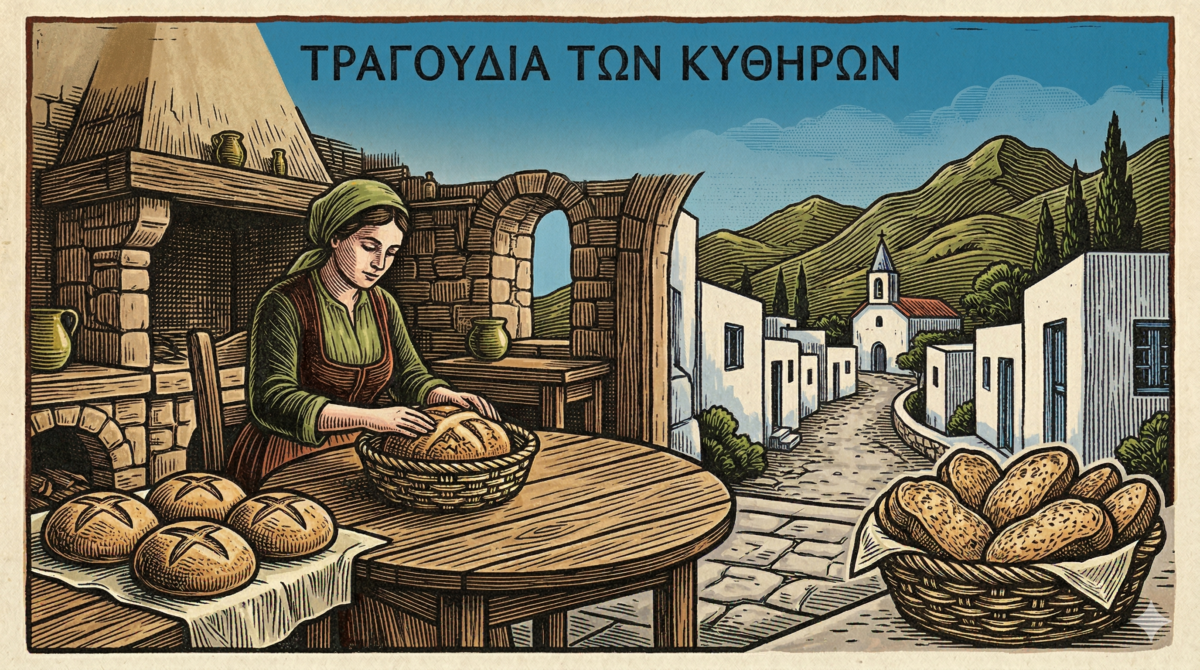
This tribute is an ode to «Chirigo», as sung by its people. These songs are not just lyrics, but living memories that describe the geography, folklore and daily life of the island. To each of them have been added folkloric, geographical and historical notes that shed light on their content and origins.
LET THE MOUNTAINS BE LOWERED
Let the mountains be lowered
if I could see Chirigo
Where he's got pretty girls
and red as an apple.
Further down from Kavomalias
above Crete
to the beautiful Chirigo
Aphrodite is born.
O my Holy Mother, Castrini
and you're Holy Alone
Don't let go, girl.
in Chirigo alone.
Orange trees of Karava
where you make oranges
Give me daughter the kiss
you don't want pleas.
Tsirigo beautiful island
I don't want your harm
for I'm treading on your soil
and I drink your water.
0 sun when it first rises
gilds your shores
and the moon rejoices
your many beauties.
0 in Bourgos with churches
country with patinas
and the meadow with dew
and with the greens.
I come from Paliopolis
and I'm going out to the Gurnades
Mitata and Viaradika
they have the greens.
Notes:
Origin: Perhaps the most famous and iconic song of Kythera (Tsirigo). It serves as a musical “map” of the island.
Place Names & References: There is a geographical definition of the island («below Kavomalia, above Crete’) and a reference to the myth that Kythera is the island of Aphrodite.
Settlements & Sanctuaries: Shrines such as Panagia Kastrini (in the Castle of Chora) and Agia Moni are commemorated, as well as numerous villages: Karavas (known for its springs and orange trees), Mesa Vourvos (a historical settlement under the Castle), Paleopolis, Mitata and Viaradika (known for their rich vegetation).
PAPADOPANAGIA
I didn't tell you, Panagiotina.
I didn't tell you. I didn't sue you.
with the nightingale bird.
And with the sea writing
and with the swallow.
I didn't tell you that.
I didn't tell you. I didn't sue you.
with your grammar book
Wait for him and he comes
your lover.
Notes:
Pattern: It belongs to the traditional narrative songs (parallels) of love. The motif of the «message» through the birds (nightingale, swallow) is nationwide, but here it has been adapted to the local musical idiom.
THE RED SWORD
You've done it again
the red sword
with crazy people and last year
with madness and feto.
Your red sword
your blue belt
has not left alone
no lad.
My redhead
and my blockbuster
A little more of your noodles
and you have deceived my mind.
It's not my fault that I love you
just don't get angry
God made you beautiful
hearts to hurt.
Beautiful you are, my eyes
and the sun is jealous of you
and when he comes back and sees you
it's gone and reigns supreme.
Notes:
Clothing: The «spaletto» (from the Italian spalletto / spalla meaning shoulder) is a traditional female silk scarf or jacket that was worn over the shoulders and crossed over the chest. It is a basic component of the Ionian and Kythiraean costume.
Themes: Erotic, playful song («patinada» or serenade) that celebrates the beauty of the girl through her traditional costume.
SONGS OF MARRIAGE
A’ WEDDING DRESS MESSARIAN
Twenty years of drinking
the vine in my yard
and tonight they're taking it away
and let it go to my wish.
Go to hell, son.
It's good for you
and we were waiting for him
your separation.
There, my child, where you're going
like a vine to take root
like the royal blossom
of your strands to reach out.
B’ BRIDAL GOWN
Today a wedding takes place
today the day shines
today is crowned
I'll be the dove.
My bride of clear glass
and bright moon
where you found it, where you chose it
this lad.
Notes:
Messaritikos & Xotaric: Names that originate from the areas of the Kythira countryside. «Messaritikos» means from Messaria (the central villages), while «Xotarian» indicates origin from the «Out» villages of the island.
Symbols: The first song is the parents« direction (symbolism of the daughter as a »vine« being transplanted). The second is a common pan-Hellenic wedding motif celebrating the couple's match (»aitos and dove").
IN THE OLD TOWN I MADE A COUPLE
In Paleopolis I made a couple
and I got a good look.
I untie my spots and go upstairs
and I'm getting them all over the place.
I saw the snowman from afar
and I went home.
Warmth as I entered the arch
from the fireplace and the woodshed.
Around the wise all for dinner
thank God and went to bed.
Daybreak Katharodethem
Lenten beyond belief.
Smelling like an English lord
Old Scordos was the first to get it.
Libinas and Kallitsounis are here
and Lazanas and Makarounis.
0 Playman and Pepperade
...and Revuthis and Old Fava.
There's Alatzas and Xydatos
At forty, Labrinatos will come
Catch the dance, little adults
and we'll be together again next year.
Notes:
Ethnography: It is a stunning ethnography of rural life. It describes the ploughing («I made a pair», «brush/beetle») in Paleopolis and the coming of Carnival.
Names & surnames: The song rescues characteristic surnames and nicknames of families of Kythera (Kallitsounis, Makarounis, Lazanas, Favas, etc.), acting as a kind of social chronicle of the old Kytherians.
BACK TO THE DANCE
He's caught up in the dance again
the beautiful orange
and smelled one side
and smelled the other one.
Forward ombre basil
and a viola in the back
and alongside jasmine
that smells of everything.
He's caught up in the dance again
the silver rod
and in the background
the pearl.
Notes:
Dancing: Classic circular dance song. Plants and flowers (orange, basil, violet, jasmine) are used metaphorically to praise the dancers, depending on their position in the circle («in front», «behind»).
MY MOTHER A SON
When I was a little girl
small and minor, good and untainted by love
I thought she was a piece of cake.
but that unprofitable one was bitter poison.
My mother, a young man passes through and through and through
he talks to me, I don't talk to him, he says hello twice.
Tell me, girl, in your precious youth
because you've got me to keep this serious.
Notes:
Themes: It consists of popular Greek trays (with minor variations). It expresses the naivety of youth in the face of love, which in the process turns out to be «bitter poison».
AH GIORGIS
Down in Agios Georgios
down in the cold water
they killed Giannakis
the only healthy one.
Turks cut him up
Romans cried for him
and two little girls
they were making fun of him.
John, you don't have a mother, you don't have a sister.
and beautiful woman to make you sad?;
But I have a mother, I have a sister
and beautiful woman to spare me.
Notes:
Background Pattern: A Kythiraean variant of one of the most famous historical/acritical dirges of the Greek area («Kato to Agios Georgios in the cold water»). It describes the death of a young man and the mourning of his own people.
I HAD A BIRD IN THE CAGE.
I had a little bird in the cage
sweetcorn
and the cage opened up like a wild animal
and he left and I lost it.
Come and let me cheer you up, my strange bird
and my alligator hawk.
Come and let the foreignness rejoice you
and I drink poison.
Come to rejoice you have spread your wings
and you flew away from me.
Come and be happy, but come back soon
in my arms.
Come and I'll be glad to see you no matter how well you get along
beautiful though you may be
the place where you were born
don't be a bum.
Notes:
Song of Xenia: Foreignness has left a deep scar on Kythera, as historically there has been a huge wave of emigration (mainly to Australia and America). The «little bird» allegorically symbolizes the young man leaving the parental home («open the cage»). The song is a moving plea for love.
CARABITIC
Oh, poor Karava.
with your orange trees
oh, my, my, my, my, and with your cold water
and with your girls.
Oh, poor Karava.
with the water in the stream
oh-my-my-my-my, all the girls for water
and they come kissing.
Amman - amman - amman - amman f’ Amyrgiali mild water
and I sat on the terrace
aman - aman - aman
and I got my mind taken over by a carabid girl.
Ooh-ooh-ooh-ooh-ooh-ooh-ooh-ooh-ooh-ooh-ooh-ooh-ooh-ooh
I bid you good night
♪ oh, my, oh, my, oh, my, oh, my, oh, my, oh, my, oh, my, oh, my, oh, my, oh, my, oh, my, oh, my, oh, my, oh, my, oh, my, oh, my.
our secrets are hidden.
Notes:
Origin: Local dance and song of the village of Karavas in the north of Kythera.
Geography: Karavas is famous for its abundant running waters (a reference to “Amyrgiali”, the famous springs of Amir Ali) and the lush vegetation of orange groves. The streams have historically been meeting and flirting places for young people.
THE ZAGARAKIA
I'm taking my dice
and I'm going to hunt
Rabbits and rabbits to find
and come back.
I picked them up and dropped them
in the forests and in the mountains
but they made me
a rich daughter.
I find the daughter and she was washing
in a marble trough
I sat down and I look at her
and he put me in a sense.
Notes:
Folklore: The «zagari» is the hound. The song begins as a hunting song, but evolves into a cute love story, where the «prey» is not an animal, but a beautiful girl washing at the tap - a classic setting in Greek folk songs.
RADICALS (TENDRIL)
Open the Key Ring
to St. John's grace
and that he is the radical
to come and get it.
And again reopen
to get her own
And whoever's lucky
to get its root out.
I pour the apple into the water
And I drink the water, mind you.
don't get confused
in the net I'm setting up for you.
Four apples I sent you
the one bitten
and in the bite
I've sent you a kiss.
In my root I put you
and I'm going to root you
to see if it's the lucky one
my eyes to take you.
Notes:
Custom of Cledon: It is directly linked to the feast of St. John the Rigana (23-24 June). The “Rizika” are the objects (rhizikaria) that unmarried girls threw into the «still water» in a pitcher.
Function: During the opening of the Cledon, as the objects were being retrieved, they were sung, which were supposed to function as divination or an omen (the «rhiziko») for the future husband of the owner of the object.
POTUS
Oh, my, oh, my, in the river the beautiful ones
in the country the starites
Oh, boy, oh, boy, and in the Logothetian
blondes and black-eyed.
Oh, oh, oh, oh I loved in the river
I loved in the country
Oh, my God, I loved in Karava
and what I will become now.
Oh, my God, my Holy Helena.
and you, my Countess.
Oh, oh, oh, oh, oh, oh, oh, oh, oh, oh, oh, oh, oh, oh, oh, oh, oh, oh, bring my love
or take my mind.
Notes:
Origin: Dance of the village Potamos (the main village of northern Kythera).
Place names: He mentions the neighbouring settlements of Potamos, Chora (the capital of the island), Logothetianika and Karava, making an «assessment» of the beauty of the women of each area.
Priest: Invocation to Agia Elessa, patron saint of the homonymous mountain and monastery in the southwest of Kythera (she was martyred on the island), as well as to Panagia Konteletou.
MYRTLE RUNNER'S DIPLOMA
Super bragging divine
as an honest man of honour
your holy image
You are granted to the apes.
Of miracles as an infinite fountain,
the relief of dangers and sufferings
ever-present Maria
Wherefore we cry unto thee according to thy desire.
Glory be to Him who was made flesh through you,
Glory to the one who brought you forth
of all the Cypriots in power
cover and shelter.
Notes:
Religious Tradition: It is not a folk song but the official ecclesiastical hymn (Apolytikio) of Panagia Myrtidiotissa.
The patroness of Kythera: Myrtidiotissa is the ultimate patroness of the island. According to tradition, her icon was found in myrtle trees by a shepherd. The apocalyptic is chanted by all Tsirigians around the world.
I HAD A ROOSTER, TOO.
Oh, how I've been with you
I too had a rooster
and farted from time to time.
Oh, how I've been with you
but the fox took him from me
and he never told me.
Oh, how I've been with you
I had a little blue belly
was stunted.
Oh, how I've been with you
nor did he eat atribe
or a drunkard.
Oh, how I've been with you
and lifted her legs
and made her cross.
Oh, how I've been with you
and begging God
to bury her shepherd.
Notes:
Composition: It is a traditional, extremely mocking and satirical song of the countryside.
Vocabulary: Interesting local words are distinguished: «zula» (goat), «achelea» (probably a local term for a wild or unruly goat), «athribi» (a type of thyme). The humour culminates with the goat... making her cross for her shepherd to die, underlining the daily difficulties of farming in a cheerful way.
MESSA
Erie and me
Air Messarite for blow a little
Eri ki aman aman
because the Potemkin has poisoned me.
Eri ki aman aman
Let me sing and rejoice
next year who knows
Eri ki aman aman
to die or live
or I'll be in other places.
Eri ki aman aman
the stranger in the foreign land
he has to wear black
Eri ki aman aman
to match the costume
with the light of the heart.
Notes:
Origin: The title refers again to Mesa Kythera, (i.e. the middle demos, the municipality of the south). The first record depicts a playful «competition» between the regions of the island (Messarikos air vs.).
Philosophy & Foreignness: The following verses are inspired by the traditional philosophy of the ephemeral nature of life («who knows about time») and end with the heavy yearning of foreign travel, a theme that, as mentioned above, dominates the collective memory of the Kythirians.