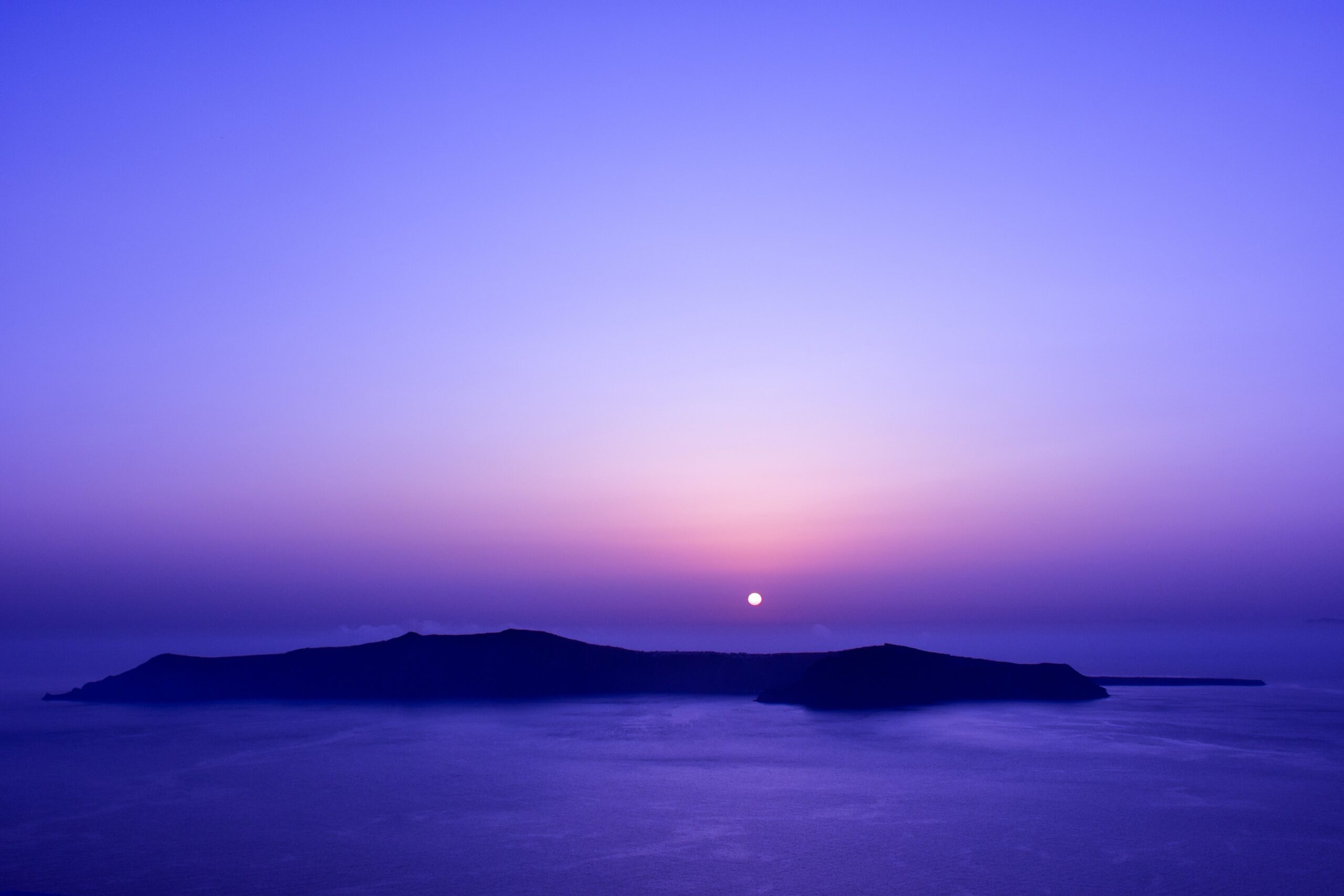
An international team of researchers conducted an in-depth study of the volcanic material ejected by the Minoan eruption of the Santorini volcano, in order to uncover the secrets of Europe’s largest volcanic eruption in the last 10,000 years and to contribute to the understanding of major volcanic eruptions worldwide. The Department of Geology and Geoenvironment at the University of Athens (UoA) is also participating in the research.
Many of the most destructive volcanic eruptions in history occurred on island volcanoes, which is why much of the material from these eruptions has settled on the seafloor. This makes it difficult to study this material to determine the true magnitude of an eruption, with the result that the scale of these major events and the risks they pose are not yet well understood, even among experts.
An international team of scientists, led by marine geoscientist Jens Karstens of the German GEOMAR Helmholtz Centre for Ocean Research in Kiel, and including Associate Professor Evi Nomikou of the Department of Geology and Geoenvironment at the National and Kapodistrian University of Athens, Evi Nomikou, and researchers from institutions in Norway, the U.S., and France, accurately measured the Minoan eruption of the Santorini volcano, which occurred approximately 3,600 years ago, as well as the volcanic material that was ejected and deposited both on land and at sea. Their study was published in the journal *Nature Communications*.
By combining the most advanced geophysical and geological methods, scientists have reexamined the Minoan eruption of Santorini and more accurately determined the volume of magma ejected, which is used to measure the magnitude of an eruption. As Evi Nomikou, an associate professor at the National and Kapodistrian University of Athens, explains to the Athens-Macedonian News Agency (ANA-MPA), through the study of this material, «we are trying to piece together this “puzzle,” what the Santorini volcano was like before the Minoan eruption, what it was like afterward, and what the actual volume was that was ejected and spread around Santorini. We’ll only be able to figure this out if we study the seabed very carefully.».
In this new publication, the researchers found that the volume of material ejected onto the land and into the seabed around Santorini was 26–41 cubic kilometers, significantly smaller than previously assumed (earlier estimates suggested 86 cubic kilometers of ejected magma). The volume of the ejected material also provides information about the volume of the magma chamber located beneath the volcano.
This is the first time such precise values have been calculated for all the individual components, since, until now, estimates of the explosion’s volume were based either on estimates of the volume of the caldera collapse or on incomplete records of the explosion’s products. Both approaches, on their own, are limited in their explanatory power.
For the new calculations, the researchers combined different methods from several research expeditions. For example, they were able to identify ash deposits from the Minoan eruption in 41 sediment cores collected during the 2017 research expedition aboard the Poseidon, therebydetermine the volume of ash from the eruption. The data they collected even allowed them to characterize the material that fell into the center of the volcano’s crater.
«This publication is the result of excellent collaboration between Greek and foreign scientists who participated in previous oceanographic expeditions around the seabed of Santorini. Geological and geophysical data were collected and analyzed, and combining these led to a more accurate interpretation of the magnitude of the Minoan eruption,» notes Ms. Nomikou.
Using this new scientific approach, the research team drew conclusions about the actual extent of the Minoan eruption and ultimately established a more reliable benchmark for better classification and measurement of other major volcanic eruptions worldwide.
«Eruptions can cost lives and even affect the climate. We are pleased that our research has contributed to a step toward a better understanding of these large-scale events and, consequently, to improving risk assessment,» explains team leader Dr. Jens Karstens.
The research is now continuing with the undersea exploratory drillings conducted in December 2022 and January 2023 as part of the major oceanographic expedition of the International Ocean Discovery Program (IODP). The seafloor drillings were carried out at locations identified by the research team as critical, following an analysis of seismic profiles and seafloor topography, in order to confirm, through drilling, the volume of volcanic material from the Minoan eruption of Santorini.
Maria Kouzinopoulou