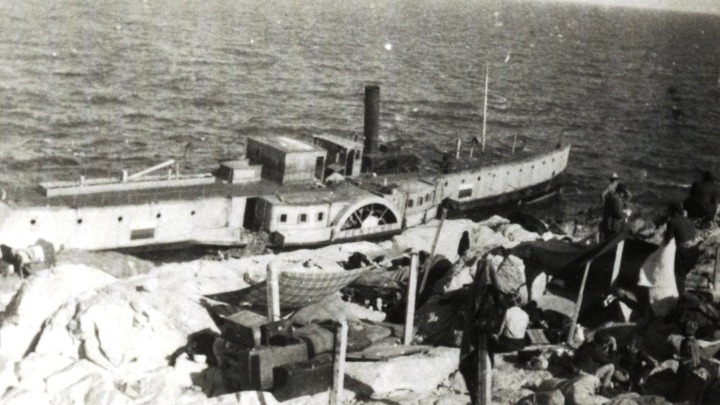
The historic shipwreck of the PENTCHO, which was used to transport Jewish refugees in 1940, was found and identified on the Aegean seabed and in the waters of the island of Hamili.
It was the 1930s when the rise of fascism and Nazism in Europe prompted hundreds of thousands of Jews to flee their homes to countries where anti-Semitism was rife for a country where they would not be in danger. Many of them attempted to make the daring journey to British-occupied Palestine, where thousands of Jews gradually gathered.
The transportation of Jews by sea to Palestine, without the necessary permission of the British, began in 1934 and came to be known as Aliyah Bet or Ha'apalah. By the end of 1938, the British government, because of opposition from the Arab element, announced that it would lower the permissible limit for Jewish settlers to settle in Palestine. At that time, secret - illegal - organisations were set up with the aim of continuing to transport Jewish refugees to Palestine, mainly by sea. For this purpose, between 1933 and 1944, about eighty-six voyages were made, for several of which Greek-owned ships were used, which managed to transport about thirty-four thousand refugees to their destination.
The wheeled steamer PENTCHO in the Aegean Sea
The danger for shipowners was great, because their ships, when detected by the British authorities, were seized and the crew imprisoned. Thus, the availability of boats to continue this illegal immigration was limited and over-aged vessels were usually used. Among these often unseaworthy vessels was the PENTCHO, a wheeled riverboat. The 33-year-old PENTCHO made her first and last voyage in the turbulent waters of the Aegean in 1940. On board the trolley steamer PENTCHO were 514 passengers - including 142 women and 9 children - from Bohemia, Moravia, Slovakia, Poland and Austria. The captain of the ship was the Russian Igor Markeyevitch.
Most were members of the Betar organization, which, in the 1930s, had helped many thousands of Jews to resettle in Palestine. The purpose of Betar was to cultivate in young Jews the vision of establishing a Jewish state in Palestine and to provide them with military training. Among them was Imi Lichtenfeld who then developed the martial art of Krav Maga.
The episodic journey
PENTCHO departed from Sulina, Romania, on 21 September 1940 and opened in the Black Sea. There she was also faced with a storm but managed to reach Istanbul. After leaving the Dardanelles in the Aegean Sea, the ship moved south until it was spotted by a Greek warship. As the PENTCHO was sailing without a flag, the Greek vessel fired warning shots forcing it to stop and then ordered it to follow it to Mytilene. After provisions were made, the trolley continued on its course and on 30 September 1940 sailed to Piraeus.
The Greek Jewish community came to the aid of the refugees by making it possible to supply the boat with water and coal. On October 2, the Jewish New Year's Day, the community offered food to the refugees, who left the next day. The PENTCHO would sail southeast to Mersin, Turkey, and from there it would sail to Palestine. The vessel sailed to Astypalaia, where the refugees were offered food and then headed south to sail through the Kasos-Crete Strait. However, the PENTCHO encountered mechanical problems, and eventually the boiler was disabled, leaving the vessel adrift. The crew tried in vain to get the locomotive running, and the drifting vessel ran aground at 19:40 on 9 October 1940 on the rocks of Hamili Island.
The grounding and the subsequent friction of the vessel on the steep coastline caused a breach in the hull and an inflow of water. The passengers and crew constructed makeshift bridges and connected the vessel to the shore, which allowed their safe disembarkation. After managing to bring ashore anything that might be useful for their stay on the island, they built makeshift shacks.
The rescue and the end of the Odyssey
In the meantime, four volunteers and one crew member boarded the PENTCHO's only lifeboat and set off in search of help.
Four days later, the dinghy was spotted by an aircraft from the British aircraft carrier ILLUSTRIUS and the destroyer NUBIAN was alerted to rush to their aid. The British informed the Red Cross of the existence of the castaways on the islet, so that the information could be passed on to the Italians.
The refugees who had disembarked in Hamili managed to survive thanks to the food, clothes, utensils, fuel and all the necessities they had been able to carry from the steamer for their stay on the inhospitable rocky islet. There they organised their lives having secured from the ship's supplies a daily plate of soup. Bad weather conditions did not allow the shipwrecked men to be located until 14 October 1940, when the pilot of an Italian aircraft spotted the wreck of the PENTCHO.
The self-organization of the shipwrecked people, which allowed their preservation on the inhospitable rocky islet, was a characteristic sign of the will of Jews everywhere to return to their ancestral land.
After 10 days of their stay in Hamili, on 18 October 1940, the Italian Navy auxiliary CAMOGLI approached the islet. At first, women, children and the sick were put on board. The following day, the men were removed, except for twenty people who remained on the islet with the luggage of the shipwrecked men. Subsequently, members of the Greek Jewish community who had in the meantime been informed of what had happened arrived in Hamili. They gave supplies to the remaining castaways and the promise that they would return, having previously found a way to help them continue their journey to Palestine. But things took a different turn. On 26 October 1940, an Italian boat arrived to pick up the castaways and their luggage. They were all taken by the Italians to Rhodes, where they were kept in a makeshift camp. In early 1942, most of PENTCHO's shipwrecked crew were transferred to the Ferramonti detention camp in Italy, where they remained until their liberation by the Allies in September 1943. The following June, they were transferred to Alexandria and from there they were taken by train to Palestine. In the end, it took them 40 months, not 40 days, to reach their coveted destination...
Research and documentation - A forgotten shipwreck at the bottom of the Aegean Sea
The remains of the historic shipwreck were found and identified by Greek divers. Among the forgotten wreckage, the wheels and the bow of the ship, which rests on the seabed on the starboard side, stand out. The steam boiler, which was the «heart» of the ship, emerges from the seabed in an upright position and in perfect condition. The two anchors of the PENTCHO were left forever on the rocky Aegean seabed. Alongside the underwater exploration, archival and historical research was carried out by Aris Bilalis and Kostas Thoktaridis in order to document the extremely important history of the ship.
PENTCHO - The identity of the ship and the monument
PENTCHO, built in 1907 as STEFANO, was 50 metres long and 12 metres wide. It was registered in Naples and operated on river trips on the Danube. She was originally owned by R. Anatra & Ungarische Petroleum A.G., based in Budapest. She was purchased for ten thousand dollars by a Jewish organization in Romania in early 1940. Later alterations were made to the layout so that the wheeled steamer could carry passengers and, after being renamed PENTCHO, she was sent to Bratislava, Slovakia.
It is worth noting that a memorial to the PENTCHO shipwreck, which was a major turning point in the effort to transport Jewish refugees to Palestine by sea, has been erected in the Israeli city of Netanya.