By Tonia A. Maniatea
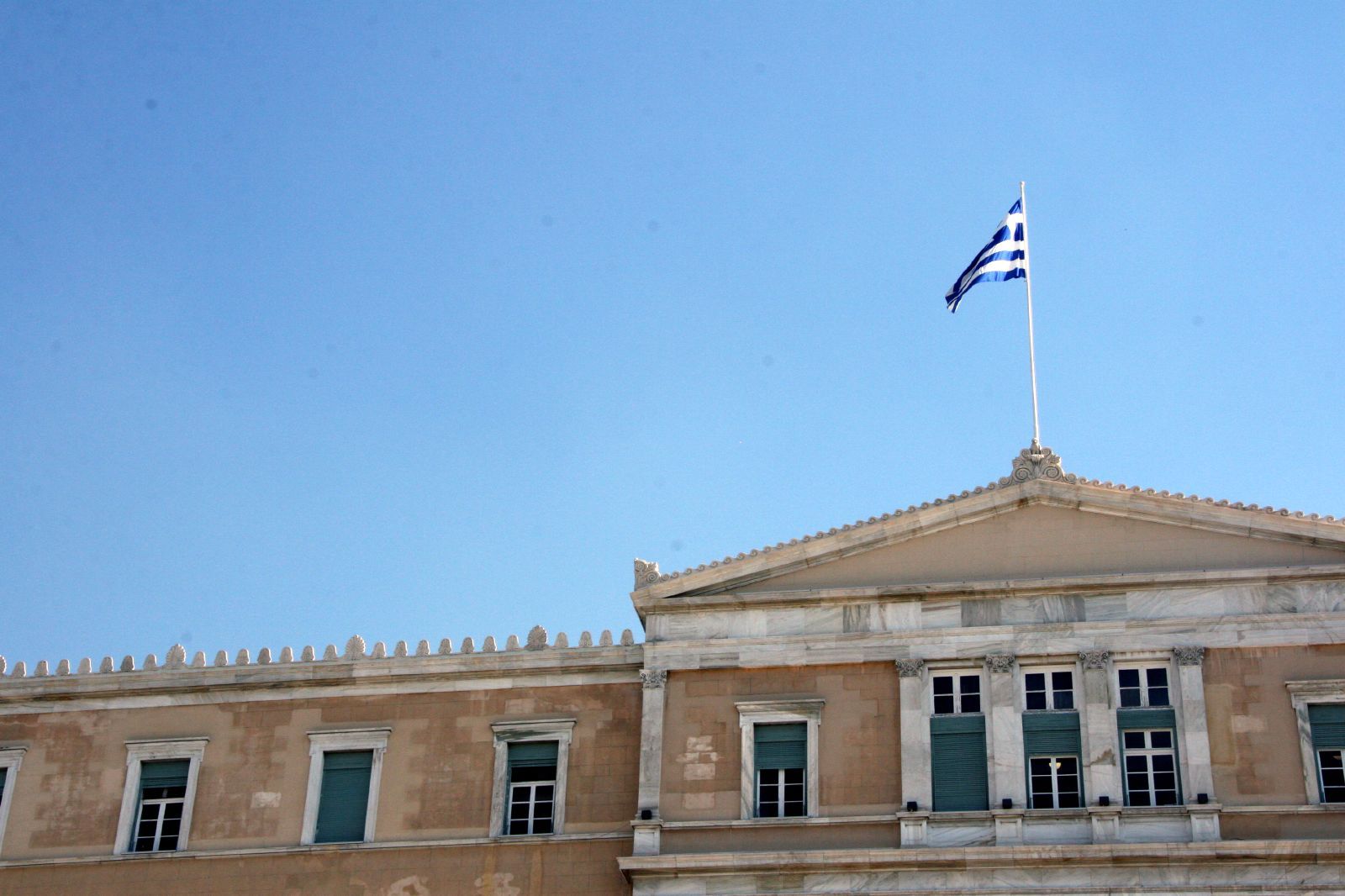
The reference is not particularly... attractive, but it gives a clear picture of the socio-cultural facts of the time, there in the first decades of the 19th century (actually, around 1836-37) in Athens of a few thousand people, where the capital of the country had been transferred from Nafplio and where the kingdom of the young Bavarian king Otto was to be established. In her historical novel «The Schism», Philomela Lapata characteristically describes the ... participation of the Athenians in the construction of the present building of the Parliament, which at that time, 177 years ago, emerged at the easternmost end of the confined city to house the royal family and its court. At that time, Athens was generally spread out around the Acropolis. In the shadow of the rock, from Psyrris to Makriyannis, the everyday life of the Athenians unfolded. The rivers were filled with the sound of chanting water, the trocans of the living were echoing on the outskirts, and the mountains could be distinguished at a glance on the horizon. The air brought to the city the scents of the wild botanicals that reigned on Mount Hymettus, or «trelovouni», as the Athenians called it, because its characteristic was the sudden changes in the weather.
A flood of images of Athens in the early 19th century were bequeathed to us through their rich work by writers of the era, such as the Soutsos brothers, Papadiamantis, Roidis, Ragavis, Vikelas... Athens was a city that was measured by the... bar at that time. In fact, life in the east ended shortly after Hadrian's Gate. From there onwards it was chaos... Indicative is the case of the Philelekpaediktiki Gesellschaft (Philekpaediktiki Society) which bought at that time from the Monastery of Zoodochos Pigi (Andros) for 2 drachmas per cubit, a plot of land 8.620 square cubits at the corner of Panepistimiou (then called Megalo Voulevarto) and Pesmazoglou (then Menandrou) streets, in order to build the Arsakeio School and for its construction requested the help of the municipality. When he saw the plot of land one of the councillors exclaimed: «They asked us to help them to build a school, so that our girls could learn letters, and these blessed ones went to build it in the exile of Adam.».
The new Greek capital, then, is cramped, battered and poor, but that is the image of the whole country anyway. Simply put, Athens' past shines and its future looks promising... When the city is chosen as the capital of the newly established Greek state, George Ludwig Maurer, a professor at the University of Munich, a member of the Royal Academy, a lifelong advisor to the Bavarian state and a member of Otto's three-member Regency in the newly established Kingdom of Greece, writes: «What King could choose another seat for his government when he has the spiritual seat of the world in his hands?;». However, the city that assumes the primacy of the newly established Greek state is nothing like its former glory. It is a dusty little town, with sculpted houses and outlying outhouses, with a few family two-storey buildings here and there, with a serious water supply problem and bloody dirt streets, for, you see, the butchers who supply their customers with meat slaughter the animal in front of their shops, and as drainage is a non-existent affair, its blood flows unhindered.
The fun of the locals is the walk along Voulevartou Street (Amalias Avenue) which roughly starts from Hadrian's Gate and ends at the Mesogean Gate (today's Othonos in Syntagma Square), one of the seven of a wall that encloses Athens. It is so named because it is the starting point of a road leading to the Mediterranean. A few metres from the point, on the lower side of the opening, a band usually plays in the afternoons to the delight of the walkers. The area is also known as Boubounistra, because of a fountain whose water, which comes down from Ampelokipi following the course of the Hadrian's aqueduct, runs with such force that it sounds like a boom.
Some, a few Athenians, have the luxury of an estate (or more) outside the confined urban fabric. These usually load themselves onto a monitor or directly onto the back of a horse and visit.
As soon as the capital of the state is transferred to Athens, those with property are looking to be the first to know where the king's palace will be housed, so that they can buy a piece of land and set up their luxurious home...
TO BUILD THE PALACE ON THE ROCK OF ACROPOLIS!
In such a promising Athens, therefore, Otto's father, Louis I, who would finance the project, was looking for a suitable site to build his son's palace. A place safe, with a good climate and an open horizon. The proposals from the architects of the Bavarian court come almost simultaneously and meet nowhere.
Leo von Klenze proposed the Kerameikos, Ludwig Lange the foothills of Lycabettus, Karl Friedrich Schinkel made the extremely advanced proposal that the palace should be built on the rock of the Acropolis (!) and Stamatis Kleanthis and Eduard Schaubert at the junction of Piraeus and Stadiou Streets (Omonia Square).
Louis first - and fortunately - rejects Sinkel's proposal as «inappropriate» and wavers between the others. The story goes that the solution is provided by his advisers with a trick. At the three proposed spots in Athens, and at a fourth, suggested by the then director of the Munich Academy of Fine Arts, Friedrich von Gaertner, they place a piece of meat. The spot with the meat, which would later rot, would be the ideal spot for the construction of the palace. The... fate of the meat shows the hill of Bubunistra. It's Gertner's choice. One... small detail, the stench that «descends» from the neighbouring «goat farms» (the name of Kolonaki, because there were plenty of mangeries at that time), will later be assigned for... remediation to the pair of architects Cleanthi-Saubert.
The Bavarian architect designs the building and its appearance and appears to the king. It is the time when the monarchy is flourishing in Europe and thus, the monarch's house has to be imposing and luxurious. The surface area of the building designed by Gertner is larger than that of Buckingham Palace (!) and its façade is «particularly peripatetic», including most of the architectural elements of the period. But Louis wants a palace as inexpensive as possible. He picks up a red stylus and begins to draw lines. He erases the elements that adorn the face of the palace. Rumor has it that Gertner is angry. «But, Your Majesty, you have left only one barracks!» he says to Louis, only to get the answer: «never mind. Its bulk is enough.».
The hill of Boubounistra is in the countryside, but when the palace, which is planned and will be the first building in the area, is completed, the king will be able to look out from his balcony and gaze out over the Acropolis.
Architecturally, Gertner's creation will be a typical example of a classical building with strict lines and a flat development due to the slope of the ground. Louis wants it simple and Doric, but the architect manages to make it imposing and beautiful with measured decorative elements. It is even said that since then the area around the palace has been subject to special building conditions and the construction of any new mansion requires the approval of the plans by Otto himself.
According to the book entitled «In Athens, once upon a time...» by the Athenian writer Dionysios Iliopoulos, the foundation stone of the palace was laid on the morning of 26 January (according to other sources, with slight deviations and taking into account the old calendar, on the 5th or 6th or 16th of February) of 1836, with the representatives of the great powers and Athenian society present. The day after the foundation ceremony, the Bavarian architect wrote in a publication of the time: «When they gave the hammer to the young King and he handed it over with childlike devotion to his father, King Louis, he embraced his child with tears in his eyes and gave him away under the gaze of the Athenian public...».
Nor two months after the start of work, Gertner leaves Athens for Munich. He leaves the project supervisors, two architects, lieutenants of the royal guard, at his feet and closes himself in his office in the German city in order to design the interior of the Athens palace. He unfolds all the details in 247 drawings!
The construction of the mansion lasted a total of 11 years (the interior decoration, ceilings and walls, will be completed much later), with the work of more than 500 workers, as well as volunteer artists from the Cycladic islands, where marble craftsmanship flourishes. For the occasion, the quarries of Penteli, which supply the construction site, are being reopened. As for the timber, which is required, it «travels» from Constantinople especially for the Athenian palace (according to the records of the Ministry of Foreign Affairs).
The ground, first and second floors were completed in the first four years and on 11 January 1840 the first beam of the roof was placed, an event that was duly celebrated a few days later (the... bad tongues talk about the consumption of 500 lambs and 5,000 bottles of wine!). The building consists of four peripheral wings, one on each side, and a central internal wing on either side of which are two atria (internal courtyards) with an equal number of staircases for easier access and communication. It is surrounded by Doric colonnades to the east and south and porticoes to the west. There are 52 windows in the front. There are three large windows in the centre of the second floor and 16 smaller isometric windows on either side of them. Similar windows can also be seen on the first floor. On the ground floor, on either side of the entrance, there are another 14 isosceles windows, one of which (the third from the left) is blind. It does not open or close. It exists only for symmetry.
Almost simultaneously with the palace, whose... final touch is delayed due to the increased requirements of a royal residence, mansions appear on the perimeter of the hill. The duo of Cleanthi and Saumbert, to whom - in the meantime - Kapodistrias had entrusted the urban planning of Athens, worked hard, but probably in vain... The two architects proposed a grand design for the city with wide streets and impressive squares, which would require expropriation and high compensation. Their initial proposal is rejected as «extremely costly».
BLOOD AND VIOLENCE ON THE FRESH WALLS OF THE PALACE - A PREDESTINED MARCH IN THE NAME OF DEMOCRACY
With these and those, the roof of the palace is completed, the work on the interior decoration, which has started from the ground floor anyway, is slowly and carefully progressing and the time comes for the installation of the royal couple. Otto and Amalia, who in the meantime were temporarily staying at the Dekozis-Vouros mansion (in today's Klathmonos Square - it serves as a museum of the city of Athens), enter their new residence on 6 August 1843. The basement housed warehouses. On the ground floor the secretariat and the palace treasury with their auxiliary rooms, the King's Catholic Chapel, the treasury and the kitchens. On the first floor are the halls of the throne, the trophies, the adjutants, the ball and the games. Also, the dining room and the royal apartments, which communicate with each other. The second floor is occupied by the private apartments of the heirs, the courtier and the palace staff.
The interior decoration, designed by Gertner - as the few remaining elements testify - is exquisite. The trophy and adjutant's chambers (now unified into the Eleftherios Venizelos Hall) are jewels in their illustrations. The frieze (1.22 m high and 78 m long) depicts events of the Greek Revolution and portraits of fighters and was designed by the sculptor Ludwig Michael von Schwanthaler with the collaboration of the painters Philippos and Georgios Margaritis.
In the same year, Cleanthes and Saubert receive a new «shot», this time from the religious leadership of the country, when they propose as the site for the construction of the new, largest metropolitan church of Athens (the church of Agia Irini, in Aeolou Street, is the metropolis) the place where the Ophthalmia Hospital will eventually be built. «It is too far from the urban fabric and will make it difficult for the faithful», the hierarchs object, and the proposal of the two architects falls again into the void. The metropolitan church, in the end, is decided to be built next to the surviving 13th century medieval church of Theotokos Gorgoepikoos and Agios Eleftherios, an area assessed as easier and safer to access for the Athenian faithful.
However, the construction of the palace cost 100,000 pounds, a cost that was covered entirely by Otto, taking the sum from his father's personal fund as an interest-free loan. From this sum he returns to the royal treasury all and every £2,000. The rest is to be paid by the Greek State. In his «Political History of Modern Greece», Spyros Markezinis states that that Otto never - even after his deposition from the throne - claimed compensation for the confiscation of the palace from the Greek State and that the issue was later raised by Bismarck on behalf of Otto's heirs. The point is that by 1880, the Greek state's coffers are reduced by 98,000 pounds...
With the installation of the royal couple in the newly built palace, which rises imposingly on the hill of Boubounistra, the area is «christened» Palace Square. Its name will soon be changed. Only days after the move, on the night of September 2 to 3, Lieutenant General Dimitrios Kallergis with his confidants, Ioannis Makrygiannis with his irregular soldiers and the fighter of 21, known as «Fustaneloforos», Dimitrios Kallifronas with the citizens of Athens, surround the palace asking Otto for a concession of the Constitution.
«Big push. The people and the army, uniformed men with arms on their shoulders, exhausted by the intensity of sleeplessness, officers of the order together with disorderly bodies of old soldiers and famous fighters of the Revolution of 21, as well as heroes led by General Makriyannis, despite the outstretched arms of the Bavarian soldiers, had surrounded the Palace and indiscriminately prevented the entrance to it. [...] A roar, as if from the bowels of the earth, stirred like a sudden storm that morning of September 3, 1843. [...] “Constitution! Constitution! We want a Constitution! Long live the Constitution!” Greece was a Greece drunk on democracy and the Constitution» («The Schism» - F. Lapata)
The revolt of 3 September in the Palace Square, with the «maiden» siege of the palace, is predominant in history as the «bloodless revolution», although both the English historian Douglas Dakin and the Greek Constantine Paparrigopoulos refer to it as «almost bloodless». According to the former (in his work «The Unification of Greece»), at that rally a gendarme was killed on duty. According to the second (in the «History of the Greek Nation»), the victims of the revolution are «Only two gendarmes slain, and one of them severely beaten in Nebania.».
That night, however, with the passionate, determined voices, echoing for the first time in the freshly painted walls of the brand new palace, Palace Square is renamed again, and this time automatically as Syntagma Square. It remains so to this day. To democratically interpret those still passionate, demanding voices that followed...
A GARDEN TRANSFORMS THE «STRATO» - THE TOILETS ARE NOW FINDING THEIR PLACE IN THE PALACE...
The palace stands massive in the middle of nowhere. The few luxurious residences around it are not enough to distract the eye from the vast fields, which indeed make it look like a barracks in the middle of a firing range. So Amalia takes... action. Right next to the palace she landscaped a large garden (covering the same area to this day), commissioning the planting to the French horticulturist François Louis Bareaud, who designed the internal network of paths and determined the form and position of the ornamental features, buildings, water features and enclosures.
In 1839, more than 15,000 ornamental plants travelled from Genoa to be planted in the Queen's garden. Many more are brought from Sounion and Euboea. Amalia throws herself passionately into the landscaping. Such is her interest in the garden that she spends at least four hours a day tending it. In 1842, she herself planted the Washingtonias (they live to this day) at the entrance to the garden from the avenue that bears her name.
In the late 1860s, as plants and trees have now been harvested, the palace and its garden «smell» of Europe. It is a paradise that gives a boost to the urban fabric. In the city-village where, just before, the gaze is scattered on the open horizon, in the «heart» of the 19th century, miracles are born. The adjacent villas and some infrastructure in water supply and sewerage, which in the meantime is underway with the help of foreign loans and sponsorships from prominent Greeks abroad, with the first and best being the father and son Sina, George and Simon, are slowly transforming Athens into an attractive capital. Its boundaries are growing with luxurious mansions and public buildings being built within a short distance from Syntagma Square, near the Ophthalmology and Arsakeio, which have been completed and are now operational, while the neighbouring buildings to house the University and the Academy are under construction under the signature of the Danish architects Hansen brothers. In a few years the National Library will be built, which will complete the Athenian trilogy of neoclassicism and will mark Panepistimiou Street. Construction sites around the small residential core are preparing enviable residences and state complexes.
In 1870, at the intersection of Amalias and Xenophontos streets, the three-storey Kyriakouli Mavromichalis Mansion was built (today it houses the offices of the European Parliament in Greece). Six years later, in 1876, a mansion was built on Menandrou (Pezmazoglou), near Arsakeio, where the old Stock Exchange was housed, while in 1882-85 the German architect Ernesto Chiller, who would construct a series of masterpiece buildings in Athens (including the present Presidential Palace), erected his two-storey residence on Mavromichalis Street. Many others preceded it, among them the residence of the Austrian ambassador (today's Fidiou), the Theodoridou House (at the intersection of Panepistimiou and Homer), the Ilision Mansion (Vas. Sofias), the National Printing House (on Stadiou Street, between Arsaki and Santarosa), the National Bank building (Aeolou Street, at the height of Kotzias Square), but also an example of an urban apartment building, the work of Kleanthios (18 Lykodimou Street), dating back to 1845. Now scattered hotel businesses are springing up in central and semi-central parts of the city, with the hotel of Great Britain, first in 1866 at the present intersection of Stadiou and Karageorgi Servia streets and then (1874) in its present location, in a mansion designed by Theophilos Hansen. Athens was transformed into a megalopolis worthy of its status as the capital of the Greek state.
Meanwhile, after the royal couple settled in the Palace of Bubunistra and as the years passed with political ferment within the country, which was trying to find its feet as a newly established state, revolutionary anti-royal movements were on the increase.
In October 1962, by a resolution of the Nation, Otto's reign was abolished and the monarch and his wife Amalia were forced to be evicted, while retaining the throne, which, in November of the same year, was occupied by the Danish Prince George I. The palace in Syntagma Square acquired new tenants and in a few years, when George married Olga Constantinovna of Russia, a new hostess, who made alterations and additions. First, the lavatories are now located inside the palace. In addition, the staircase of the east wing is being modified and an Orthodox chapel of St. George is being created on the second floor. And because the demands arising from Athens’ status as a capital city have increased and it is now necessary to accommodate officials in the magnificent palace, the design also includes the creation of several guesthouses.
In 1884 a great fire, which is thought to have been caused by a lighted candle in the chapel of St George, incinerated the second floor of the north wing. A second fire occurred in 1909 and completely destroyed the central wing and the corresponding parts of the east and west wings. The royal family moved to the summer palace of Tatoi. In fact, this is the beginning of the end for the «royal use» of the palace. Although the couple George I and Olga returned to the building in 1912, the Greco-Bulgarian War, the assassination of the king and the declaration of the First World War interrupted the restoration of the damage. Crown Prince Constantine chose as his residence the palace of Herodou Atticus (today's Presidential Palace), whose construction had been commissioned for him, and Olga and members of the royal family were occasionally housed in the palace in Syntagma Square. In 1922, the royal mother left Greece for good and the palace was left to various public uses. At first, state services, private social institutions and international organizations coordinated to deal with the complex problems arising from the Asia Minor Catastrophe passed through its premises. In the second decade of the 20th century, services of the Ministries of Agriculture, Military, Health, but also the International Migration Service, the City Police, the ’Christian Union of Young Women« (CHEN), the Hellenic Red Cross, the International Women's Association, etc. find a home here. There is also an infant clinic, a student boarding school, a Near East Relief hospital and orphanage, as well as the Benaki Laboratories. George I's apartments and the chapel on the ground floor are used for the storage of the royal estate, which ends up in the Historical and Ethnological Society.
In 1925, a small building was erected in the courtyard of the palace and until today it is known as the «Palataki».
In 1927, the «Museum of George I's Souvenirs’ was inaugurated as a branch of the National Historical Museum, which operated in the building until 1930 and from 1936 to 1941.
The surrounding area at the front of the building changed its appearance with the creation of the Monument to the Unknown Soldier, designed by the architect Emmanuel Lazaridis in 1928.
In November 1929, the government of Eleftherios Venizelos, after many discussions in the Parliament, decided that it should be housed, together with the Senate, in the building of the Palace of Syntagma Square. The work to convert the building into the Palace of the Parliament and the Senate, designed by the architect Andreas Kriezis, is the most radical intervention in the building since its construction. The main wing is being demolished and a new one is being built to house the Chamber of Deputies and the Senate. The ground floor will be used for the offices of the Prime Minister and the President of the Parliament and the first floor for the services of the House. The second floor accommodates the library of the Parliament and the Council of State, which remains in the building until 1992, when it moves to the Arsakeion Mansion.
On 1 July 1935, the Fifth National Assembly solemnly begins its work in the new Plenary Hall.
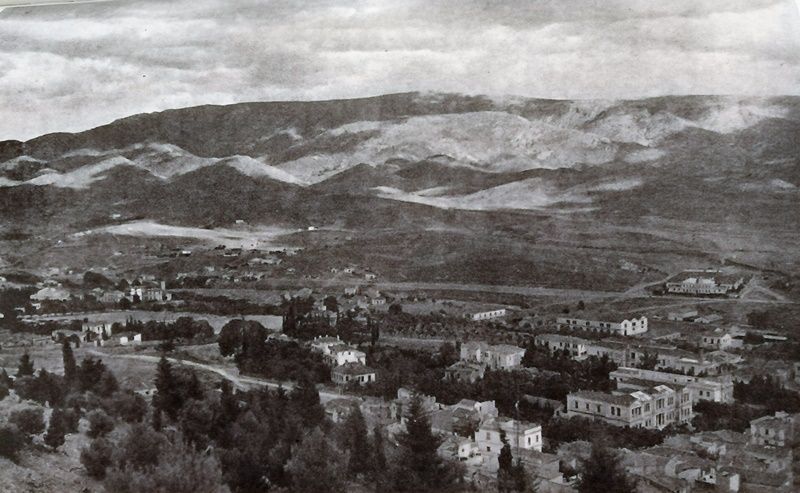
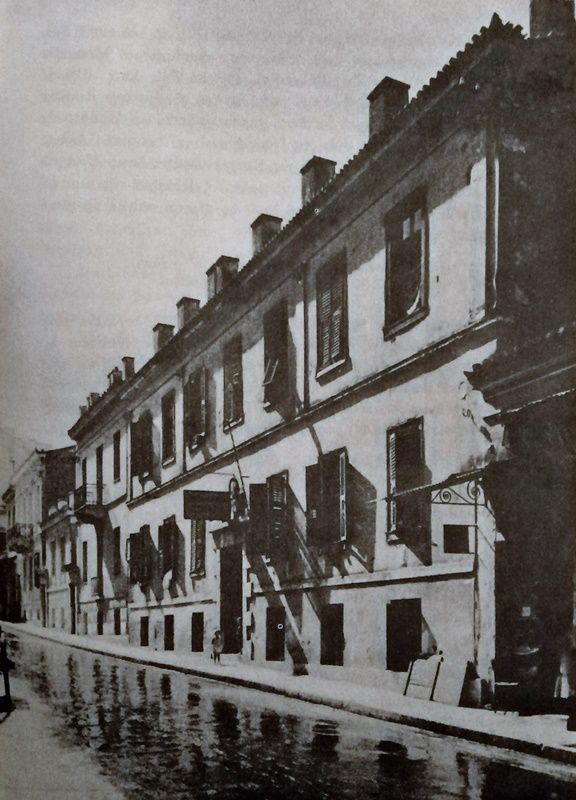
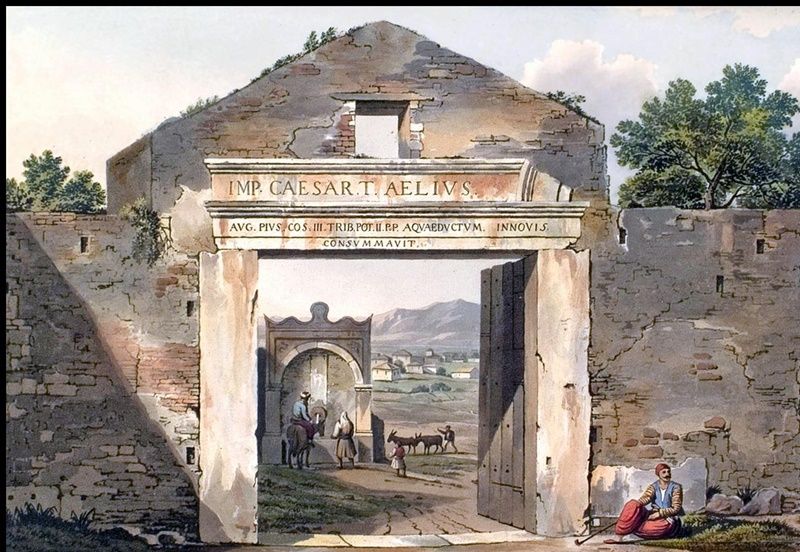
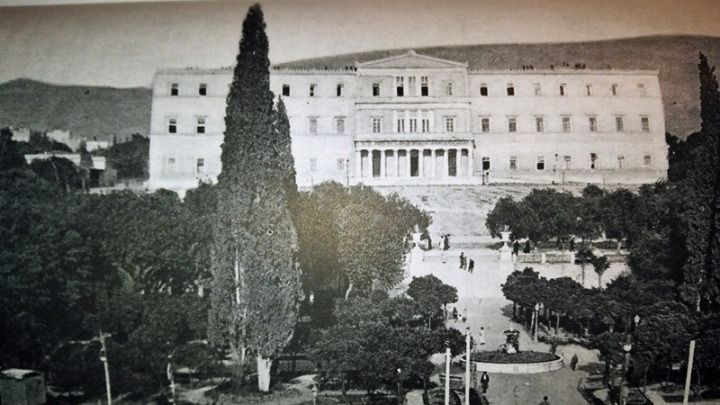
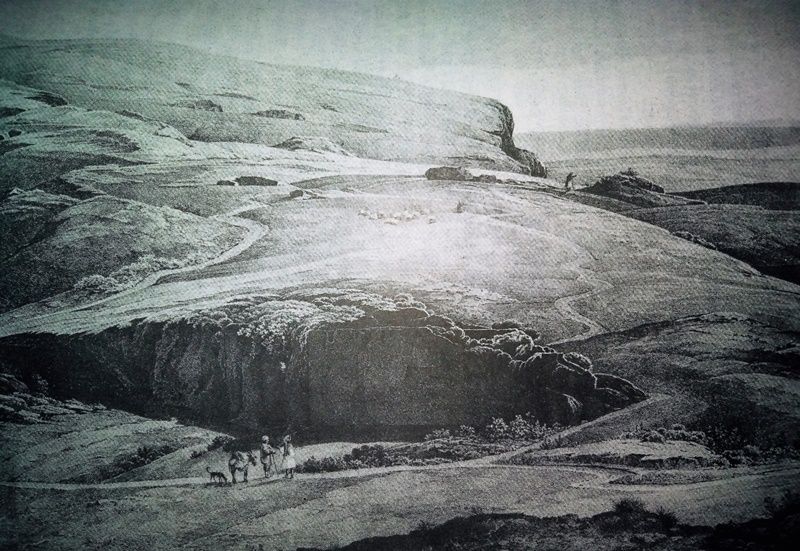
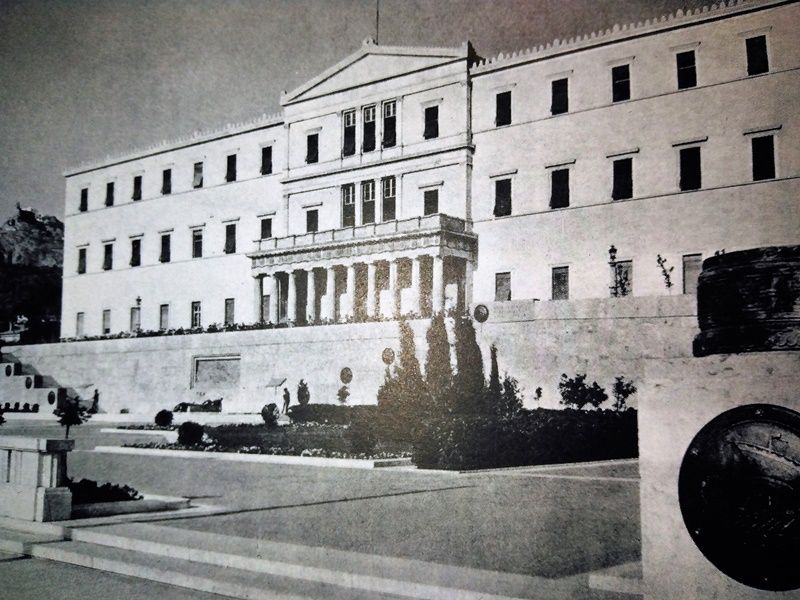
PHOTO SOURCES:
«History of the Athenians» - D. Kaburoglou (Bookstore of Hestia - 1890)
«Views in Greece» - Dodweel & Pomandi (Edition London 1821)