They rise imposingly in deserted and central streets of Athens, carrying for years their own history. Mansions, abandoned houses, caves and other buildings are accompanied by urban myths and legends that link them to the most frightening narratives and ghost stories. The so-called «haunted houses» of Athens have often been the subject of «research», but as writer and journalist Kostas Stoforos tells the Athens-Macedonian News Agency, many of the stories surrounding them «start from the fact that many of these buildings were used by the occupation forces and were considered cursed».
Starting the tour of the “haunted” buildings of Athens from the mountain of Penteli, at an altitude of 720m in its southwestern part, the famous Cave of Davelis dominates. The cave took its name from the homonymous libertine (Davelis), while in the past it was called the cave of the Ammon, i.e. of the sinless. In this place the god Pan was worshipped, while next to it there were two churches, Agios Nikolaos and Agios Spyridon. The two churches, after suffering enormous damage, were eventually shored up and preserved. The frescoes are now on display at the Byzantine Museum of Athens. The cave was explored by the caveologists Ioannis and Anna Petrochilou. Rumors about the cave started to give and take away around the 1970s as researchers reported that various strange phenomena such as electromagnetic, magnetic vortices were occurring in Penteli, while some claim that researchers who went inside lost their memory, their measuring instruments were affected, compasses were disintegrated, metal detectors went crazy, cameras malfunctioned. Some attributed the phenomenon to the existence of strong magnetic fields. At the same time, there were rumours that the cave was communicating through tunnels with the Ducissus Placentia Palace.
There are many myths about the mansion of Dukissis Plakentias, the Castle of Rhododaphne, as the Duchess of Plakentias called her summer residence in Penteli. Sophie de Marbois-Lebrun, also known as the Duchess of Placentia, was the daughter of the French diplomat Francis Barbe-Barbois and the American Elizabeth Moore, daughter of the governor of Pennsylvania, USA. Franklin Moore. She acquired the title of Duchess when she married at the age of 20 Charles Lebrun, Duke of Plakentia and protégé of Napoleon, with whom she lived for 10 years. They had a daughter, Caroline-Elisa Lebrun, whom the Duchess of Plakentia was rumoured to love too much. The legends about her begin when her only daughter dies. The death of the daughter had shocked her. The Duchess refused to accept her loss so it is said that she decided to have her body embalmed so that she would not have to part with her. According to the legends of the time, her love was so great and pathological that she kept her embalmed body inside the mansion and treated her daughter as if she were alive. As Mr. Stoforos says, «The legends about the Duchess of Plakentia claim that she went around the palace in a white nightgown at night and those who passed by thought she was a ghost, or a fairy. Meanwhile an unexplained fire that burned down the palace and cremated the embalmed body of her daughter plunged the Duchess further into madness and spawned legends. Before the area was overrun with new residents and the building was restored, no one dared to pass by, many said a white-robed figure prowled the ruins searching, others heard strange voices and howling of nonexistent dogs. The Duchess was said to have died in Penteli, many times until her death dressed in white like a ghost, gaunt and gaunt-faced, dying she had fits, talking to her daughter and crying for hours. The older people told that the mother had gone mad, stopped walks in the cave and in Lake Thalassi (or Thalossi), stopped receiving people in her house and did not even accept the inhabitants of Penteli who came to offer her a few of their products honey, fresh bread, milk, eggs and figs».
At the intersection of Profiti Ilias and Markos Botsari streets in Halandri, passers-by come across a dilapidated house. It is the house of Gina Bahauer, a Greek classical pianist of international fame. She was born in Athens and died suddenly in 1976. On 22 August 1976, for the first time, Gina Bachauer was not faithful to her appointment with the audience waiting for her in the packed Herodeion. Since then, the stories that have been circulating about this house report that strange noises can be heard from the house, piano melodies, and a woman in black is walking around. As Mr. Stoforos recounts, «Gina Bahauer during the dictatorship never played again, but when she came to Chalandri she would invite friends and acquaintances to her garden, pull out the piano and play a recital for those who came and sat on the lawn».
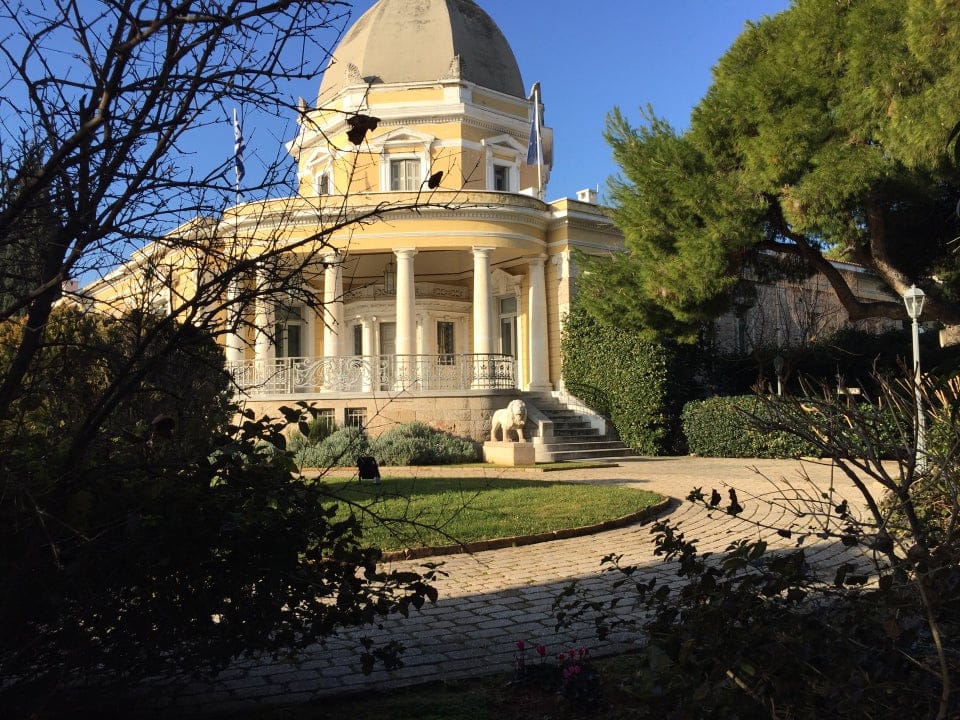
One of the most impressive and much talked about buildings in Athens is the Villa Kazoulis in Kifissia. It is an area of 47 acres built by the Egyptian businessman of Alexandria Nikolaos Kazoulis and was his summer residence. It is said that the architect Panagiotis Aristofron, Nikolaos Kazoulis« son-in-law, was the one who built the strange dome that still adorns the building today. Panagiotis Aristophron was a Plato scholar and had a valuable library of philosophical works installed in several of the 25 rooms of the building, while it was his wish that the villa should one day become a centre for the study of the great philosopher. The reason for the myths about the Villa of Kifissia was the fact that it was built on a Turkish cemetery. During the German occupation, the building was occupied by the Germans who installed the SS garrison there. Dozens of fighters would be martyred in the basement of Villa Kazoulis and it has been considered a cursed building ever since. Testimonies of people who have visited it speak of a strange feeling that spreads through the deserted rooms. The mansion was used for the filming of the movie »Lieutenant Natasha", starring Aliki Vougiouklaki.
The mansion of mystery in Pikermi has its own legend, for which there are two versions. The first says that in the house Pericles Kallergis, the foreman of the Skouze estate that surrounded the mansion, killed his wife and then committed suicide. According to residents, since then no tenant has managed to stay in the house for a long time. The other version, however, claims that this building was also used as a garrison during the Occupation and that torture was carried out in the basement. Residents and investigators claimed that there were strange symbols inside the house, while some passers-by reported hearing voices, screams, moans and strange lights coming from the basements.
The Metz region was a fertile ground for those who wanted to tell ‘scary and strange’ stories. Agra Street in particular has attracted many rumours as number 22 is home to a house that belonged to a former stable master of King Constantine. There are reports of strange lights, mysterious moving figures and those who have visited the house speak of a strange atmosphere and a chilling feeling of unreasonable fear. A little further on in Pagrati, at Pyronos and Prooptisia Streets, is the house of the politician Bakopoulos. It is rumored that during the occupation, the Gestapo was stationed there. After the liberation of Greece, all the residents of the area spoke of the voices and cries of those killed by the Nazis.
At 4 Smolenski Street in Neo Faliro, a neoclassical building has remained uninhabited and dilapidated for years. It is the house of a cloth merchant named Kourtalis, according to the myths that circulated, it is said that the owner in the last years of his life went bankrupt and began to sink into madness. Until his death, he remained confined to the house. Today in the half-ruined mansion some claim to see a figure walking around whispering unintelligible words. Several call the house the «Tower of Dreams» and more than a few people pass by the house having heard its strange story.
For years there has been a legend around the name of the painter Sophia Laskaridou. Passing by Laskaridou Street in Kallithea, one encounters an impressive two-storey neoclassical building. It is the house of the painter. Sophia Laskaridou lived and died there, but her life was destined to change after the suicide of her lover, the writer Pericles Giannopoulos. Pericles Giannopoulos could not bear the fact that Laskaridou was far away from him and in 1910 he committed suicide. After that Laskaridou sank into mourning. Legend has it that her ghost roams the abandoned house, full of guilt over the death of the literary man.
These urban myths about haunted houses and ghost stories are, as Mr.Stoforos says to APE-MPE, oral accounts that have survived through various books or reports that have been carried out, there is of course no evidence or proof of all this.
Even if the stories belong to the realm of fantasy, the buildings remain in place, dilapidated and abandoned, taking «life and value» from the legends that surround them.
Ioanna Kardara