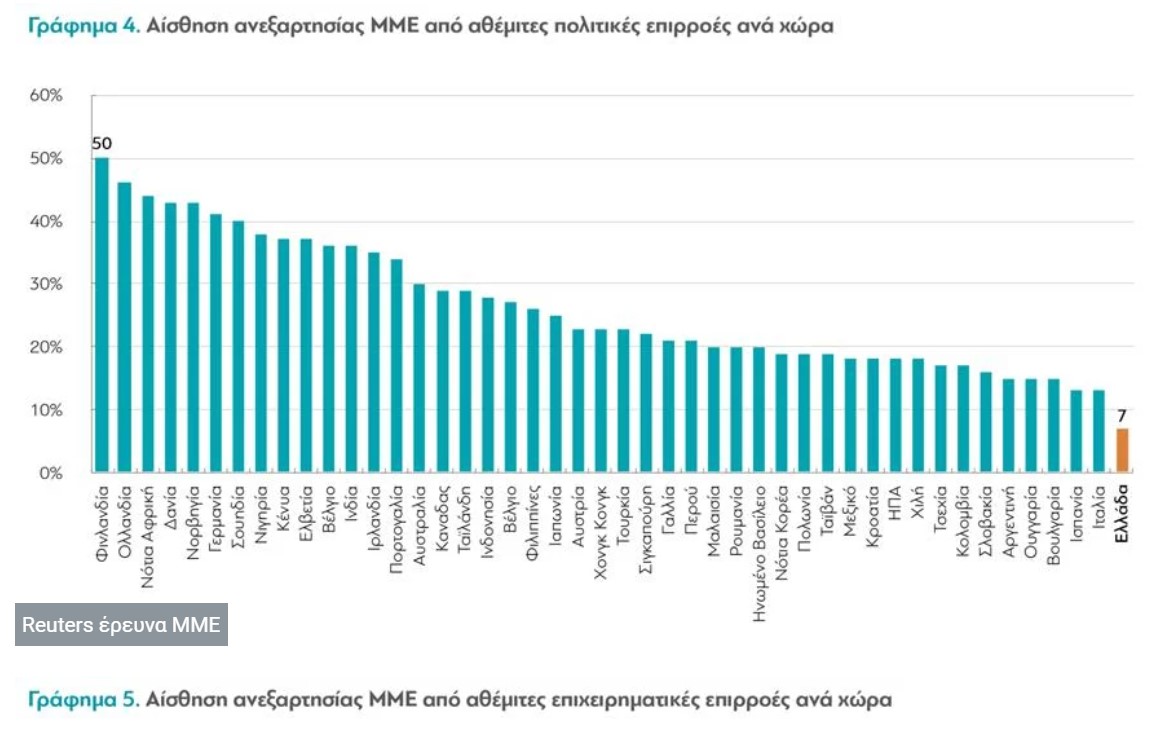
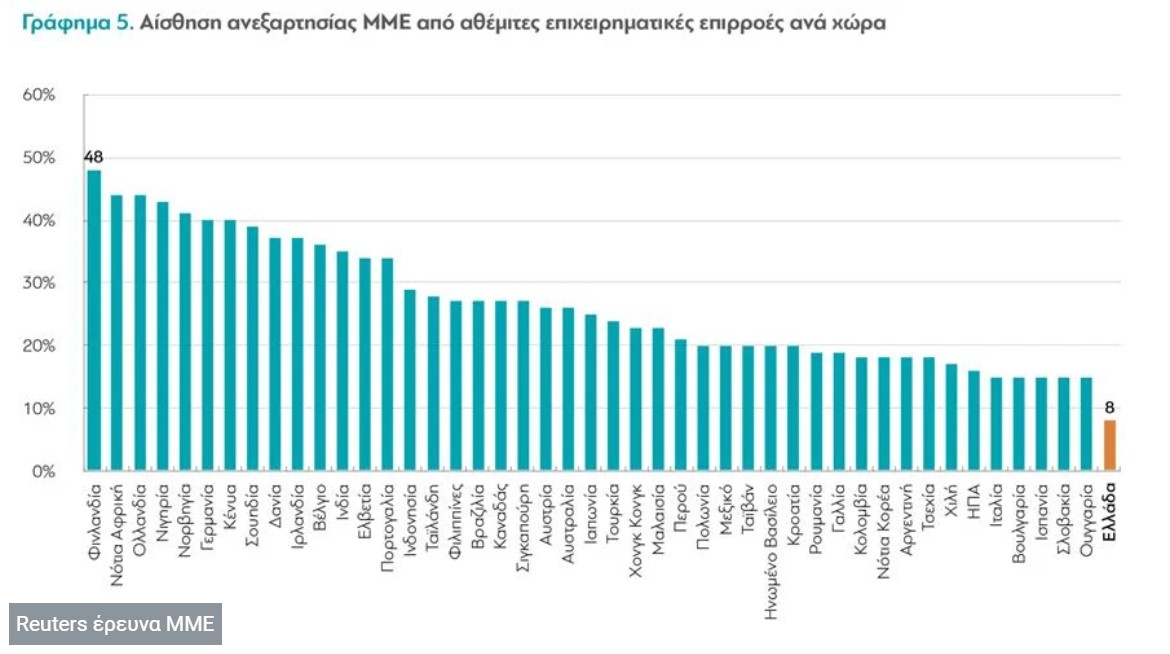
The back to the news turns an overwhelming percentage of Greek citizens who say they do not trust them not at all, while our country occupies the last place among the 46 participating countries in the sense of media independence from both political and business influences.
These are among the conclusions of the Annual Report on the Information on the Internet (Digital News Report) of Reuters Institute for the Study of Journalism of the University of Oxford, the results of which were presented by Distribution.
The data are based on in a major online poll a sample of more than 2,000 persons by country. The sample is representative of the population of each country that has an internet connection (in Greece the percentage is 78%) and not representative of the total population. In Greece the sample this year was 2,004 people.
As the research associate of the Reuters Institute explains, Antonis Kalogeropoulos, from users' responses on trust in the news, it appears that Greece ranks relatively low compared to the other countries in the survey, with only 27% of the sample saying they trust «most news most of the time».
Our country seems to be leaving behind with lower rate (26%) only the USA, while Taiwan and Hungary share equally low percentages with Greece. At the other end of the spectrum, the highest trust in the news is shown by Finns (69%), who traditionally have more confidence in institutions, South Africans (61%), but also a country from the European South, Portugal, also with 61%.

Greece is traditionally low in trust in the news, and while during the first phase of the pandemic confidence in our country - as in most countries in the survey - may have risen in the first phase of the pandemic, it was notOverall, this year confidence has fallen by 5 percentage points.
If the political orientation of the respondents is included in the equation, it is clear that in recent years political polarisation has also affected the relationship between citizens and the media. If the sample is divided into «left,» «centrist» and «right» based on how they position themselves on the political axis, it seems that as early as 2016 there were already low levels of trust in the news from all three groups. In 2022, however, the differences are greater. More specifically, while among «left-wing» respondents there was a slight drop (from 18%, to 16%) there was a rise in confidence among «centrist» (from 22% to 30%) and «right-wing» respondents (from 24% to 42%).
«Thus the 6 percentage points of trust that separated left and right respondents in 2016 became 26 in 2022, reflecting the political debate over the media between the government and the opposition in recent years,» the analysts note.
The poll was conducted between the end of January and the beginning of February 2022. During that time the prevalence of the Omicron mutation was in the news, and the Russian invasion of Ukraine began when the survey had already been completed.
This year's exhibition focuses on the cynicism of Greeks towards journalism and the media, as well as the ways in which younger internet users find and read news.
Cynicism and trust in the media
Η sense of transparency behind the production of news is one of the parameters that affects trust in news. This year's report included questions about possible undue influences on media content from political or business power centres.
Respondents were asked to agree or disagree with the statements «The media in my country are mostly free from undue political influence» and «The media in my country are mostly free from undue business influence».
Although in none of the 46 countries surveyed does the majority of the sample believe that the media are largely free from undue influence, in Greece the results of this challenge are impressive.
Only 7% and 8% of the sample believe that the media are free from undue political or business influence, respectively. These percentages place Greece in last place among the 46 countries, while no particular differences were observed in the percentages recorded in our country based on the gender, age, level of education or political orientation of respondents.
How the younger audience is informed
Almost non-existent presence of the printed press and very limited influence of television and radio in the information habits of citizens up to 35 years of age. A contributing factor is the fact that most internet users of this age group got online as minors and have no memories of the information landscape before the advent of the internet.
Different information habits by age are distinct when considering the main source of information of respondents of different ages (either online or offline). In detail, those under 35 choose online sources (74%) to a greater extent than respondents over 35 (64%). 30% of those over 35 and only 18% of those under 35 choose «TV» as their main source of information, while very small percentages choose radio and the press as their main source of information, regardless of age.
In reduced by 7% television percentages reflects the fatigue of the pandemic period, and since the survey was completed before the Russian invasion of Ukraine, these viewing figures have not been taken into account.
It should be noted that, as the analysts also note, the age differences in the choice of online resources and TV would be even greater if the survey had included the percentage of Greeks who do not have an internet connection, who are generally older.
In any case, however, Greeks still do not pay for news content with only 11% saying they pay for their online information.
Another interesting element that «reveals» the age of the respondents is related to the way they search for news on the internet. Thus, while older respondents are more likely to find news online by going directly to news websites with 24% of over 35s having this habit, only 13% of younger respondents find news in this way. Younger internet users prefer to either «find» news on social media (34%, compared to 25% for over 35s), or to search for current affairs topics on search engines (34% compared to 26% respectively).
As similar surveys have shown, at the device level, the use of smart phones for information in recent years has surpassed that of traditional computers,
«Battle of the generations» on social media platforms too
Despite the fact that the primacy of the Facebook for reading and commenting on news has not been lost in both age groups, it seems to have been significantly shaken as a third (34%) of younger people prefer to be informed on Instagram (compared to 18% among those over 35).
On the other hand, older people prefer to exchange news links or discuss the news via messaging in Viber.
The political news audience
There are also significant differences in the content of the news chosen by the citizens of the two age groups. Younger people show less interest in most types of news. For example, only 40% of young people under 35 are interested in political news - the corresponding figure for those over 35 is 63%. The differences are more limited for other types of news, for topics related to social justice, social inequalities or lifestyle.
«Young people in Greece show less interest in political developments and news related to them. Their relationship with information is more passive compared to older people. They are more likely to believe that news will “find them” on platforms such as Facebook and Instagram and seem less willing to actively seek it out,» the analysts underline.
At the same time, through social media or search engines, younger users are more likely to read news from alternative media or internet personalities. But the prioritisation of news on social media and search engines is done by algorithms rather than by journalists and editors-in-chief and this has consequences for the quality of information warns the κ. Kalogeropoulos.
«As it turns out, unmediated information directly from news websites is associated with better levels of awareness of current developments than “mediated” information via social media. This is likely to be due to the technological architecture of MSM, which can cause a sense of saturation from the many and varied pieces of information that co-exist on platforms such as Facebook,» he concludes.