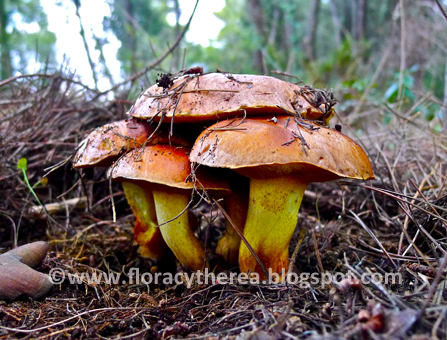
Suillus collinitus (Fr.) Kuntze 1898
Spotted pig
Syn. Collinated bolete. Fr. , Suillus fluryi Huijsman
An impressive mushroom that lives symbiotically with several species of pine, mainly Aleppo pine.
It loves the limestone soils of warmer regions and is therefore quite common in Southern Europe and rarer in Central and Northern Europe.
Modern experiments show that mushrooms improve the growth of young trees and their adaptation to disturbed soils by providing them with water and trace elements. In return, pine trees share photosynthesis products, mainly carbohydrates, with their fungal companions. The tree's roots appear to be more capable of surviving after fire or plowing when they coexist with this fungus.
The name of the genus Suillus, comes from the Latin sus = pig, while the characteristic adjective of the species, collinitus, comes from the Latin verb collino = to spot.
The species was first described by Elias Magnus Fries, who named it Collinitus boletus while Otto Kuntze considered it more appropriate to classify it in the genus Suillus in 1898.
In Kythira, this mushroom is called spongaritis, a name used for all boletes found on the island. This particular species is not considered edible as it mainly grows under pine trees.
The few mushroom pickers are very strict:
“Never, ever pick mushrooms that grow under pine trees.”.