It is located at number 18 of Filellinon Street, in the district of Kambielos, one of the largest and most populated districts of the Old Town. It highlights the first form of urban architecture created by the Venetians on the island, revealing the urban morphology of the city, which was used by its conquerors as a military and naval base.
The reason for this is the oldest Corfiot bourgeois house of the Venetian occupation that has withstood over the years, the violent earthquakes that mercilessly hit the Ionian Islands, but also the devastating bombing of the island during the Second World War.
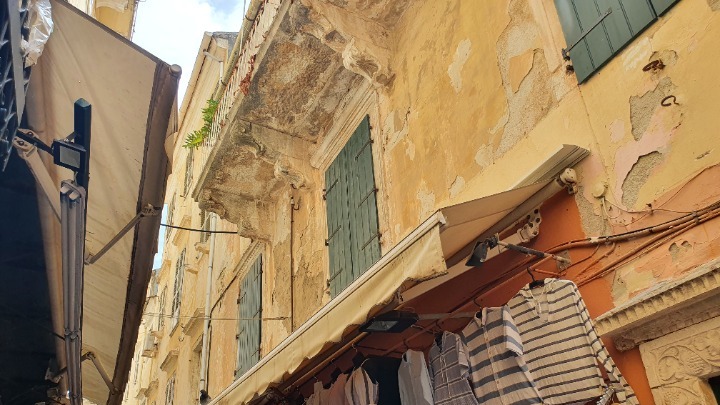
Its façade elements reveal the simple architecture used by the Venetians for the urban fabric of the city, with elements of Renaissance and Mannerism.
The elaborate, elaborate construction of the entrance made of carved stone reveals that it is a Corfiot urban house of the Venetian period, obviously a mansion, as it has two floors, a flat front with a flat surface and a horizontal row of windows. It bears the colour of ochre and its window sashes remain green, elements used by the Venetians in urban buildings.
The heavy wooden staircase connecting the floors stands out from the entrance doorway.
This old building, with such an important historical architectural weight, is an example of Venetian architecture of building units in linear repetition, of different sizes, built in series and connected to each other.
The appearance of the building reveals the Venetian urban detached house or the popular apartment building in contrast to the monumental, simple architecture of their public buildings.
It is not known whether an aristocratic family or a merchant family lived in this building, as in the historical centre of Corfu, during the Venetian rule, there were no class criteria in the settlements. The districts were characterised by commercial zones or zones where the buildings had workshops on the ground floor. Campiello was an example of pure housing as it is today.
The building is located in a canyon only two metres wide, but of particular importance as it led to the harbour.
Philellinon Street (Mastraca, as the Venetians called it), was considered one of the main routes as it was an extension of St Spyridon Street (Cale del Santo) leading to the port, today's Metropolis Square or the old port as it is now widely known.
In 2012, at a meeting held with representatives of the Chamber, the professional bodies of the old town and the head of the Byzantine Antiquities Ephorate, Tenia Rigakou, it was proposed that Filellinon Street be used as a «pilot» road that would show how they could be practically transformed, in terms of the operation of commercial and tourist businesses, the streets and alleys of the historic center, in order to harmonize with the requirements of the obligations of Corfu in the context of the designation of the city as a UNESCO monument.
The stone carved slab at the entrance of the oldest Corfiot town house of the Venetian occupation depicts blossoming flowers embracing the heavy wooden door, while the year of construction of the building is 1447.
It may be 575 years since then, but the imposing Venetian building is still alive. Its interiors have been renovated, and a family lives on each floor. A law office is also housed in the same building, while on the ground floor there are small shops, some selling tourist goods and others jewellery.
«The building is very solid and has stood the test of time. The story of the first occupant of the house is not known, but it is still active, as there are still families living here who love and care for it. Just as we take care of our shop, which we completely renovated inside,» the young shopkeeper Vasiliki Isidora Tsogou will tell APE-MPA, who greets with a huge smile the dozens of tourists who will pass through the busiest canteen on Philellinon Street. How many of them will notice Corfu's oldest Venetian house is not known, but it is certain that most of them will stop to have their photos taken in front of the ornate entrance of the house, not knowing that it carries a history of almost six centuries.
Annie Tapascu