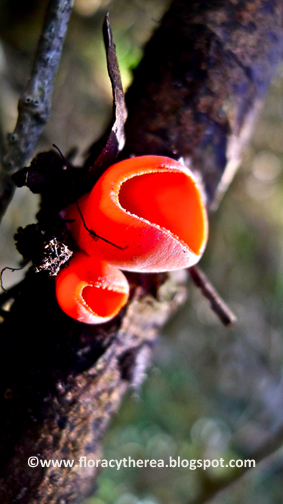
Crimson cup mushroom (Jacq.) Boudier. 1885
Ascomycete with a cup-shaped fruiting body 1-5 cm in diameter. It grows on fallen branches in late winter and early spring in damp, shady places. The bright red color of the inner side (hymenium) makes it stand out like a ruby among the dark colors of dead plant matter.
H Sarcophagus It is said to have been used as a medicinal plant by Native American tribes (Seaver 1928). They used the dried and powdered mushroom as a styptic.
In England, it was used together with greens as a decoration when serving dishes. (Dickinson and Lucas, 1982). Some authors consider it edible (Aroora 1986) and a good source of food for rodents in winter and snails in spring. (Brown 1980)
Laboratory research at the University of Kashmir showed that Sarcophagus has remarkable antioxidant activity. (A. H. Wani, et al.)
The Latin name of the genus comes from the Greek word σαρξ – σαρκός (sarx) and the ancient Greek word σκύφος (skyphos) = a wide-mouthed drinking vessel with or without handles.
Distinguishing between certain species of the genus, e.g. between the red-headed and the Austrian species, is difficult and requires microscopic examination. However, all species are classified as endangered and must be protected.