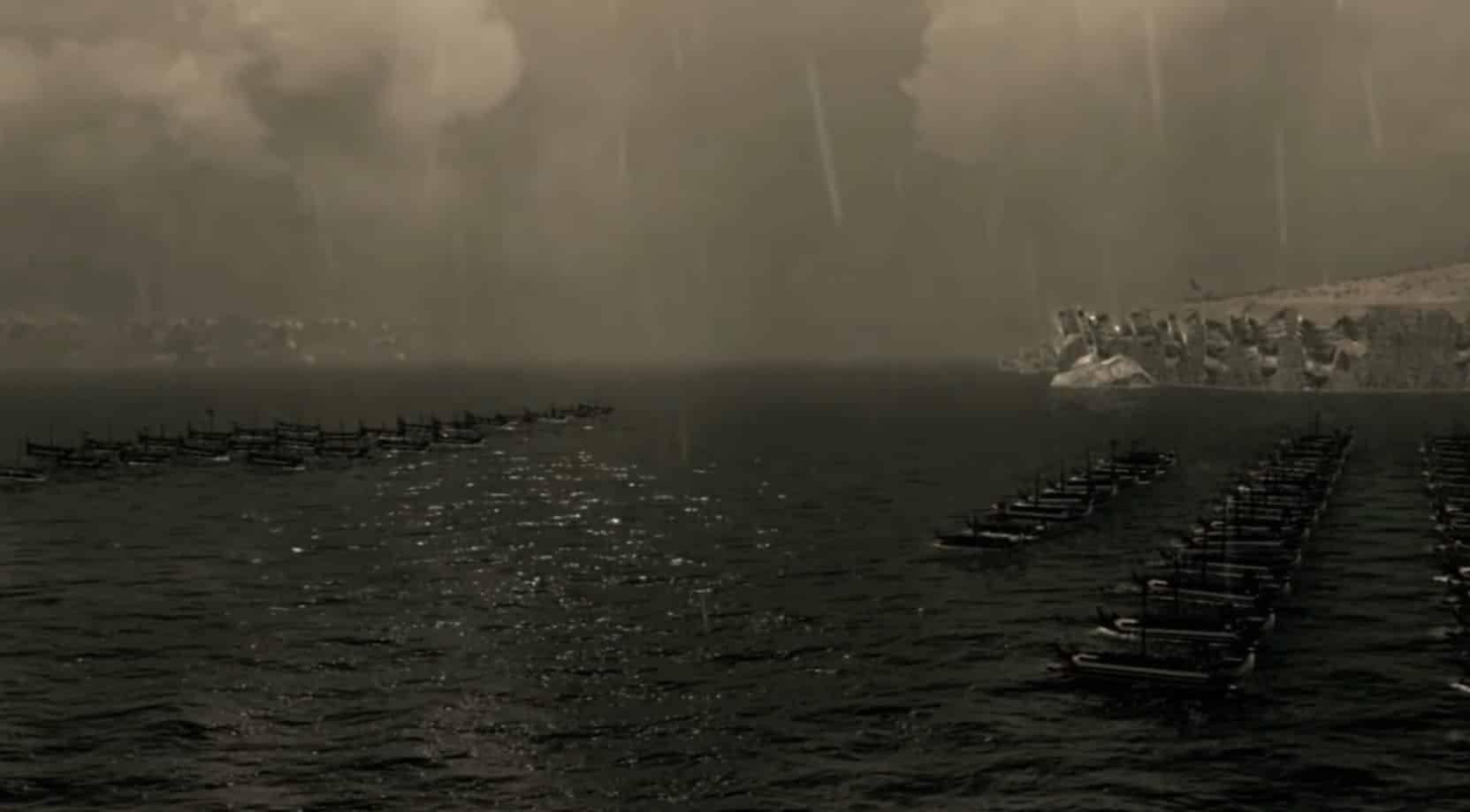
After the fall of the Thermopylae, the Persians of Xerxes they moved on to Athens, which they captured easily, because the Athenians had abandoned it. They had received an oracle from oracle of Delphi, that only «the wooden walls» would save them, and they considered their ships as such, to which they took refuge. Only a few old men, not wishing to listen to the Themistocles that the «wooden walls» were the ships, they stayed in Athens, closed themselves in the Acropolis and built real wooden walls around them. As it happened, when the Persians arrived, they killed them and burned Athens. Almost as soon as the Persians entered Athens, they anchored in the bay of Faliro and the Persian fleet, having sailed past the Euboea and the Sounion.
During the council, the tension went beyond the limits and heavy expressions were exchanged between the Greek leaders. Herodotus reports that the Corinthian general Adimantos mocked Themistocles, telling him that he no longer had a homeland, because Athens had been conquered by the Persians. But Themistocles replied proudly: «The two hundred threads are ours, the two hundred threads are paid.», because of the three hundred Greek ships, two hundred were Athenian. According to Plutarch, in a moment of tension, the Spartan Euribiadis raised his staff to strike Themistocles. He, then, unperturbed, dispatched him with the famous: «Step on it, but listen.».
Eurubiadis may have been formally the leader of the Greek forces, but Themistocles was the mastermind of the operation. To speed up the battle, he used the following trick: He secretly sent his pedagogue to the Persians Sikinos to tell them that the Greeks are supposedly preparing to leave Salamina and if they want to defeat them they should run to catch up. Xerxes fell into the trap and ordered the Greek fleet to encircle the Greek fleet and block the route of its retreat to the Isthmus of Corinth. At this crucial moment, Themistocles' political rival and exiled in Aegina Aristides, crossed the Persian lines at the risk of his life and reached the ship of Themistocles. After revealing to him the movements of the Persian fleet, he announced to him that now that their country was in danger he forgot all enmity with him and accepted to fight as a simple soldier under his command.
First the Greeks rushed in, singing the paean: «O ye children of the Greeks, be ye free, O homeland, and be ye free, ye children of women, of gods and goddesses, and of ancestors, and be ye for all struggles». Then began a fierce, cruel and terrible struggle. The war songs of the Greeks, the trumpets, the war cries, the crackling of the terrible pistons, the fires that the Greeks threw at the Persian ships, the smoke, but above all the naval skill, valour and bravery of the Athenians and the Aeginites defeated the Persians and their allies the Phoenicians. By midday, the victory began to tilt in the Greeks' favour.
The battle continued all day, until in the evening the sea was full of sticks and Persian bodies. The Persians were defeated. Diodorus of Sicily reports that the Persians lost 200 ships and the Greeks 40. During the naval battle, Aristides, in a parallel operation, landed at Psyttaleia with a group of elite Athenian soldiers and annihilated the Persian garrison that had been deployed on the Saronic islet.
The brilliant victory of the Greeks was largely due to the strategic genius of Themistocles and the superior naval art of the Greeks.. The Athenian politician and general was awarded exceptional honours. When he once attended the Olympic Games as a spectator, all those present hailed him as the saviour of Greece.